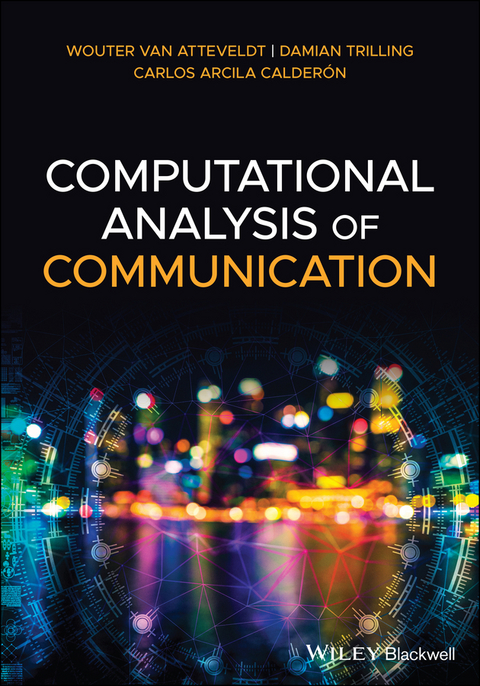
Computational Analysis of Communication (eBook)
John Wiley & Sons (Verlag)
978-1-119-68027-7 (ISBN)
Provides clear guidance on leveraging computational techniques to answer social science questions
In disciplines such as political science, sociology, psychology, and media studies, the use of computational analysis is rapidly increasing. Statistical modeling, machine learning, and other computational techniques are revolutionizing the way electoral results are predicted, social sentiment is measured, consumer interest is evaluated, and much more. Computational Analysis of Communication teaches social science students and practitioners how computational methods can be used in a broad range of applications, providing discipline-relevant examples, clear explanations, and practical guidance.
Assuming little or no background in data science or computer linguistics, this accessible textbook teaches readers how to use state-of-the art computational methods to perform data-driven analyses of social science issues. A cross-disciplinary team of authors-with expertise in both the social sciences and computer science-explains how to gather and clean data, manage textual, audio-visual, and network data, conduct statistical and quantitative analysis, and interpret, summarize, and visualize the results. Offered in a unique hybrid format that integrates print, ebook, and open-access online viewing, this innovative resource:
- Covers the essential skills for social sciences courses on big data, data visualization, text analysis, predictive analytics, and others
- Integrates theory, methods, and tools to provide unified approach to the subject
- Includes sample code in Python and links to actual research questions and cases from social science and communication studies
- Discusses ethical and normative issues relevant to privacy, data ownership, and reproducible social science
- Developed in partnership with the International Communication Association and by the editors of Computational Communication Research
Computational Analysis of Communication is an invaluable textbook and reference for students?taking computational methods courses in social sciences, and for professional social scientists looking to incorporate computational methods into their work.
Dr. Wouter van Atteveldt is an Associate Professor of Political Communication at Vrije Universiteit, Amsterdam. He is co-founder of the Computational Methods division of the International Communication Association, and Founding Chief Editor of Computational Communication Research. He has published extensively on innovative methods for analyzing political text and contributed to a number of relevant R and Python packages.
Dr. Damian Trilling is an Associate Professor, Department of Communication Science, at the University of Amsterdam, and Associate Editor of Computational Communication Research. His research uses computational methods such as the analysis of digital trace data and large-scale text analysis to study the use and effects of news media. He has developed extensive teaching materials to introduce social scientists to the Python programming language.
Dr. Carlos Arcila Calderón is an Associate Professor, Department of Sociology and Communication, at the University of Salamanca, Chief Editor of the journal Disertaciones, and member of the Editorial Board of Computational Communication Research. He has published extensively on new media and social media studies, and has led the prototype Autocop, a Spark-based environment to run distributed supervised sentiment analysis of Twitter messages.
Provides clear guidance on leveraging computational techniques to answer social science questions In disciplines such as political science, sociology, psychology, and media studies, the use of computational analysis is rapidly increasing. Statistical modeling, machine learning, and other computational techniques are revolutionizing the way electoral results are predicted, social sentiment is measured, consumer interest is evaluated, and much more. Computational Analysis of Communication teaches social science students and practitioners how computational methods can be used in a broad range of applications, providing discipline-relevant examples, clear explanations, and practical guidance. Assuming little or no background in data science or computer linguistics, this accessible textbook teaches readers how to use state-of-the art computational methods to perform data-driven analyses of social science issues. A cross-disciplinary team of authors with expertise in both the social sciences and computer science explains how to gather and clean data, manage textual, audio-visual, and network data, conduct statistical and quantitative analysis, and interpret, summarize, and visualize the results. Offered in a unique hybrid format that integrates print, ebook, and open-access online viewing, this innovative resource: Covers the essential skills for social sciences courses on big data, data visualization, text analysis, predictive analytics, and others Integrates theory, methods, and tools to provide unified approach to the subject Includes sample code in Python and links to actual research questions and cases from social science and communication studies Discusses ethical and normative issues relevant to privacy, data ownership, and reproducible social science Developed in partnership with the International Communication Association and by the editors of Computational Communication Research Computational Analysis of Communication is an invaluable textbook and reference for students taking computational methods courses in social sciences, and for professional social scientists looking to incorporate computational methods into their work.
Dr. Wouter van Atteveldt is an Associate Professor of Political Communication at Vrije Universiteit, Amsterdam. He is co-founder of the Computational Methods division of the International Communication Association, and Founding Chief Editor of Computational Communication Research. He has published extensively on innovative methods for analyzing political text and contributed to a number of relevant R and Python packages. Dr. Damian Trilling is an Associate Professor, Department of Communication Science, at the University of Amsterdam, and Associate Editor of Computational Communication Research. His research uses computational methods such as the analysis of digital trace data and large-scale text analysis to study the use and effects of news media. He has developed extensive teaching materials to introduce social scientists to the Python programming language. Dr. Carlos Arcila Calderón is an Associate Professor, Department of Sociology and Communication, at the University of Salamanca, Chief Editor of the journal Disertaciones, and member of the Editorial Board of Computational Communication Research. He has published extensively on new media and social media studies, and has led the prototype Autocop, a Spark-based environment to run distributed supervised sentiment analysis of Twitter messages.
| Erscheint lt. Verlag | 10.3.2022 |
|---|---|
| Sprache | englisch |
| Themenwelt | Mathematik / Informatik ► Mathematik |
| Sozialwissenschaften ► Kommunikation / Medien | |
| Sozialwissenschaften ► Politik / Verwaltung | |
| Sozialwissenschaften ► Soziologie | |
| Schlagworte | Communication & Media Studies • Communication Analysis • communication science analysis • Communication Studies • computational analysis methods • computational analysis social science • computational analysis social science textbook • how to use computational analysis • Kommunikationswissenschaft • Kommunikation u. Medienforschung • social science data analysis • Statistics • Statistics for Social Sciences • Statistik • Statistik in den Sozialwissenschaften |
| ISBN-10 | 1-119-68027-1 / 1119680271 |
| ISBN-13 | 978-1-119-68027-7 / 9781119680277 |
| Informationen gemäß Produktsicherheitsverordnung (GPSR) | |
| Haben Sie eine Frage zum Produkt? |
 PDF (Adobe DRM)
Kopierschutz: Adobe-DRM
Adobe-DRM ist ein Kopierschutz, der das eBook vor Mißbrauch schützen soll. Dabei wird das eBook bereits beim Download auf Ihre persönliche Adobe-ID autorisiert. Lesen können Sie das eBook dann nur auf den Geräten, welche ebenfalls auf Ihre Adobe-ID registriert sind.
Details zum Adobe-DRM
Dateiformat: PDF (Portable Document Format)
Mit einem festen Seitenlayout eignet sich die PDF besonders für Fachbücher mit Spalten, Tabellen und Abbildungen. Eine PDF kann auf fast allen Geräten angezeigt werden, ist aber für kleine Displays (Smartphone, eReader) nur eingeschränkt geeignet.
Systemvoraussetzungen:
PC/Mac: Mit einem PC oder Mac können Sie dieses eBook lesen. Sie benötigen eine
eReader: Dieses eBook kann mit (fast) allen eBook-Readern gelesen werden. Mit dem amazon-Kindle ist es aber nicht kompatibel.
Smartphone/Tablet: Egal ob Apple oder Android, dieses eBook können Sie lesen. Sie benötigen eine
Geräteliste und zusätzliche Hinweise
Buying eBooks from abroad
For tax law reasons we can sell eBooks just within Germany and Switzerland. Regrettably we cannot fulfill eBook-orders from other countries.
aus dem Bereich