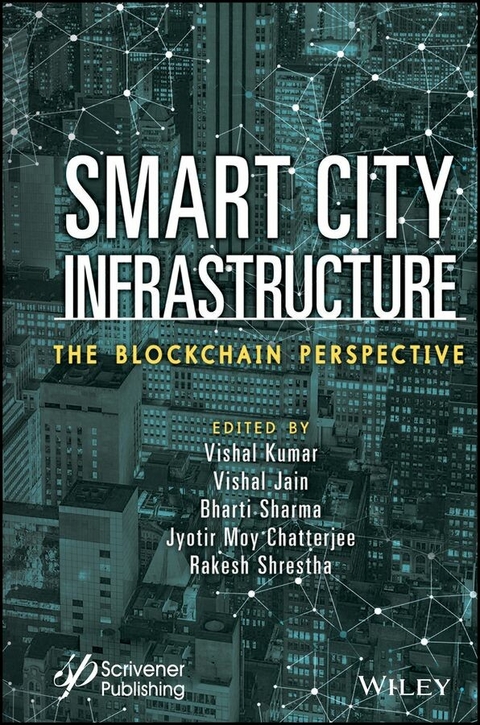
The wide range of topics presented in this book have been chosen to provide the reader with a better understanding of smart cities integrated with AI and blockchain and related security issues.
The goal of this book is to provide detailed, in-depth information on the state-of-the-art architecture and infrastructure used to develop smart cities using the Internet of Things (IoT), artificial intelligence (AI), and blockchain security-the key technologies of the fourth industrial revolution. The book outlines the theoretical concepts, experimental studies, and various smart city applications that create value for inhabitants of urban areas. Several issues that have arisen with the advent of smart cities and novel solutions to resolve these issues are presented. The IoT along with the integration of blockchain and AI provides efficient, safe, secure, and transparent ways to solve different types of social, governmental, and demographic issues in the dynamic urban environment. A top-down strategy is adopted to introduce the architecture, infrastructure, features, and security.
Audience
The core audience is researchers in artificial intelligence, information technology, electronic and electrical engineering, systems engineering, industrial engineering as well as government and city planners.
Vishal Kumar, PhD is an assistant professor in the Department of Computer Science and Engineering at Bipin Tripathi Kumaon Institute of Technology, Dwarahat (an Autonomous Institute of Govt. of Uttarakhand), India.
Vishal Jain, PhD is an associate professor at the Department of Computer Science and Engineering, School of Engineering and Technology, Sharda University, Greater Noida, UP India. He has more than 450 research citation indices with Google Scholar (h-index score 12 and i-10 index 15).
Bharti Sharma, PhD is an assistant professor and academic head of the MCA department of DIT University, Dehradun, India.
Jyotir Moy Chatterjee is an assistant professor in the Information Technology Department at Lord Buddha Education Foundation (LBEF), Kathmandu, Nepal. He has published more than 60 international research paper publications, three conference papers, three authored books, 10 edited books, 16 book chapters, two Master's theses converted into books, and one patent.
Rakesh Shrestha, PhD is a postdoctoral researcher at the Department of Information and Communication Engineering, Yeungnam University, South Korea.
SMART CITY INFRASTRUCTURE The wide range of topics presented in this book have been chosen to provide the reader with a better understanding of smart cities integrated with AI and blockchain and related security issues. The goal of this book is to provide detailed, in-depth information on the state-of-the-art architecture and infrastructure used to develop smart cities using the Internet of Things (IoT), artificial intelligence (AI), and blockchain security the key technologies of the fourth industrial revolution. The book outlines the theoretical concepts, experimental studies, and various smart city applications that create value for inhabitants of urban areas. Several issues that have arisen with the advent of smart cities and novel solutions to resolve these issues are presented. The IoT along with the integration of blockchain and AI provides efficient, safe, secure, and transparent ways to solve different types of social, governmental, and demographic issues in the dynamic urban environment. A top-down strategy is adopted to introduce the architecture, infrastructure, features, and security. Audience The core audience is researchers in artificial intelligence, information technology, electronic and electrical engineering, systems engineering, industrial engineering as well as government and city planners.
Vishal Kumar, PhD is an assistant professor in the Department of Computer Science and Engineering at Bipin Tripathi Kumaon Institute of Technology, Dwarahat (an Autonomous Institute of Govt. of Uttarakhand), India. Vishal Jain, PhD is an associate professor at the Department of Computer Science and Engineering, School of Engineering and Technology, Sharda University, Greater Noida, UP India. He has more than 450 research citation indices with Google Scholar (h-index score 12 and i-10 index 15). Bharti Sharma, PhD is an assistant professor and academic head of the MCA department of DIT University, Dehradun, India. Jyotir Moy Chatterjee is an assistant professor in the Information Technology Department at Lord Buddha Education Foundation (LBEF), Kathmandu, Nepal. He has published more than 60 international research paper publications, three conference papers, three authored books, 10 edited books, 16 book chapters, two Master's theses converted into books, and one patent. Rakesh Shrestha, PhD is a postdoctoral researcher at the Department of Information and Communication Engineering, Yeungnam University, South Korea.
1
Deep Dive Into Blockchain Technology: Characteristics, Security and Privacy Issues, Challenges, and Future Research Directions
Bhanu Chander
Department of Computer Science and Engineering, Pondicherry University, Pondicherry, India
Abstract
Since the innovation, blockchain technology has exposed ingenious applications in our daily passing life. From the beginning of crypto-currency to the current smart contract, blockchain is practiced in numerous fields like digital forensics, insurance payments, online micro-payments, healthcare records sharing, and supply chain tracking. Through enlarge the blockchain talent to the Internet of Things (IoT), Wireless Sensor Networks (WSNs), and Cyber-Physical Systems (CPS), we can obtain a provable and noticeable record transaction data offline-to-online data verification and optimize existing network performance. The abovementioned works aimed at expanded safety measures, automatic transaction command, decentralized stands, etc. The incorporation of blockchain technology has modernized the traditional trade due to its distributed ledger characteristic. Every record is secure by rules of cryptography which makes it more secure and impregnable. Therefore, blockchain can modify the way we buy and sell, how we intermingle with the government, and prove the legitimacy of everything from property names to natural fresh vegetables.
In recent times, the rapid expansion in urbanization population causes various cost-effective and environmental issues, influencing people’s living circumstances and class of life. The thought of a smart city that developed with the rise of IoT brings the ability to solve urban issues. Information and Communication Technology (ICT), IoTs, and WSNs play a vital part in executing smart cities. Blockchain has several good creations like pseudonymity, trust-free, intelligibility, democratic state, computerization, decentralization, and safety measures. These creations of blockchain useful to progress smart city services then endorse the expansion of smart cities. On the other hand, to use blockchain efficiently, it must consider security and privacy portions.
This chapter presents the exceptional safety as well as privacy sides of blockchain. Mainly, we present a detailed explanation of the background work of blockchain and consensus methods. After that, we shifted focus to blockchain integration with smart city development, challenges, and applications. Further, we review common security attacks on blockchain and security improvement solutions and the directions for future research.
Keywords: Blockchain, smart city, security, privacy, Internet of Things
1.1 Introduction
Blockchain has gained tremendous popularity in recent times because of its fundamental properties and peer-to-peer operations. Blockchain theory was the future of well-known researcher Santoshi Nakamotos in 2008 with Bitcoin crypto-currency innovation. More than 2,500 crypto-currencies exist, but the authentic utilization of Bitcoin is still not explored effusively. Various issues like secure document transferring, anti-money laundering, decentralization, and authorized and unauthorized mining actions are near related to Bitcoin [1–5]. The Bitcoin system model nearly takes 5 to 8 minutes for the mining process and validation of the transaction, which plays a crucial role in numerous appliances such as industry, economics, supply chain management, healthcare, and the Internet of Things (IoT). In present situations, digital information streams from one-end to a new dissimilar end via an unauthorized transmission channel. Where securities models and privacy are the two significant worries in any transaction, blockchain produces a protected peer-to-peer broadcast. Moreover, all the transactions of blockchain publicly accessible for analyzing although none can amend the transaction one time it is recorded [1–6].
Blockchain is a scattered data catalog that monitors an emergent directory of transaction reports with systematizing them into a hierarchical series of blocks because of database management. Coming to safety potential, blockchain builds and maintains with peer-to-peer overlie setup and secured with intellectual, decentralized exploitation of cryptography techniques. Experts forecasted that blockchain-related annual revenue would reach approximately 22 billion dollars at the end of 2030, with an annual growth rate of 29.6%. Numerous distinguished organizations like Accenture, Cisco, Morgan Stanley, Google, Citibank, Ali baba, IBM and IT vendors, financial consultancies, and internet giants designed and developed a high-standard research laboratory to make a capital layout blockchain knowledge [3–6]. Moreover, blockchain with Artificial Intelligence (AI), Machine Learning (ML), and big data are considered the heart of computing skills for the upcoming generation financial inducts. A few governments have released methodological reports along with white papers on blockchain utilization for a positive approach. Some of them like the European Central Bank unconfined credentials on distributed ledger expertise, and the UK government liberated a fresh testimony that illustrates the outlook of distributed ledger technology. The Chinese administration liberated white papers on the blockchain tools besides improvement in China; the USA builds an authorized and authoritarian background for blockchain knowledge development. In academe, several documents are available on blockchain in the earlier period, consist of a dozen of the article, and provide information on safety then secrecy risks of blockchain. Furthermore, most of the safety then secrecy risk–based articles of blockchain-focused on uncovering attacks that suffer blockchain, and some target specific proposals for employing some current countermeasure adjacent to a subset of various attacks. Among these, very few attempts describe a complete investigation of the safety then confidentiality characteristics of blockchain along with different protocol implementation methods [2–8].
1.2 Blockchain Preliminaries
1.2.1 Functioning of Blockchain
Blockchain is a collection of heterogeneous distributed networks. It considers as a unique technology of this century among other famous innovations because of its elements like crypto techniques, consensus algorithms, and public ledger; working procedure of blockchain consists of various styles, among those we mentioned some of them: customer, client, or node who desire to make a transaction will record and broadcasts the data to the appropriate setup, next to the receiver or the node who interest to receive the data validate the genuineness of data received, and after validation stores data in a block inside the network, every node or the customer in the network authorize the transaction through implementing the PoW or else PoS algorithms which need the validation, and finally, the network that utilized the consensus models will be stored into the block and connected to the blockchain list. Then, every single node in the setup acknowledges the relevant block and then enlarges the chain position on block.
1.2.2 Design of Blockchain
The expansion of the blockchain system will make tremendous changes and impact approximately every industrial, educational, and scientific field in the coming days. In particular, financial transactions are progressing in inventive ways, making it exceptionally important for one and all to understand the blockchain mechanism’s architecture and working style. Blockchain blocks are continuously enhance, secure with crypto techniques [6–10]. Here, each block holds a crypto-based hash value of the preceding block, a timestamp, along with transaction info.
In the design of blockchain, information or records are professional along with a related listing of transaction blocks well-maintained in a balanced catalog in the pattern of smooth files. Each block, linked with the preceding block, the initial block entitled the source block. The blockchain database visualized as a good stack, blocks mounded on the peak of one another, finished as the initial block as the stack’s base. Every block of blockchain authorized with cryptography has a function by implementing the SHA-256 algorithm and stored in the block’s header. One parent block can hold multiple children block; every child block encloses some parent hash value. The characteristics of child blocks purely depend on the parent block’s identity and properties. This procedure prolongs until getting each grandchild blocks [6–12]. The cascade consequences confirm that, just once a block has several productions, it cannot interfere with all the successive blocks’ forceful recalculations. For more understanding, we mentioned some ingredients with more explanations [4–16].
- i. Data: In blockchain, data stored in the database mostly depend on the respective services and applications, like recording the transmission particulars and banking with IoT. They were storing if data performed peer-to-peer, cloud formation, etc.
- ii. Hash: In the hash function, we can give any length message as input, but it produces unique predetermined length output. If any assailant made changes in the message, then the output comes out entirely differently. For example, if anyone client makes an effort to modify the info kept in a block, then afterward, the block shows an entirely different hash value. To avoid this kind of situation, there must be an assurance that minors of the network must have the knowledge prepared by revising the ledger replicate of...
| Erscheint lt. Verlag | 17.2.2022 |
|---|---|
| Sprache | englisch |
| Themenwelt | Informatik ► Theorie / Studium ► Künstliche Intelligenz / Robotik |
| Schlagworte | Artificial Intelligence • Computer Science • Electrical & Electronics Engineering • Elektrotechnik u. Elektronik • Informatik • Künstliche Intelligenz • Smart City • Systems Engineering & Management • Systemtechnik • Systemtechnik u. -management |
| ISBN-13 | 9781119785545 / 9781119785545 |
| Informationen gemäß Produktsicherheitsverordnung (GPSR) | |
| Haben Sie eine Frage zum Produkt? |
 EPUB (Adobe DRM)
Kopierschutz: Adobe-DRM
Adobe-DRM ist ein Kopierschutz, der das eBook vor Mißbrauch schützen soll. Dabei wird das eBook bereits beim Download auf Ihre persönliche Adobe-ID autorisiert. Lesen können Sie das eBook dann nur auf den Geräten, welche ebenfalls auf Ihre Adobe-ID registriert sind.
Details zum Adobe-DRM
Dateiformat: EPUB (Electronic Publication)
EPUB ist ein offener Standard für eBooks und eignet sich besonders zur Darstellung von Belletristik und Sachbüchern. Der Fließtext wird dynamisch an die Display- und Schriftgröße angepasst. Auch für mobile Lesegeräte ist EPUB daher gut geeignet.
Systemvoraussetzungen:
PC/Mac: Mit einem PC oder Mac können Sie dieses eBook lesen. Sie benötigen eine
eReader: Dieses eBook kann mit (fast) allen eBook-Readern gelesen werden. Mit dem amazon-Kindle ist es aber nicht kompatibel.
Smartphone/Tablet: Egal ob Apple oder Android, dieses eBook können Sie lesen. Sie benötigen eine
Geräteliste und zusätzliche Hinweise
Buying eBooks from abroad
For tax law reasons we can sell eBooks just within Germany and Switzerland. Regrettably we cannot fulfill eBook-orders from other countries.
aus dem Bereich