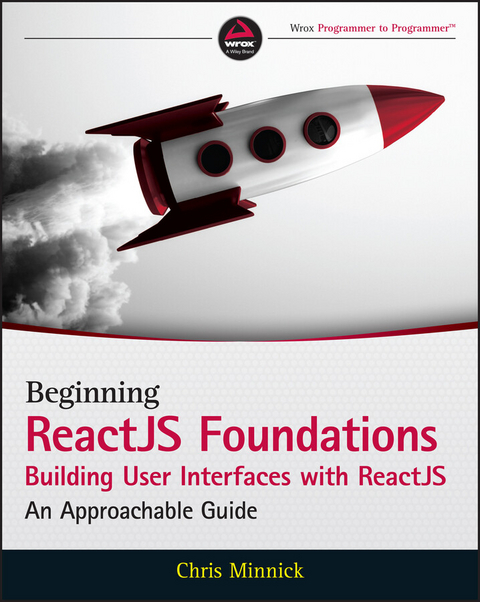
Beginning ReactJS Foundations Building User Interfaces with ReactJS (eBook)
John Wiley & Sons (Verlag)
978-1-119-68558-6 (ISBN)
Quickly learn the most widely used front-end development language with ease and confidence
React JS Foundations: Building User Interfaces with ReactJS - An Approachable Guide walks readers through the fundamental concepts of programming with the explosively popular front-end tool known as React JS.
Written by an accomplished full-stack engineer, speaker, and community organizer, React JS Foundations teaches readers how to understand React and how to begin building applications with it. The book:
- Explains and clarifies technical terminology with relevant and modern examples to assist people new to programming understand the language
- Helps experienced programmers quickly get up to speed with React
- Is stocked throughout with practical and applicable examples of day-to-day React work
Perfect for beginner, intermediate, and advanced programmers alike, React JS Foundations will quickly bring you up to speed on one of the most useful and widely used front-end languages on the web today. You can start building your first application today.
Quickly learn the most widely used front-end development language with ease and confidence React JS Foundations: Building User Interfaces with ReactJS - An Approachable Guide walks readers through the fundamental concepts of programming with the explosively popular front-end tool known as React JS. Written by an accomplished full-stack engineer, speaker, and community organizer, React JS Foundations teaches readers how to understand React and how to begin building applications with it. The book: Explains and clarifies technical terminology with relevant and modern examples to assist people new to programming understand the language Helps experienced programmers quickly get up to speed with React Is stocked throughout with practical and applicable examples of day-to-day React workPerfect for beginner, intermediate, and advanced programmers alike, React JS Foundations will quickly bring you up to speed on one of the most useful and widely used front-end languages on the web today. You can start building your first application today.
About the Author CHRIS MINNICK is an accomplished author, trainer, and web developer with experience working on web and mobile projects with both small and large companies. The companion website at www.reactjsfoundations.com provides code listings for each chapter, plus examples and downloads that can be used to test out the various ReactJS techniques in the book.
INTRODUCTION
SINCE ITS CREATION BY FACEBOOK IN 2013, REACTJS has become one of the most popular and widely used front-end user interface libraries on the web. With the creation of React Native in 2015, ReactJS has become one of the most widely used libraries for mobile app development as well.
ReactJS has always been a bit of a moving target. It has gone through several major changes over the years, but through it all, the core principles of React have remained the same.
If you want to learn to develop next-generation cross-platform web and mobile apps using the latest syntax and the latest tools, you've come to the right place. My goal with this book is to save you from the countless hours of trial and error that were my experience with trying to piece together bits of old and new information from the web and books.
Whether you're coming to React as a mobile developer, a web developer, or as any other kind of software developer, this book is for you. If you have experience with ReactJS as it existed in the earlier days (before about version 16), this book is for you too!
In this book, I've attempted not only to give the most up-to-date syntax and patterns for developing ReactJS applications, but also to give enough background and timeless information for it to remain relevant for years to come.
So, welcome to ReactJS.
WHY THIS BOOK?
Thank you for choosing to begin, or continue, your React journey with me. My aim with this book is to provide an up-to-date and thorough explanation of React and the React ecosystem along with hands-on code that will prepare you to quickly start using React productively in the real world.
I'm thrilled to be writing this book at this time for a number of reasons:
- I have the experience and knowledge to do it right.
- React is one of the most popular JavaScript libraries today.
- I believe React will be even more popular in the future.
- Existing online resources and books too often give incomplete and/or outdated information about how to program with React.
Let's take a quick look at each of these points, starting with a little bit about who I am and how I came to React and this book.
About Me
I've been a web developer since 1997, and I've been programming in JavaScript since 1998. I've built or managed the building of web applications for some of the world's largest companies over the years. As a web developer, writer, and teacher, I've had to learn and use plenty of languages and JavaScript frameworks. There's a difference between learning something and applying it, and I've been working on projects with React and doing React consulting for several years now.
I've been teaching web development and JavaScript online and in person since 2000, and I've been teaching React since 2015. In the years that I've been teaching React, I've written three weeklong courses designed for in-person delivery, numerous short video courses, and two longer video courses. I've taught React on three continents, and my students have been web developers, Java and C programmers, COBOL programmers, database administrators, network administrators, project managers, graphic designers, and college students.
As I'm writing, the global COVID-19 pandemic has decimated the in-person training industry. While this situation has given me more time at home with the pets, it's also given me time to think deeply about React and about the React book that I wish existed today. This book is the result of my looking at all of the top React books, looking at the current state of how React is being used, and looking at what React is likely to look like in the future.
React Is Popular
React is a JavaScript library that was born out of Facebook's need to create scalable and fast user interfaces. Ever since Facebook released it to the world as an open source project, it has been one of the most widely used ways to build dynamic web and mobile applications.
One popular game among JavaScript developers is to think of a noun, add “.js”, and search GitHub to find the JavaScript framework with that name. In a time when new JavaScript frameworks and libraries pop up and die off with shocking regularity, React is one of three libraries released since 2010 that have stuck around and gained the kind of developer usage that will guarantee that they will be supported and in widespread use for a long time to come.
React Is Both Progressive and Conservative
React has been able to stick around so long and gain so many users because it's always been a forward-looking framework that's not afraid to make big changes to adapt to new features in JavaScript, new ways of writing user interfaces, and feedback from developers. Over the years, React has gone through several major changes in how the basic unit of a React application, the component, is written. But, amidst all this change, React has stuck to a central paradigm and each major change to React has maintained compatibility with previous versions.
Don't Believe Everything on the Internet
While the end result of all this change is that React has gotten easier to write and more robust over the years, it's also caused a pileup of outdated and often wrong example code and tutorials on the internet and in books. If you've done any research on React prior to buying this book, you've surely noticed this, and you've likely been confused by it. Perhaps you bought this book after having a frustrating experience with learning React online only to learn that you learned about an old version of it.
This book aims to be a solid and complete guide to all of the most important (and some less important) features, concepts, and syntaxes used in React.
WHAT'S COVERED IN THIS BOOK?
This book covers everything you need to know to write high-quality React code. You'll learn about React components using the functional method of writing them as well as the class method. You'll learn about managing the state of your application using several different methods, including with React Hooks and with the setState method. You'll learn how to put components together to make complete and dynamic user interfaces. You'll learn how to fetch data from an external data source and use it in your application. And, you'll learn how to store data in the user's web browser to improve the performance and usability of your application. Speaking of usability, you'll learn about best practices for making your application work on mobile devices as well as on the desktop, and you'll also learn how to make sure that your application will be accessible.
Because React takes advantage of many of the latest and greatest improvements and enhancements to the underlying JavaScript language, I'll be giving you JavaScript lessons throughout the book. Some of the new JavaScript syntax can be a little confusing to those of us who first learned the language in its early days, but I'll provide plenty of simple and real-world examples to explain each new bit of syntax or shortcut.
WHAT'S NOT COVERED?
Although React is a JavaScript library, this is not a book for newcomers to JavaScript or to web programming. I expect that you've had at least some experience with JavaScript. If you're not familiar with the latest additions and revisions to JavaScript, that's not a problem. But, if you're new to JavaScript or to programming in general, I recommend that you learn the basics of programming with JavaScript before you tackle React.
Similarly, this is not a web design book. I assume that you're familiar with HTML and CSS and feel comfortable writing both. I also assume a basic knowledge of how web browsers work and how web pages are rendered in browsers.
Finally, this book is intended to teach the fundamentals of React to anyone who wants to gain the ability to write React applications. Although it does cover many of the most commonly used patterns and conventions in React development, and many of the more advanced topics in React are covered as well, there are many topics that will only be mentioned in passing or that had to be omitted for the sake of space. To cover everything having to do with more advanced React development would require several volumes, which would all need to be updated every couple of months.
Once you understand the fundamentals of React as taught in this book, you'll be more than qualified to explore the vast React online ecosystem and find tutorials, documentation, and example code to continue your React education.
Some of the more advanced topics that are beyond the scope of this book are: unit testing, building mobile applications with React Native, Redux, and isomorphic/universal React. If all that sounds like a bunch of nonsense jargon at this point, you came to the right place! You may not know everything about how to implement all these more advanced things by the end of the book, but you'll certainly know what they are and how to get started with them.
PREREQUISITES
Programming React can feel like assembling a complex piece of furniture from a Swedish furnishing store. There are a lot of parts that don't make much sense individually, but when you follow the instructions and put them together in the right way, the simplicity and beauty of the whole thing may surprise you.
Internet...
| Erscheint lt. Verlag | 3.2.2022 |
|---|---|
| Sprache | englisch |
| Themenwelt | Mathematik / Informatik ► Informatik ► Programmiersprachen / -werkzeuge |
| Informatik ► Software Entwicklung ► User Interfaces (HCI) | |
| Mathematik / Informatik ► Informatik ► Theorie / Studium | |
| Mathematik / Informatik ► Informatik ► Web / Internet | |
| Schlagworte | app development • Application development • Computer Science • front-end dev • Front-end Development • Front-end framework • front-end language • Front-end Web Development • Informatik • JavaScript • JavaScript front-end • Programmierung • Programmierung / Benutzeroberflächen • Programming / User Interface Design • react • React JavaScript • web app development • Web application |
| ISBN-10 | 1-119-68558-3 / 1119685583 |
| ISBN-13 | 978-1-119-68558-6 / 9781119685586 |
| Informationen gemäß Produktsicherheitsverordnung (GPSR) | |
| Haben Sie eine Frage zum Produkt? |
 EPUB (Adobe DRM)
Kopierschutz: Adobe-DRM
Adobe-DRM ist ein Kopierschutz, der das eBook vor Mißbrauch schützen soll. Dabei wird das eBook bereits beim Download auf Ihre persönliche Adobe-ID autorisiert. Lesen können Sie das eBook dann nur auf den Geräten, welche ebenfalls auf Ihre Adobe-ID registriert sind.
Details zum Adobe-DRM
Dateiformat: EPUB (Electronic Publication)
EPUB ist ein offener Standard für eBooks und eignet sich besonders zur Darstellung von Belletristik und Sachbüchern. Der Fließtext wird dynamisch an die Display- und Schriftgröße angepasst. Auch für mobile Lesegeräte ist EPUB daher gut geeignet.
Systemvoraussetzungen:
PC/Mac: Mit einem PC oder Mac können Sie dieses eBook lesen. Sie benötigen eine
eReader: Dieses eBook kann mit (fast) allen eBook-Readern gelesen werden. Mit dem amazon-Kindle ist es aber nicht kompatibel.
Smartphone/Tablet: Egal ob Apple oder Android, dieses eBook können Sie lesen. Sie benötigen eine
Geräteliste und zusätzliche Hinweise
Buying eBooks from abroad
For tax law reasons we can sell eBooks just within Germany and Switzerland. Regrettably we cannot fulfill eBook-orders from other countries.
aus dem Bereich