


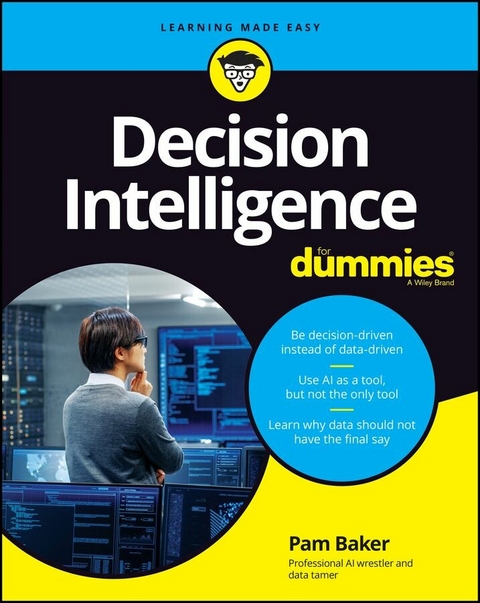
Decision Intelligence For Dummies (eBook)
John Wiley & Sons (Verlag)
978-1-119-82486-2 (ISBN)
Learn to use, and not be used by, data to make more insightful decisions
The availability of data and various forms of AI unlock countless possibilities for business decision makers. But what do you do when you feel pressured to cede your position in the decision-making process altogether?
Decision Intelligence For Dummies pumps the brakes on the growing trend to take human beings out of the decision loop and walks you through the best way to make data-informed but human-driven decisions. The book shows you how to achieve maximum flexibility by using every available resource, and not just raw data, to make the most insightful decisions possible.
In this timely book, you'll learn to:
- Make data a means to an end, rather than an end in itself, by expanding your decision-making inquiries
- Find a new path to solid decisions that includes, but isn't dominated, by quantitative data
- Measure the results of your new framework to prove its effectiveness and efficiency and expand it to a whole team or company
Perfect for business leaders in technology and finance, Decision Intelligence For Dummies is ideal for anyone who recognizes that data is not the only powerful tool in your decision-making toolbox. This book shows you how to be guided, and not ruled, by the data.
Pam Bakeris a veteran business analyst and journalist whose work is focused on big data, artificial intelligence, machine learning, business intelligence, and data analysis. She is the author of Data Divination - Big Data Strategies.
Learn to use, and not be used by, data to make more insightful decisions The availability of data and various forms of AI unlock countless possibilities for business decision makers. But what do you do when you feel pressured to cede your position in the decision-making process altogether? Decision Intelligence For Dummies pumps the brakes on the growing trend to take human beings out of the decision loop and walks you through the best way to make data-informed but human-driven decisions. The book shows you how to achieve maximum flexibility by using every available resource, and not just raw data, to make the most insightful decisions possible. In this timely book, you ll learn to: Make data a means to an end, rather than an end in itself, by expanding your decision-making inquiries Find a new path to solid decisions that includes, but isn t dominated, by quantitative data Measure the results of your new framework to prove its effectiveness and efficiency and expand it to a whole team or company Perfect for business leaders in technology and finance, Decision Intelligence For Dummies is ideal for anyone who recognizes that data is not the only powerful tool in your decision-making toolbox. This book shows you how to be guided, and not ruled, by the data.
Pam Bakeris a veteran business analyst and journalist whose work is focused on big data, artificial intelligence, machine learning, business intelligence, and data analysis. She is the author of Data Divination - Big Data Strategies.
Introduction
Ready for a mind-blowing reveal on how to make great decisions, whether you’re using your own brain or some supercharged artificial intelligence application? Decision intelligence, a methodology for forming a decision aimed at achieving a specific outcome, is here, and it's on track to change forever how businesses plan for their future.
Everybody would agree that the goal in all decision-making is to reap the best possible outcome. Decision intelligence helps you achieve that goal by requiring that you decide that outcome first and then work backward from there to identify the processes and information you’ll need to make it happen!
Decision intelligence is built on science — several sciences, actually — but some of those scientific formulas can be grasped intuitively. The decision intelligence process is designed to improve your professional performance by a) ensuring that every business decision delivers the best possible outcome, b) pointing you toward innovations that are profitable, c) helping you become an industry mover by becoming a creative disruptor, and d) enabling you to flip failed AI projects into successful endeavors. What's more, decision intelligence can also be used to improve your private life via better decision-making, and you can often do it in your own head or on the back of a napkin or by using a simple table or spreadsheet.
The secret to success in decision intelligence lies in changing how you think about problem-solving and reordering your steps when it comes to the decision-making process. Ask yourself how much money, time, and effort your organization is willing to waste on yet another bad business decision or one more failed AI project, and then ask yourself whether you can afford to ignore a better way to make decisions — especially when you already have on hand much of what you’ll need to take advantage of a decision intelligence approach. It’s not often that you can turn your business around at little or no additional cost to you.
About This Book
The book you’re holding in your hands is a guide primarily for you if you’re a business or finance leader. The book aims to fill you in on decision intelligence, a new framework for making better, more profitable business decisions. It also serves as an introduction for artificial intelligence (AI) and digital decisioning practitioners to take a different approach aimed at making automated decision processes deliver desirable business outcomes. To top it all off, this guide shows you that decision intelligence is not merely a business approach — it’s equally useful when making decisions about your personal life.
This book takes a studied approach to having you reimagine the decision-making, by focusing on a set of discrete tasks you need to accomplish. Here are those tasks, in no particular order:
- Flip the data mining model from data first to data last. You start with a decision aimed at the best possible business outcome and end with the data and the processes you need to bring about that outcome in the real world.
- Rebalance human and machine roles. Decision intelligence calls for a redirection from a data driven to a decision driven organization. This framework clearly casts humans as decision-makers, where AI acts as sidekick, and where data is relegated to a supporting actor.
- Map changes caused by putting the decision first in terms of
- Business impact
- Processes
- Tools
- Business and Ethical Principles
- Teams
- Learn decision theory and a multidisciplinary approach to decision-making: You learn which steps you must take in order to succeed with decision intelligence, from new perspectives on
- Business impact
- AI projects
- Upstream and downstream decisioning
- Disruptive innovation
- Job roles
This book answers your questions about what decision intelligence is, which conditions must be created at your company in order for it to succeed, how you can plan a project, and how to implement it successfully. I've also made an effort to ensure that this book can be used in myriad ways and by anyone, from individuals to powerful leaders of huge organizations. As such, it offers these benefits:
- An overview of the steps involved in putting the decision before the data in the decision-making process
- A guidebook with practical suggestions for the various options, overall flexibility, and choices of implementations of a decision intelligence strategy
- A reference book divided into parts, chapters, and sections so that you can quickly find the content you’re looking for when you need it
This book — designed so that you can swiftly get a grasp on everything — features many examples, instructions, checklists, illustrations, and tables. It’s also structured systematically according to the decision intelligence framework and its many moving parts.
Conventions Used in This Book
This book doesn’t have many rules. The entire book is structured so that you can quickly find everything you need and get a grasp on the content. The detailed table of contents helps you jump right to the information you need, and each chapter begins with a brief and succinct description of the chapter's main topics. Whenever topics overlap or other chapters are mentioned, cross-references help you conveniently jump back-and-forth between the chapters. If you’re interested in a particular term, you can look it up in the index.
Foolish Assumptions
This book is not (only) for decision-makers in business or finance. Decision intelligence is too crucial for improving business outcomes to be contained only to the C-suite and data scientist levels. In organizations that practice or seek data- and AI-democratization, decision intelligence should be practiced at every level of decision-making throughout the organization, even at the microdecision and mundane-decision levels. Whether you work at a company, an educational institution, a research institute, a public agency, or a nonprofit organization, you can benefit from the decision-driven approach that is at the heart of decision intelligence. Whether you have an education in the technical, economic, management science, or social science fields, this creative approach gives you new ideas on how to use what you know (and what you have to decide) more productively.
On an individual level, the following assumptions are made in this book about readers who will most likely gain the most from the information in this book:
- You’re in charge of an organization or department and you want to be decision driven instead of data driven so that every decision is productive and profitable.
- You’re trying to accelerate your career plans and you want to shine by making important decisions so that the best possible outcome is realized.
- You are applying, or you are planning to apply, AI or machine learning at your organization, and you need to know how to make projects succeed in terms of measurable business impacts.
- Your company is already working with data-driven methods and falling well short of your organization’s goals and expectations. You want to enhance or replace your previous work with new methods, tips, and tricks for improving its implementation, and you want a guide on how to make it work and perform consistently well over time.
You don’t need to have any specific skills for this book — you only have to be curious and intent on making good decisions — every time.
What You Don’t Have to Read
It’s worth your time to read the entire book. You can find important tips everywhere in it. Even if you can use only a few of its suggestions, the time and money you invest will be worth it. I guarantee that you’ll be able to use more than just a few elements of this information in your private life, your career, and your organization — regardless of your job role or your experience in decision-making. Some of the text in this book appears in a gray box, in order to highlight background information. You don’t absolutely need this info, but it’s always helpful.
How This Book Is Organized
This book is organized into six distinct parts, as described in this section. The design is intended to help you break free of any brain ruts and consider new ways of thinking about making decisions based on a variety of perspectives.
Part 1: Getting Started with Decision Intelligence
This section gives you an overview of the principles and methods in the decision intelligence framework. You can find out why being decision driven outperforms being data driven. You can also learn how to create the necessary conditions for decision intelligence projects to succeed at your organization, how to plan a project, and how to reinvent what it means to have an actionable outcome.
Part 2: Reaching the Best Possible Decision
The first phase of the decision intelligence process is all about making the decision from which you build the steps and then choosing the tools and data to realize the result of that decision in the real world. Shaping the decision, mapping a path, and choosing the right tools are essential to creating the best possible outcome. At the...
| Erscheint lt. Verlag | 31.12.2021 |
|---|---|
| Sprache | englisch |
| Themenwelt | Mathematik / Informatik ► Informatik ► Theorie / Studium |
| Schlagworte | Big Data • Business data processing • Computer Science • Data Analysis • data intelligence applications • Data Science • decision intelligence basics • decision intelligence fundamentals • decision making process • decision making textbook • decision science • decision science textbook • Informatik • Wirtschaftsinformatik |
| ISBN-10 | 1-119-82486-9 / 1119824869 |
| ISBN-13 | 978-1-119-82486-2 / 9781119824862 |
| Informationen gemäß Produktsicherheitsverordnung (GPSR) | |
| Haben Sie eine Frage zum Produkt? |
 EPUB (Adobe DRM)
Kopierschutz: Adobe-DRM
Adobe-DRM ist ein Kopierschutz, der das eBook vor Mißbrauch schützen soll. Dabei wird das eBook bereits beim Download auf Ihre persönliche Adobe-ID autorisiert. Lesen können Sie das eBook dann nur auf den Geräten, welche ebenfalls auf Ihre Adobe-ID registriert sind.
Details zum Adobe-DRM
Dateiformat: EPUB (Electronic Publication)
EPUB ist ein offener Standard für eBooks und eignet sich besonders zur Darstellung von Belletristik und Sachbüchern. Der Fließtext wird dynamisch an die Display- und Schriftgröße angepasst. Auch für mobile Lesegeräte ist EPUB daher gut geeignet.
Systemvoraussetzungen:
PC/Mac: Mit einem PC oder Mac können Sie dieses eBook lesen. Sie benötigen eine
eReader: Dieses eBook kann mit (fast) allen eBook-Readern gelesen werden. Mit dem amazon-Kindle ist es aber nicht kompatibel.
Smartphone/Tablet: Egal ob Apple oder Android, dieses eBook können Sie lesen. Sie benötigen eine
Geräteliste und zusätzliche Hinweise
Buying eBooks from abroad
For tax law reasons we can sell eBooks just within Germany and Switzerland. Regrettably we cannot fulfill eBook-orders from other countries.
aus dem Bereich


