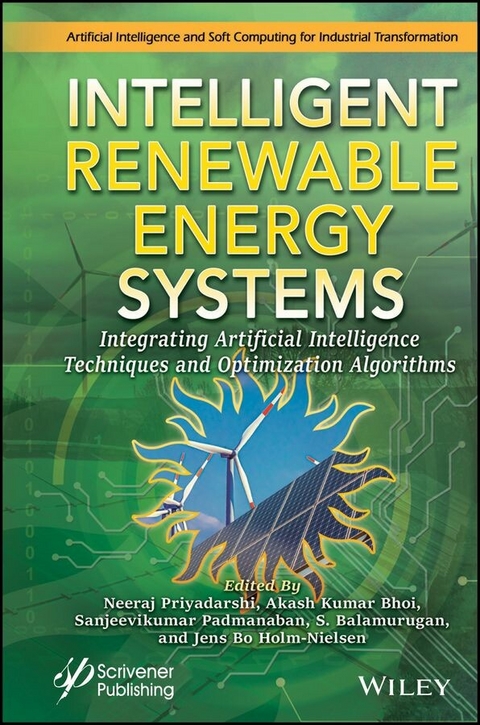
Intelligent Renewable Energy Systems (eBook)
John Wiley & Sons (Verlag)
978-1-119-78628-3 (ISBN)
This collection of papers on artificial intelligence and other methods for improving renewable energy systems, written by industry experts, is a reflection of the state of the art, a must-have for engineers, maintenance personnel, students, and anyone else wanting to stay abreast with current energy systems concepts and technology.
Renewable energy is one of the most important subjects being studied, researched, and advanced in today's world. From a macro level, like the stabilization of the entire world's economy, to the micro level, like how you are going to heat or cool your home tonight, energy, specifically renewable energy, is on the forefront of the discussion.
This book illustrates modelling, simulation, design and control of renewable energy systems employed with recent artificial intelligence (AI) and optimization techniques for performance enhancement. Current renewable energy sources have less power conversion efficiency because of its intermittent and fluctuating behavior. Therefore, in this regard, the recent AI and optimization techniques are able to deal with data ambiguity, noise, imprecision, and nonlinear behavior of renewable energy sources more efficiently compared to classical soft computing techniques.
This book provides an extensive analysis of recent state of the art AI and optimization techniques applied to green energy systems. Subsequently, researchers, industry persons, undergraduate and graduate students involved in green energy will greatly benefit from this comprehensive volume, a must-have for any library.
Audience
Engineers, scientists, managers, researchers, students, and other professionals working in the field of renewable energy.
Neeraj Priyadarshi, PhD, works in the Department of Energy Technology, Aalborg University, Denmark, from which he also received a post doctorate. He received his M. Tech. degree in power electronics and drives in 2010 from the Vellore Institute of Technology (VIT), Vellore, India, and his PhD from the Government College of Technology and Engineering, Udaipur, Rajasthan, India. He has published over 60 papers in scientific and technical journals and conferences and has organized several international workshops. He is a reviewer for a number of technical journals, and he is the lead editor for four edited books, including Scrivener Publishing.
Akash Kumar Bhoi, PhD, is an assistant professor in the Department of Electrical and Electronics Engineering at Sikkim Manipal Institute of Technology (SMIT), India. He is also a research associate at Wireless Networks (WN) Research Laboratory, Institute of Information Science and Technologies, National Research Council (ISTI-CRN) Pisa, Italy. He is a member of several technical associations and is an editorial board member for a number of journals. He has published several papers in scientific journals and conferences and is currently working on several edited volumes for various publishers, including Scrivener Publishing.
Sanjeevikumar Padmanaban, PhD, is a faculty member with the Department of Energy Technology, Aalborg University, Esbjerg, Denmark and works with CTIF Global Capsule (CGC), Department of Business Development and Technology, Aarhus University, Denmark. He received his PhD in electrical engineering from the University of Bologna, Italy. He has almost ten years of teaching, research and industrial experience and is an associate editor on a number of international scientific refereed journals. He has published more than 300 research papers and has won numerous awards for his research and teaching.
S. Balamurugan is the Head of Research and Development, QUANTS IS & Consultancy Services, India. He has authored or edited 40 books, more than 200 papers in scientific and technical journals and conferences and has 15 patents to his credit. He is either the editor-in-chief, associate editor, guest editor, or editor for many scientific and technical journals, from many well-respected publishers around the world. He has won numerous awards, and he is a member of several technical societies.
Jens Bo Holm-Nielsen currently works at the Department of Energy Technology, Aalborg University and is head of the Esbjerg Energy Section. He helped establish the Center for Bioenergy and Green Engineering in 2009 and served as the head of the research group. He has served as technical advisor for many companies in this industry, and he has executed many large-scale European Union and United Nation projects. He has authored more than 300 scientific papers and has participated in over 500 various international conferences.
INTELLIGENT RENEWABLE ENERGY SYSTEMS This collection of papers on artificial intelligence and other methods for improving renewable energy systems, written by industry experts, is a reflection of the state of the art, a must-have for engineers, maintenance personnel, students, and anyone else wanting to stay abreast with current energy systems concepts and technology. Renewable energy is one of the most important subjects being studied, researched, and advanced in today s world. From a macro level, like the stabilization of the entire world s economy, to the micro level, like how you are going to heat or cool your home tonight, energy, specifically renewable energy, is on the forefront of the discussion. This book illustrates modelling, simulation, design and control of renewable energy systems employed with recent artificial intelligence (AI) and optimization techniques for performance enhancement. Current renewable energy sources have less power conversion efficiency because of its intermittent and fluctuating behavior. Therefore, in this regard, the recent AI and optimization techniques are able to deal with data ambiguity, noise, imprecision, and nonlinear behavior of renewable energy sources more efficiently compared to classical soft computing techniques. This book provides an extensive analysis of recent state of the art AI and optimization techniques applied to green energy systems. Subsequently, researchers, industry persons, undergraduate and graduate students involved in green energy will greatly benefit from this comprehensive volume, a must-have for any library. Audience Engineers, scientists, managers, researchers, students, and other professionals working in the field of renewable energy.
Neeraj Priyadarshi, PhD, works in the Department of Energy Technology, Aalborg University, Denmark, from which he also received a post doctorate. He received his M. Tech. degree in power electronics and drives in 2010 from the Vellore Institute of Technology (VIT), Vellore, India, and his PhD from the Government College of Technology and Engineering, Udaipur, Rajasthan, India. He has published over 60 papers in scientific and technical journals and conferences and has organized several international workshops. He is a reviewer for a number of technical journals, and he is the lead editor for four edited books, including Scrivener Publishing. Akash Kumar Bhoi, PhD, is an assistant professor in the Department of Electrical and Electronics Engineering at Sikkim Manipal Institute of Technology (SMIT), India. He is also a research associate at Wireless Networks (WN) Research Laboratory, Institute of Information Science and Technologies, National Research Council (ISTI-CRN) Pisa, Italy. He is a member of several technical associations and is an editorial board member for a number of journals. He has published several papers in scientific journals and conferences and is currently working on several edited volumes for various publishers, including Scrivener Publishing. Sanjeevikumar Padmanaban, PhD, is a faculty member with the Department of Energy Technology, Aalborg University, Esbjerg, Denmark and works with CTIF Global Capsule (CGC), Department of Business Development and Technology, Aarhus University, Denmark. He received his PhD in electrical engineering from the University of Bologna, Italy. He has almost ten years of teaching, research and industrial experience and is an associate editor on a number of international scientific refereed journals. He has published more than 300 research papers and has won numerous awards for his research and teaching. S. Balamurugan is the Head of Research and Development, QUANTS IS & Consultancy Services, India. He has authored or edited 40 books, more than 200 papers in scientific and technical journals and conferences and has 15 patents to his credit. He is either the editor-in-chief, associate editor, guest editor, or editor for many scientific and technical journals, from many well-respected publishers around the world. He has won numerous awards, and he is a member of several technical societies. Jens Bo Holm-Nielsen currently works at the Department of Energy Technology, Aalborg University and is head of the Esbjerg Energy Section. He helped establish the Center for Bioenergy and Green Engineering in 2009 and served as the head of the research group. He has served as technical advisor for many companies in this industry, and he has executed many large-scale European Union and United Nation projects. He has authored more than 300 scientific papers and has participated in over 500 various international conferences.
1
Optimization Algorithm for Renewable Energy Integration
Bikash Das1, SoumyabrataBarik2*, Debapriya Das3 and V. Mukherjee4
1Department of Electrical Engineering, Govt. College of Engineering and Textile Technology, Berhampore, West Bengal, India
2Department of Electrical and Electronics Engineering, Birla Institute of Technology and Science Pilani, K. K. Birla Goa Campus, Goa, India
3Department of Electrical Engineering, Indian Institute of Technology, Kharagpur, West Bengal, India
4Department of Electrical Engineering, Indian Institute of Technology (Indian School of Mines), Dhanbad, Jharkhand, India
*Corresponding author: soumyabratab@goa.bits-pilani.ac.in
Abstract
With the development of society, the electrical power demand is increasing day by day. To overcome the increasing load demand, renewable energy resources play an important role. The common examples of renewable energy resources are solar photovoltaic (PV), wind energy, biomass, fuel-cell, etc. Due to the various benefits of the renewable energy, the incorporation of renewable energy resources into the distribution network becomes an important topic in the field of the modern power system. The incorporation of renewable energy resources may reduce the network loss, improve voltage profile, and improve the reliability of the network. In this current research work, optimum placements of renewable distributed generations (RDGs) (viz. biomass and solar PV) and shunt capacitors have been highlighted. For the optimization of the locations and the sizes of the RDGs and the shunt capacitors, a multi-objective optimization problem is considered in this book chapter in presence of various equality and inequality constraints. The multi-objective optimization problem is solved using a novel mixed-discrete student psychology-based optimization algorithm, where the key inspiration comes from the behaviour of a student in a class to be the best one and the performance of the student is measured in terms of the grades/marks he/she scored in the examination and the efficacy of the proposed method is analyzed and compared with different other optimization methods available in the literature. The multi-objective DG and capacitor placement is formulated with reduction of active power loss, improvement of voltage profile, and reduction of annual effective installation cost. The placement of RDGs and shunt capacitors with the novel proposed method is implemented on two different distribution networks in this book chapter.
Keywords: Renewable energy integration, shunt capacitors, distributed generation, mixed discrete student psychology-based optimization algorithm, distribution networks
1.1 Introduction
In order to satisfy the increasing electricity load demand, electrical power generation needs to be scheduled properly [1–25]. Electrical power sources can be classified into two categories named as non-renewable and renewable sources. Non-renewable sources mainly include fossil fuels [26–45]. To generate electrical power from fossil-fuels, the fossil-fuels need to be burned. But the combustion of fossil-fuel causes pollution which affects the atmosphere. On the other hand, renewable energy resources cause zero or very little pollution. The main drawback of renewable energy resources is that the extraction of energy is dependent on nature [46–55]. In spite of having the disadvantages, the renewable energy resources are gaining more and more interest in the extraction of electrical power and to satisfy the increasing load demand.
To get better benefits, the placement of distributed generation (DG) to the distribution network needs proper strategy and planning [56–71]. Improper placement of DG may lead to increase in network loss, as well as may cause instability to the network. DG injects power into the distribution network. Based on the power injection, the DG sources can be classified into three categories viz.:
- a) Unity power factor (UPF) DG,
- b) Lagging power factor (LPF) DG and
- c) Reactive power DG.
UPF DG injects active power only to the network whereas LPF DG injects both active and reactive power to the distribution network. On the other hand, reactive power DG generates only reactive power. An example of UPF DG is solar photovoltaic cells. Biomass and wind turbines can be considered as an example of LPF DG. The shunt capacitor injects reactive power to the network and it can be said as the reactive power DG.
Proper incorporation of renewable distributed generation (RDG) may reduce the network power loss, improve the voltage profile, improve the voltage stability index (VSI), improve reliability, etc. Due to the various benefits of the incorporation of distributed generation to the distribution network, various researchers have considered this topic as their research interest. The literature review reveals that for the placement of DG to the distribution network, various researchers have considered different approaches to optimize the location and the size of the DG sources. The approaches include analytical, classical optimization methods as well as the metaheuristic optimization algorithm. In order to reduce the active power loss of the distribution network, Acharya et al. [1] have proposed an analytical approach to optimize the size and location of the DG source. Gozel and Hocaoglu [2] have proposed another analytical expression to determine the optimum size and location of DG. This approach is based on the current injection method with an objective to reduce the network power loss. Wang and Nehair [3] have proposed an analytical approach to optimize the size of UPF DG [3]. Wang and Nehair have considered different types of load demands of the distribution network [3]. On the other hand, Hung et al. [4] have proposed an analytical expression to optimize the location and size of LPF DG which is capable of supplying both active and reactive power to the distribution network. It may be observed that most of the researchers have developed analytical expressions to determine the optimum size of the DG in order to reduce the network loss. Aman et al. [5] have proposed an analytical approach for optimum placement of DG considering active power loss reduction and improvement of voltage profile of the network. They have considered a voltage sensitivity analysis approach based on the power stability index to determine the size of DG using a stepwise iterative approach. Some researchers [6] have also considered classical optimization methods to optimize the size of DG. At that same time, an analytical approach to determine the optimum location of DG in the distribution network may also be seen in [7]. Analytical methods can be implemented easily and take less computation time. But the direct formulation of complex problems using the analytical method is quite difficult. The application of an analytical approach, to solve complex problems, may lead to inaccurate solutions due to the assumptions made during the problem formulation process.
To overcome the problem, some of the researchers have adopted the linear and nonlinear programming approach for optimizing the DG size [8]. A considerable number of researchers have applied the metaheuristic optimization algorithm for the DG placement problem. Different nature-inspired algorithms like genetic algorithm (GA) [9], tabu search [41], particle swarm optimization (PSO) [42, 43], combined GA-PSO [44], artificial bee colony (ABC) algorithm [45], harmony search algorithm [46, 47], differential evolution (DE) [48], teaching-learning based optimization (TLBO) [49] may be found in the literature. The application of different hybrid optimization algorithms to solve the DG placement problem may also be noticed in the literature [50−53]. In [54], the authors proposed a multi-objective GA-based approach for the optimal positioning of multiple types of DG to reduce investment costs, cost due to annual energy loss and increase the system reliability. Many of the researchers have taken into account the VSI as the primary objective function while optimizing the DG size [55, 56]. Various objective functions have been considered by different researchers to determine the size and the locations of the DG. In [57], considering the probabilistic behavior of renewable resources, the authors attempted to solve the DG optimization problem. Singh and Goswami [58] have considered nodal pricing methodology for optimizing the DG locations and capacity. They have also studied the economical aspect of DG incorporation into the distribution network. At that same time, in [59], the authors have studied the power penetration by the DG sources considering the average hourly load demand. Some other research works on the optimum DG placement problem may also be noticed in the literature [60−65].
In this current book chapter, placement of DG sources including RDGs (such as biomass, solar PV) and shunt capacitor has been considered for the study purpose. The study has been performed by considering a multi-objective function that includes reduction of active power loss, the betterment of voltage profile, and minimization of effective annual installation cost. To optimize the locations of considered DG sources, a novel optimizing technique named mixed-discrete student psychology-based optimization (SPBO) algorithm is used. The proposed algorithm is inspired by the natural behaviour of the students to be the best student in the class. The criteria to be the best student is to perform well in...
| Erscheint lt. Verlag | 29.12.2021 |
|---|---|
| Sprache | englisch |
| Themenwelt | Informatik ► Theorie / Studium ► Künstliche Intelligenz / Robotik |
| Schlagworte | ant colony optimization • Artificial Intelligence • Computer Science • Cuckoo Search Algorithm • Electrical & Electronics Engineering • Elektrotechnik u. Elektronik • Energie • Energy • Erneuerbare Energien • firefly algorithm • fuel cell • Genetic Algorithm • Informatik • Künstliche Intelligenz • machine learning • Maximum Power Point Tracking • Particle swarm optimization • photovoltaic • renewable energy • Renewable Energy System • Smart Grid • Smart Meter • Sustainable energy • Systems Engineering & Management • Systemtechnik u. -management • Wind |
| ISBN-10 | 1-119-78628-2 / 1119786282 |
| ISBN-13 | 978-1-119-78628-3 / 9781119786283 |
| Informationen gemäß Produktsicherheitsverordnung (GPSR) | |
| Haben Sie eine Frage zum Produkt? |
 EPUB (Adobe DRM)
Kopierschutz: Adobe-DRM
Adobe-DRM ist ein Kopierschutz, der das eBook vor Mißbrauch schützen soll. Dabei wird das eBook bereits beim Download auf Ihre persönliche Adobe-ID autorisiert. Lesen können Sie das eBook dann nur auf den Geräten, welche ebenfalls auf Ihre Adobe-ID registriert sind.
Details zum Adobe-DRM
Dateiformat: EPUB (Electronic Publication)
EPUB ist ein offener Standard für eBooks und eignet sich besonders zur Darstellung von Belletristik und Sachbüchern. Der Fließtext wird dynamisch an die Display- und Schriftgröße angepasst. Auch für mobile Lesegeräte ist EPUB daher gut geeignet.
Systemvoraussetzungen:
PC/Mac: Mit einem PC oder Mac können Sie dieses eBook lesen. Sie benötigen eine
eReader: Dieses eBook kann mit (fast) allen eBook-Readern gelesen werden. Mit dem amazon-Kindle ist es aber nicht kompatibel.
Smartphone/Tablet: Egal ob Apple oder Android, dieses eBook können Sie lesen. Sie benötigen eine
Geräteliste und zusätzliche Hinweise
Buying eBooks from abroad
For tax law reasons we can sell eBooks just within Germany and Switzerland. Regrettably we cannot fulfill eBook-orders from other countries.
aus dem Bereich