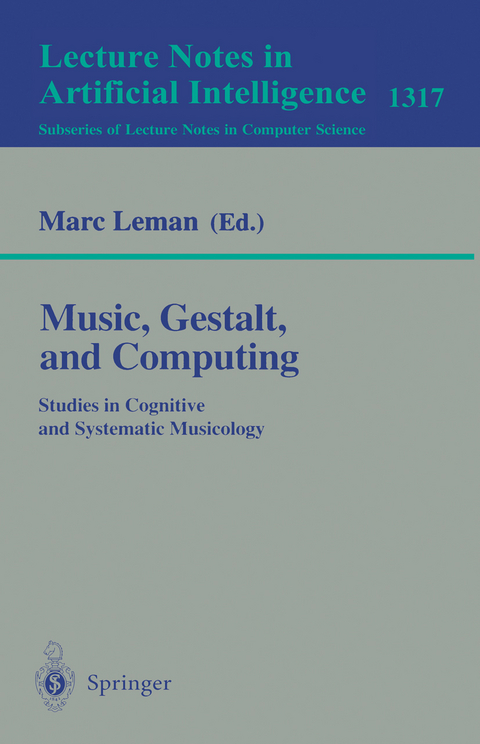
Music, Gestalt, and Computing
Springer Berlin (Verlag)
978-3-540-63526-0 (ISBN)
Origin and nature of cognitive and systematic musicology: An introduction.- Systematic, cognitive and historical approaches in musicology.- Empiricism, gestalt qualities, and determination of style: Some remarks concerning the relationship of Guido Adler to Richard Wallaschek, Alexius Meinong, Christian von Ehrenfels, and Robert Lach.- Gestalt concepts and music: Limitations and possibilities.- Logic, gestalt theory, and neural computation in research on auditory perceptual organization.- Knowledge in music theory by shapes of musical objects and sound-producing actions.- Statistical gestalts — Perceptible features in serial music.- “Verschmelzung”, tonal fusion, and consonance: Carl Stumpf revisited.- Schema and gestalt: Testing the hypothesis of psychoneural isomorphism by computer simulation.- Self-organizing neural nets and the perceptual origin of the circle of fifths.- A model of the perceptual root(s) of a chord accounting for voicing and prevailing tonality.- ‘Good’, ‘rair’, and ‘bad’ chord progressions: A regression-analysis of some psychological chord progression data obtained in an experiment by J. Bharucha and C. Krumhansl.- Problems of shape and background in sounds with inharmonic spectra.- A method of analysing harmony, based on interval patterns or “Gestalten”.- Neural network models for the study of post-tonal music.- Tempo relations: Is there a psychological basis for proportional tempo theory?.- A framework for the subsymbolic description of meter.- Musical rhythm: A formal model for determining local boundaries, accents and metre in a melodic surface.- Effects of perceptual organization and musical form on melodic expectancies.- Continuations as completions: Studying melodic expectation in the creative microdomain Seek Well.- Optimizing self-organizing timbre maps: Two approaches.- Towards a more general understanding of the nasality phenomenon.- Karl Erich Schumann's principles of timbre as a helpful tool in stream segregation research.- Cross-synthesis using interverted principal harmonic sub-spaces.- Gestalt phenomena in musical texture.- Technology of interpretation and expressive pulses.- Intonational protention in the performance of melodic octaves on the violin.- Sonological analysis of clarinet expressivity.- Perceptual analysis of the musical expressive intention in a clarinet performance.- Singing, mind and brain — Unit pulse, rhythm, emotion and expression.- Emulating gestalt mechanisms by combining symbolic and subsymbolic information processing procedures.- Interactive computer music systems and concepts of Gestalt.- Gestalt-based composition and performance in multimodal environments.- List of sound examples on the CD.
| Erscheint lt. Verlag | 10.9.1997 |
|---|---|
| Reihe/Serie | Lecture Notes in Artificial Intelligence | Lecture Notes in Computer Science |
| Mitarbeit |
Assistent: A. Camurri, J. Louhivuori, R. Parncutt, A. Schneider |
| Zusatzinfo | X, 530 p. With online files/update. |
| Verlagsort | Berlin |
| Sprache | englisch |
| Maße | 155 x 235 mm |
| Gewicht | 838 g |
| Themenwelt | Informatik ► Theorie / Studium ► Künstliche Intelligenz / Robotik |
| Schlagworte | Cognitive Psychology • Computermusik • Emotion • gestalt theory • Knowledge • musicology • psychoacoustics • Simulation • sound synthesis |
| ISBN-10 | 3-540-63526-2 / 3540635262 |
| ISBN-13 | 978-3-540-63526-0 / 9783540635260 |
| Zustand | Neuware |
| Informationen gemäß Produktsicherheitsverordnung (GPSR) | |
| Haben Sie eine Frage zum Produkt? |
aus dem Bereich