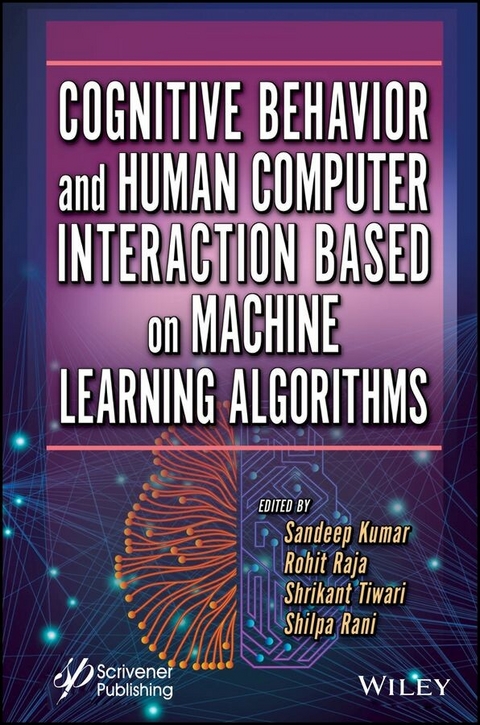
Cognitive Behavior and Human Computer Interaction Based on Machine Learning Algorithms (eBook)
John Wiley & Sons (Verlag)
978-1-119-79208-6 (ISBN)
| The book focuses on the way that human beings and computers interact to ever increasing levels of both complexity and simplicity. Assuming very little knowledge, the book provides content on theory, cognition, design, evaluation, and user diversity. It aims to explain the underlying causes of the cognitive, social and organizational problems typically are devoted to descriptions of rehabilitation methods for specific cognitive processes. This book describes new algorithms for modeling accessible to cognitive scientists of all varieties. The book is inherently interdisciplinary, publishing original research in the fields of computing, engineering, artificial intelligence, psychology, linguistics, and social and system organization, as applied to the design, implementation, application, analysis, and evaluation of interactive systems. Machine learning research has been being carried out for a decade at international level in various applications. The new learning approach is mostly used in machine learning based cognitive applications. This will give direction for future research to scientists and researchers working in neuroscience, neuro-imaging, machine learning based brain mapping and modeling etc. |
Dr. Sandeep Kumar is presently working as a Professor in the Department of Electronics & Communication Engineering, Sreyas Institute of Engineering & Technology, Hyderabad, India. He has published 70 research papers in various International/National Journals. He has been awarded 'Best Paper Presentation' in Nepal & India respectively 2017 & 2018. He has been awarded for 'Best Performer Award' in Hyderabad, India, 2018. He has been awarded also 'Young Researcher Award' in Thailand, 2018. He has been awarded also 'Best Excellence Award' in Delhi, 2019.
Dr. Rohit Raja is working as Associate Professor in the IT Department at the Guru Ghasidas, Vishwavidyalaya, Bilaspur (Central University-CG). He has done a Ph.D. in Computer Science and Engineering in 2016 from C. V. Raman University India. He has filed successfully 10 (9 National + 1 International) patents and published more than 80 Research papers in various International/National Journals.
Dr. Shrikant Tiwari is currently an assistant professor in the Department of Computer Science & Engineering (CSE) at Shri Shankaracharya Technical Campus, Junwani, Bhilai, Distt. Chattisgarh (India). He received his Ph.D. in Department of Computer Science & Engineering (CSE) from the Indian Institute of Technology (Banaras Hindu University), Varanasi (India) in 2012.
Prof. Shilpa Rani is an assistant professor in the Department of Computer Science & Engineering, Neil Gogte Institute of Technology, Hyderabad, India.
COGNITIVE BEHAVIOR AND HUMAN COMPUTER INTERACTION BASED ON MACHINE LEARNING ALGORITHMS The objective of this book is to provide the most relevant information on Human-Computer Interaction to academics, researchers, and students and for those from industry who wish to know more about the real-time application of user interface design. Human-computer interaction (HCI) is the academic discipline, which most of us think of as UI design, that focuses on how human beings and computers interact at ever-increasing levels of both complexity and simplicity. Because of the importance of the subject, this book aims to provide more relevant information that will be useful to students, academics, and researchers in the industry who wish to know more about its real-time application. In addition to providing content on theory, cognition, design, evaluation, and user diversity, this book also explains the underlying causes of the cognitive, social and organizational problems typically devoted to descriptions of rehabilitation methods for specific cognitive processes. Also described are the new modeling algorithms accessible to cognitive scientists from a variety of different areas. This book is inherently interdisciplinary and contains original research in computing, engineering, artificial intelligence, psychology, linguistics, and social and system organization as applied to the design, implementation, application, analysis, and evaluation of interactive systems. Since machine learning research has already been carried out for a decade in various applications, the new learning approach is mainly used in machine learning-based cognitive applications. Since this will direct the future research of scientists and researchers working in neuroscience, neuroimaging, machine learning-based brain mapping, and modeling, etc., this book highlights the framework of a novel robust method for advanced cross-industry HCI technologies. These implementation strategies and future research directions will meet the design and application requirements of several modern and real-time applications for a long time to come. Audience: A wide range of researchers, industry practitioners, and students will be interested in this book including those in artificial intelligence, machine learning, cognition, computer programming and engineering, as well as social sciences such as psychology and linguistics.
Sandeep Kumar, PhD is a Professor in the Department of Computer Science and Engineering, Koneru Lakshmaiah Education Foundation, Vaddeswaram, AP, India. He has published more than 100 research papers in various international/national journals and 6 patents. He has been awarded the "Best Excellence Award" in New Delhi, 2019. Rohit Raja, PhD is an associate professor in the IT Department at the Guru Ghasidas, Vishwavidyalaya, Bilaspur (Central University-CG). He gained his PhD in Computer Science and Engineering in 2016 from C. V. Raman University India. He has filed successfully 10 (9 national + 1 international) patents and published more than 80 research papers in various international/national journals. Shrikant Tiwari, PhD is an assistant professor in the Department of Computer Science & Engineering (CSE) at Shri Shankaracharya Technical Campus, Junwani, Bhilai, Distt. Chattisgarh, India. He received his PhD from the Department of Computer Science & Engineering (CSE) from the Indian Institute of Technology (Banaras Hindu University), Varanasi (India) in 2012. Shilpa Rani, PhD is an assistant professor in the Department of Computer Science & Engineering, Neil Gogte Institute of Technology, Hyderabad, India.
1
Cognitive Behavior: Different Human-Computer Interaction Types
S. Venkata Achyuth Rao1*, Sandeep Kumar2 and GVRK Acharyulu3
1CSE, SIET, Hyderabad, Telangana, India
2Computer Science and Engineering Department, Koneru Lakshmaiah Education Foundation, Vaddeswaram, Andra Pradesh, India
3Operations & Supply Chain, MBA (Healthcare & Hospital Management), School of Management Studies, University of Hyderabad, Telangana, India
*Corresponding author: drsvarao@gmail.com
Abstract
Cognitive behavior plays a significant and strategic role in human-computer interaction devices that are deployed nowadays, with artificial intelligence, deep learning, and machine learning computing techniques. User experience is the crucial factor of any successful interacting device between machine and human. The idea of providing a HCUIMS is to create interfaces in terms of the bottom level of any organization as Decision Processing User Interacting Device System (DPUIDS), next at middle level management, Decision Support User Interacting Device Systems (DSUIDS), lastly at executive level, Management Information User Interacting Device System (MIUIDS), where decisions can take at uncertainty at various catastrophic situations. Here are specific gaps demonstrated in the various user’s processes in communicating with computers and that cognitive modeling is useful in the inception phase to evolve the design and provide training.
This is provided with the fulfillment of various interactive devices like Individual Intelligences Interactions (I3), Artificial and Individual Intelligences Interaction (AI3), Brain-Computer Interaction (BCI), and Individual Interactions through Computers (I2C) in a playful manner to meet the corporate challenges in all stakeholders of various domains with better user experience.
Keywords: Cognitive behavior, user experience, interacting devices, modeling, intelligence
1.1 Introduction: Cognitive Models and Human-Computer User Interface Management Systems
Cognitive models are useful in assessing to make predictions ease at top-level management systems in several aspects or many variables to interact and provide the approximate behavioral aspects observed in various experimental empirical studies. In a real-world lifetime situation, many factors are influenced to produce outcome reports as a behavioral analysis report. This is done neural processing data with the representation of patterns. These models outcome in terms of processes and products interact with various people which are shown in the empirical experiments. These below are necessary tools for psychologists to interact with various designers who care about cognitive models. These models for HCI have an adequate different goal to use necessary interfaces better for users. In general, there are at least three cognitive models in service as a general goal [1].
- Interactive user behavioral predicting systems
- Adaptive interaction observatory changing systems
- Group interaction model building systems
1.1.1 Interactive User Behavior Predicting Systems
Human behavior predicting system interface is designed and deployed as the interaction and communication between users and a machine, an automatic dynamic, versatile system, through a user-machine interface [2]. There are strongly related real-world assumptions, and aspects are there to distinguish the domain of user-machine automatic dynamic, versatile systems, and user-computer interaction. For 50 years onward, the investigations on research in this domain are going on with different interactive human predicting systems that are evolved with the necessary propagated embedded events via a hardware and software interaction built-in displays. The best and emerging ambient designs of user interaction automatic predicting system applications have a right market place and gain values vertically in all the verticals for many products and services in various sectors like medical, transportation, education, games, and entertainment, which are the needs of the industry [3].
1.1.2 Adaptive Interaction Observatory Changing Systems
An adaptive interactive observatory system acquires its psychological aspects to the independent user based on inferences of the user prototype acquisition and reports involving activity in learning, training, inference, or necessary constraints of the decision process. The primary and needful goal of adaptive interaction observatory changing system interfacing adaptation is to consider unique perceptual or physical impairments of individual users; it allowed them to use a dynamic system more flexibly, efficiently, with minimal errors and with less frustration. An adaptive interaction observatory system interface is an embedded software artifact that improves its functionality to interact with an individual user by prototype model, thereby constructing a user model based on partial psychological considerable experience with that user [4].
As there are widespread of www, internet, and gopher services among the population day by day, more sophisticated variety of softwares, emerging technologies involve hardware events, gadgets, widgets, and events that are more and more highly interactive and responsive. Only limited early individual novice people are doing programs on punch cards and submitting late nights and overnight jobs, and subsequently time-sharing systems and debug monitors, text editors have become slower and slower and depend on multiple cores and moving forward to parallel processing. The latest emerging operating systems and real-time operating systems support various interactive software like what you see and what you get. The editor system software is too high for interactive computer games, most efficient and eminent embedded systems, automotive responsive, interactive, and adaptive conservative systems in layered interactive graphical user interfaces, and such subscribers and listeners are the key roles of adaptive interaction observatory changing systems. Such systems have been treated as an essential part of any business and academic lives with a trillion people depend on them to move toward their daily lives. Most academic work on machine learning still focuses on refining techniques and humiliating the steps that may happen at foreseen and after their invocation. Indeed, most investigations, conferences, workshops, and research interests, especially media and entertainment, virtual reality, simulation, modeling, and design, still emphasize differences between broader areas of learning methods. Eventually, evidenced by the decision-tree induction, the design analysis of algorithms, case-based reasoning methods, and statistical and probabilistic schemes often produce very similar results [5].
1.1.3 Group Interaction Model Building Systems
This chapter’s main objective is to describe the existing cognitive framework activities on group modeling information systems using synergy responsive dynamics. Such information systems are very few and necessary to be applied in hybrid organizations in order to support to increase in a wide range of business expansion and to take their strategic decisions. In this cognitive group interaction model building theory, the vital methodological dynamics were first located under the individual user interactions and then classified to allow an intensive idea to be given as a requirement analysis report for group activity prototype being a building system consideration [6]. The outcome of this brainstorming dynamics indicates the existing methods to propose a global view of interaction model systems are very rare. Also, three complex issues are needed to discuss: the inception of knowing the users’ knowledge, the interaction establishment of a consensus among users, and the main aspects of providing necessary facilitation.
A group interaction model building system is a dynamic system that is characterized by the following:
- The responsive nature and strong interactions among the actors of the group;
- An integration exists with necessary interactions, interrelations, and a strong dependency together;
- An internal abstractive complex cohesiveness is subjected to their feedback; and
- Fuzziness of the delayed behavioral reactions among the groups to assess or predict.
An organized framework is described here as a generalization of any organized approach, providing inference process and cohesive interactions in the detailed guidelines related to any aspect of group interaction model building. This analysis aims to obtain a broad view of a global vision of investigating the research that applied group interaction modeling systems. Using system dynamics allows drawing keenness to the lack of advanced interactive device management aspects to support the relating behavior aspects.
The group modeling system approach’s dynamic behavior is characterized below, emphasizing group interaction model systems.
The modeling process using two types of information systems [7]:
- Modeling information systems versus group interaction model information systems.
- Expert modeling systems versus team expert modeling information systems.
1.1.4 Human-Computer User Interface Management Systems
Human-Computer User Interface (HCUI) design mainly emphasizes foreseeing what computer interaction users need to do and approve that the human-computer interface has several elements that are flexible and easy to know, view, navigate, update, manage and...
| Erscheint lt. Verlag | 23.11.2021 |
|---|---|
| Sprache | englisch |
| Themenwelt | Informatik ► Theorie / Studium ► Künstliche Intelligenz / Robotik |
| Schlagworte | Artificial Intelligence • cognitive science • Computer Science • Informatik • Kognitionswissenschaft • Künstliche Intelligenz • Psychologie • Psychology |
| ISBN-10 | 1-119-79208-8 / 1119792088 |
| ISBN-13 | 978-1-119-79208-6 / 9781119792086 |
| Informationen gemäß Produktsicherheitsverordnung (GPSR) | |
| Haben Sie eine Frage zum Produkt? |
 EPUB (Adobe DRM)
Kopierschutz: Adobe-DRM
Adobe-DRM ist ein Kopierschutz, der das eBook vor Mißbrauch schützen soll. Dabei wird das eBook bereits beim Download auf Ihre persönliche Adobe-ID autorisiert. Lesen können Sie das eBook dann nur auf den Geräten, welche ebenfalls auf Ihre Adobe-ID registriert sind.
Details zum Adobe-DRM
Dateiformat: EPUB (Electronic Publication)
EPUB ist ein offener Standard für eBooks und eignet sich besonders zur Darstellung von Belletristik und Sachbüchern. Der Fließtext wird dynamisch an die Display- und Schriftgröße angepasst. Auch für mobile Lesegeräte ist EPUB daher gut geeignet.
Systemvoraussetzungen:
PC/Mac: Mit einem PC oder Mac können Sie dieses eBook lesen. Sie benötigen eine
eReader: Dieses eBook kann mit (fast) allen eBook-Readern gelesen werden. Mit dem amazon-Kindle ist es aber nicht kompatibel.
Smartphone/Tablet: Egal ob Apple oder Android, dieses eBook können Sie lesen. Sie benötigen eine
Geräteliste und zusätzliche Hinweise
Buying eBooks from abroad
For tax law reasons we can sell eBooks just within Germany and Switzerland. Regrettably we cannot fulfill eBook-orders from other countries.
aus dem Bereich