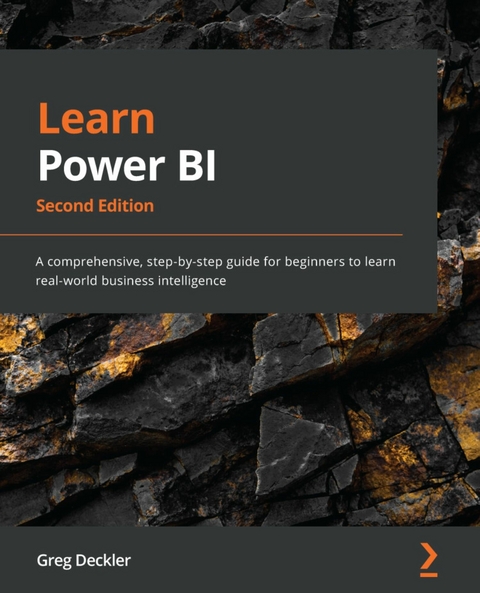
Learn Power BI (eBook)
458 Seiten
Packt Publishing (Verlag)
978-1-80181-007-4 (ISBN)
To succeed in today's transforming business world, organizations need business intelligence capabilities to make smarter decisions faster than ever before. This updated second edition of Learn Power BI takes you on a journey of data exploration and discovery, using Microsoft Power BI to ingest, cleanse, and organize data in order to unlock key business insights that can then be shared with others.
This newly revised and expanded edition of Learn Power BI covers all of the latest features and interface changes and takes you through the fundamentals of business intelligence projects, how to deploy, adopt, and govern Power BI within your organization, and how to leverage your knowledge in the marketplace and broader ecosystem that is Power BI. As you progress, you will learn how to ingest, cleanse, and transform your data into stunning visualizations, reports, and dashboards that speak to business decision-makers.
By the end of this Power BI book, you will be fully prepared to be the data analysis hero of your organization - or even start a new career as a business intelligence professional.
Learn how to use Power BI to deliver the insights needed to help your enterprise survive and thrivePurchase of the print or Kindle book includes a free eBook in PDF format.Key FeaturesLearn simple through to advanced Power BI features in a clear, concise way using real-world examplesDevelop powerful analytical models and reports that extract key business insightsPublish, share and collaborate on impressive reports, dashboards, apps, and goalsBook DescriptionTo succeed in today's transforming business world, organizations need business intelligence capabilities to make smarter decisions faster than ever before. This updated second edition of Learn Power BI takes you on a journey of data exploration and discovery, using Microsoft Power BI to ingest, cleanse, and organize data in order to unlock key business insights that can then be shared with others. This newly revised and expanded edition of Learn Power BI covers all of the latest features and interface changes and takes you through the fundamentals of business intelligence projects, how to deploy, adopt, and govern Power BI within your organization, and how to leverage your knowledge in the marketplace and broader ecosystem that is Power BI. As you progress, you will learn how to ingest, cleanse, and transform your data into stunning visualizations, reports, and dashboards that speak to business decision-makers. By the end of this Power BI book, you will be fully prepared to be the data analysis hero of your organization or even start a new career as a business intelligence professional.What you will learnGet up and running quickly with Power BIUnderstand and plan your business intelligence projectsConnect to and transform data using Power QueryCreate data models optimized for analysis and reportingPerform simple and complex DAX calculations to enhance analysisDiscover business insights and create professional reportsCollaborate via Power BI dashboards, apps, goals, and scorecardsDeploy and govern Power BI, including using deployment pipelinesWho this book is forIf you re an IT manager, data analyst, or BI user new to using Power BI for solving business intelligence problems, this book is for you. You ll also find this book helpful if you want to migrate from other BI tools to create powerful and interactive dashboards. No experience of working with Power BI is expected.]]>
Preface
To succeed in today's fast-paced business world, organizations need Business Intelligence (BI) capabilities more than ever in order to make smarter decisions that allow those organizations to be more efficient, effective, and profitable. This book is an entry-level guide specifically designed to get you up and running quickly with Power BI, including data import and transformation, data modeling, visualization, and analytical techniques without any prior knowledge of BI or Power BI.
You will find this book useful if you want to become knowledgeable about the extensive Power BI ecosystem. You'll start by understanding basic BI concepts and how BI projects are conducted. In short order, you will have Power BI Desktop installed and understand its major components. As you progress, step-by-step instructions are provided for using Power Query Editor to ingest, cleanse, and transform your data, creating simple and complex DAX calculations and visualizing your data in ways that truly bring your data to life. Additionally, you'll gain hands-on experience in creating visually stunning reports that speak to business decision makers and understand how to share and collaborate with others. Finally, you will understand how Power BI is deployed, governed, and adopted within organizations, the job and career opportunities available to BI professionals, and how to continue your learning.
By the end of this book, you'll be ready to create effective reports and dashboards using the latest features of Power BI.
Who this book is for
If you are new to BI or you are a business analyst or other technical or non-technical user who is new to Power BI, then this book is for you. No prior experience in BI or Power BI is required in order to proceed.
What this book covers
Chapter 1, Understanding Business Intelligence and Power BI, provides an introduction to key concepts of business intelligence, an overview of the Power BI ecosystem, licensing options for Power BI, and introduces the Power BI Desktop and Power BI Service.
Chapter 2, Planning Projects with Power BI, explains how business intelligence projects are planned and executed, including identifying stakeholders, goals, and requirements, required resources and data sources, and introduces the example scenario used throughout the rest of the book.
Chapter 3, Up and Running with Power BI Desktop, provides instructions for downloading and installing Power BI Desktop and an overview of the major components of the Desktop including Report, Data and Model views, the menu tabs, the Filters, and the Visualizations and Fields panes. It introduces the creation of tables and visualizations.
Chapter 4, Connecting to and Transforming Data, introduces the Power Query Editor for importing and transforming data, including transposing data, creating custom columns, adding index columns, splitting columns, referencing queries, appending and merging queries, additional transformation functions and importing data.
Chapter 5, Creating Data Models and Calculations, demonstrates how to create a data model by using the model view to create relationships between tables, and how to create and troubleshoot data analysis calculations.
Chapter 6, Unlocking Insights, introduces analysis concepts such as groups and hierarchies, row level security, report navigation using drill through and buttons, question and answer, bookmarks and advanced analysis techniques such as analyze, summarization, filtering, gauges, key performance indicators, What if parameters, conditional formatting, quick measures, report page tooltips, and advanced visuals such as, the Key Influencer's visual.
Chapter 7, Creating the Final Report, provides step-by-step instructions for creating a professional, multi-page report that provides data insights to business decision makers.
Chapter 8, Publishing and Sharing, demonstrates how to publish the final report to the Power BI Service and share the report with a larger audience.
Chapter 9, Using Reports in the Power BI Service, focuses on using reports in the Power BI Service including all of the various report functions such as editing reports, embedding, exporting, bookmarks, lineage view, comments, subscriptions and Microsoft Teams integration.
Chapter 10, Understanding Dashboards, Apps, Goals, and Security, provides information on creating and working with dashboards, including pinning and managing tiles, the creation and distribution of apps, the creation of scorecards and goals and an overview of permissions and security.
Chapter 11, Refreshing Content, demonstrates how to install, configure, and manage a data gateway, and how to schedule automatic refreshes for datasets within the Power BI Service.
Chapter 12, Deploying, Governing, and Adopting Power BI, introduces different deployment usage models for Power BI within organizations, the concept of governance of Power BI systems including all of the various Power BI Service tenant settings, and how to drive the adoption of Power BI within an organization.
Chapter 13, Putting Your Knowledge to Use, describes the overall opportunity available in business intelligence, the various types of business intelligence jobs, roles, and responsibilities, the differences between consulting and internal employees, job search strategies, interviewing and compensation negotiation tips, and finally includes information on blogs and other websites to continue your journey of learning Power BI.
To get the most out of this book
No prior experience in BI or Power BI is necessary. A keen interest in data and data analytics is helpful as well as prior experience with other BI tools.
Chapter 10, Understanding Dashboards, Apps, Goals, and Security, includes material that requires Premium or Premium Per User (PPU) licensing.
Important note
The existing Power BI UI will be updated soon to look as shown in this book.
If you are using the digital version of this book, we advise you to type the code yourself or access the code from the book's GitHub repository (a link is available in the next section). Doing so will help you avoid any potential errors related to the copying and pasting of code.
Join the Power BI Community at https://community.powerbi.com!
Download the example code files
You can download the example code files for this book from GitHub at https://github.com/PacktPublishing/Learn-Power-BI-second-edition. If there's an update to the code, it will be updated in the GitHub repository.
We also have other code bundles from our rich catalog of books and videos available at https://github.com/PacktPublishing/. Check them out!
Code in Action
The Code in Action videos for this book can be viewed at https://bit.ly/3F2HfnI.
Download the color images
We also provide a PDF file that has color images of the screenshots and diagrams used in this book. You can download it here: https://static.packt-cdn.com/downloads/9781801811958_ColorImages.pdf.
Conventions used
There are a number of text conventions used throughout this book.
Code in text: Indicates code words in the text, database table names, folder names, filenames, file extensions, pathnames, dummy URLs, user input, and Twitter handles. Here is an example: The first parameter is the 'Hours' table, on line 4, and a filter, on line 5.
A block of code is set as follows:
Column 3 =
SUMX(
FILTER(
ALL('Hours'),
[Category] = "Billable" && [EmployeeID] = EARLIER([EmployeeID])
),
[Hours]
)
Bold: Indicates a new term, an important word, or words that you see on screen. For instance, words in menus or dialog boxes appear in bold. Here is an example: Power Platform includes Power BI datasets and dataflows, as well as the Dataverse
Tips or Important notes
Enter data queries support up to 3,000 cells of information. If you run into a limitation, you can always copy the table in Power BI and then paste it into Excel. Once you've done this, you can add the required information in Excel, save it, and then import this Excel file into Power BI.
Get in touch
Feedback from our readers is always welcome.
General feedback: If you have questions about any aspect of this book, email us at customercare@packtpub.com and mention the book title in the subject of your message.
Errata: Although we have taken every care to ensure the accuracy of our content, mistakes do happen. If you have found a mistake in...
| Erscheint lt. Verlag | 18.2.2022 |
|---|---|
| Sprache | englisch |
| Themenwelt | Mathematik / Informatik ► Informatik |
| ISBN-10 | 1-80181-007-9 / 1801810079 |
| ISBN-13 | 978-1-80181-007-4 / 9781801810074 |
| Informationen gemäß Produktsicherheitsverordnung (GPSR) | |
| Haben Sie eine Frage zum Produkt? |
 EPUB (Ohne DRM)
Digital Rights Management: ohne DRM
Dieses eBook enthält kein DRM oder Kopierschutz. Eine Weitergabe an Dritte ist jedoch rechtlich nicht zulässig, weil Sie beim Kauf nur die Rechte an der persönlichen Nutzung erwerben.
Dateiformat: EPUB (Electronic Publication)
EPUB ist ein offener Standard für eBooks und eignet sich besonders zur Darstellung von Belletristik und Sachbüchern. Der Fließtext wird dynamisch an die Display- und Schriftgröße angepasst. Auch für mobile Lesegeräte ist EPUB daher gut geeignet.
Systemvoraussetzungen:
PC/Mac: Mit einem PC oder Mac können Sie dieses eBook lesen. Sie benötigen dafür die kostenlose Software Adobe Digital Editions.
eReader: Dieses eBook kann mit (fast) allen eBook-Readern gelesen werden. Mit dem amazon-Kindle ist es aber nicht kompatibel.
Smartphone/Tablet: Egal ob Apple oder Android, dieses eBook können Sie lesen. Sie benötigen dafür eine kostenlose App.
Geräteliste und zusätzliche Hinweise
Buying eBooks from abroad
For tax law reasons we can sell eBooks just within Germany and Switzerland. Regrettably we cannot fulfill eBook-orders from other countries.
aus dem Bereich