The United States of Anonymous (eBook)
328 Seiten
Cornell University Press (Verlag)
978-1-5017-6240-6 (ISBN)
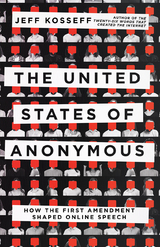
In The United States of Anonymous, Jeff Kosseff explores how the right to anonymity has shaped American values, politics, business, security, and discourse, particularly as technology has enabled people to separate their identities from their communications.
Legal and political debates surrounding online privacy often focus on the Fourth Amendment's protection against unreasonable searches and seizures, overlooking the history and future of an equally powerful privacy right: the First Amendment's protection of anonymity. The United States of Anonymous features extensive and engaging interviews with people involved in the highest profile anonymity cases, as well as with those who have benefited from, and been harmed by, anonymous communications. Through these interviews, Kosseff explores how courts have protected anonymity for decades and, likewise, how law and technology have allowed individuals to control how much, if any, identifying information is associated with their communications. From blocking laws that prevent Ku Klux Klan members from wearing masks to restraining Alabama officials from forcing the NAACP to disclose its membership lists, and to refusing companies' requests to unmask online critics, courts have recognized that anonymity is a vital part of our free speech protections.
The United States of Anonymous weighs the tradeoffs between the right to hide identity and the harms of anonymity, concluding that we must maintain a strong, if not absolute, right to anonymous speech.
Jeff Kosseff is Associate Professor in the United States Naval Academy's Cyber Science Department and author of the bestselling book, The Twenty-Six Words That Created the Internet. He was a finalist for the Pulitzer Prize for National Reporting and the recipient of the George Polk Award in National Reporting. Follow him on X @jkosseff.
Introduction
Part I: Developing the Right to Anonymity
1. America, the Anonymous
2. Empowering Anonymous Association
3. Empowering Anonymous Speech
4. The Scope of Anonymity Empowerment
5. Antimask
Part II: The Right to Online Anonymity
6. Cybersmear
7. Setting the Rules for Online Anonymity
8. Online Anonymity and Copyright
9. When the Government Wants to Unmask You
10. Anonymity Worldwide
11. Technological Protections for Anonymity
Part III: Living in an Anonymous World
12. Anonymity as a Shield
13. Anonymity as a Sword
Part IV: The Future of Anonymity
14. Real-Name Policies
15. Out in the Open
16. Empowering Anonymity through Privacy Law
Conclusion
| Erscheint lt. Verlag | 15.3.2022 |
|---|---|
| Verlagsort | Ithaca |
| Sprache | englisch |
| Maße | 150 x 150 mm |
| Themenwelt | Informatik ► Netzwerke ► Sicherheit / Firewall |
| Informatik ► Theorie / Studium ► Kryptologie | |
| Naturwissenschaften | |
| Recht / Steuern ► EU / Internationales Recht | |
| Recht / Steuern ► Privatrecht / Bürgerliches Recht ► IT-Recht | |
| Schlagworte | American Values • anonymity • anonymity protections • anonymous communications • business impact • Cloud computing regulations • Computer hacking laws • Computer-related crimes • Cyberbullying • Cybercrime prosecution • cyberlaw • Cybersecurity regulations • Data breaches • Digital Rights • First Amendment • Fourth Amendment • Free Speech • john udall • john udall, section 230 and anonymity, online anonymity, tor, online privacy policies, the federalist papers, pseudonymity • legal cases • legal debates • NAACP membership • Online anonymity • online censorship • online fraud • Online privacy • online privacy policies • Online Security • Political Discourse • privacy rights • privacy tradeoffs • pseudonymity • section 230 and anonymity • security implications • technology and identity • The Federalist Papers • Tor • United States of Anonymous |
| ISBN-10 | 1-5017-6240-0 / 1501762400 |
| ISBN-13 | 978-1-5017-6240-6 / 9781501762406 |
| Informationen gemäß Produktsicherheitsverordnung (GPSR) | |
| Haben Sie eine Frage zum Produkt? |
 EPUB (Adobe DRM)
Kopierschutz: Adobe-DRM
Adobe-DRM ist ein Kopierschutz, der das eBook vor Mißbrauch schützen soll. Dabei wird das eBook bereits beim Download auf Ihre persönliche Adobe-ID autorisiert. Lesen können Sie das eBook dann nur auf den Geräten, welche ebenfalls auf Ihre Adobe-ID registriert sind.
Details zum Adobe-DRM
Dateiformat: EPUB (Electronic Publication)
EPUB ist ein offener Standard für eBooks und eignet sich besonders zur Darstellung von Belletristik und Sachbüchern. Der Fließtext wird dynamisch an die Display- und Schriftgröße angepasst. Auch für mobile Lesegeräte ist EPUB daher gut geeignet.
Systemvoraussetzungen:
PC/Mac: Mit einem PC oder Mac können Sie dieses eBook lesen. Sie benötigen eine
eReader: Dieses eBook kann mit (fast) allen eBook-Readern gelesen werden. Mit dem amazon-Kindle ist es aber nicht kompatibel.
Smartphone/Tablet: Egal ob Apple oder Android, dieses eBook können Sie lesen. Sie benötigen eine
Geräteliste und zusätzliche Hinweise
Buying eBooks from abroad
For tax law reasons we can sell eBooks just within Germany and Switzerland. Regrettably we cannot fulfill eBook-orders from other countries.
aus dem Bereich