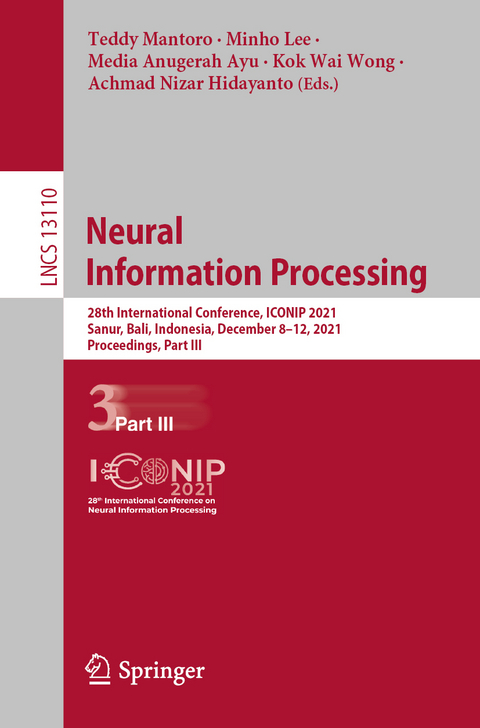
Neural Information Processing
Springer International Publishing (Verlag)
978-3-030-92237-5 (ISBN)
The four-volume proceedings LNCS 13108, 13109, 13110, and 13111 constitutes the proceedings of the 28th International Conference on Neural Information Processing, ICONIP 2021, which was held during December 8-12, 2021. The conference was planned to take place in Bali, Indonesia but changed to an online format due to the COVID-19 pandemic.
The total of 226 full papers presented in these proceedings was carefully reviewed and selected from 1093 submissions. The papers were organized in topical sections as follows:
Part I: Theory and algorithms;
Part II: Theory and algorithms; human centred computing; AI and cybersecurity;
Part III: Cognitive neurosciences; reliable, robust, and secure machine learning algorithms; theory and applications of natural computing paradigms; advances in deep and shallow machine learning algorithms for biomedical data and imaging; applications;
Part IV: Applications.
Cognitive Neurosciences.- A Novel Binary BCI Systems Based on Non-oddball Auditory and Visual Paradigms.- A Just-In-Time Compilation Approach for Neural Dynamics Simulation.- STCN-GR: Spatial-Temporal Convolutional Networks for Surface-Electromyography-Based Gesture Recognition.- Gradient descent learning algorithm based on spike selection mechanism for multilayer spiking neural networks.- Learning to Coordinate via Multiple Graph Neural Networks.- A Reinforcement Learning Approach for Abductive Natural Language Generation.- DFFCN: Dual Flow Fusion Convolutional Network for Micro Expression Recognition.- AUPro: Multi-label Facial Action Unit Proposal Generation for Sequence-level Analysis.- Deep kernelized network for fine-grained recognition.- Semantic Perception Swarm Policy with Deep Reinforcement Learning.- Reliable, Robust, and Secure Machine Learning Algorithms Open-Set Recognition with Dual Probability Learning.- How Much Do Synthetic Datasets Matter In Handwritten Text Recognition.- PCMO: Partial Classification from CNN-Based Model Outputs.- Multi-branch Fusion Fully Convolutional Network for Person Re-Identification.- Fast Organization of Objects Spatial Positions in Manipulator Space from Single RGB-D Camera.- EvoBA: An Evolution Strategy as a Strong Baseline for Black-Box Adversarial Attacks.- A Novel Oversampling Technique for Imbalanced Learning Based on SMOTE and Genetic Algorithm.- Dy-Drl2Op: Learning Heuristics for TSP on the Dynamic Graph via Deep Reinforcement Learning.- Multi-label classification of hyperspectral images based on label-specific feature fusion.- A Novel Multi-Scale Key-Point Detector Using Residual Dense Block and Coordinate Attention.- Alleviating Catastrophic Interference in Online Learning via Varying Scale of Backward Queried Data.- Construction and Reasoning for Interval-Valued EBRB Systems.- Theory and Applications of Natural Computing Paradigms.- Brain-mimetic Kernel: A Kernel Constructed from Human fMRI Signals Enabling aBrain-mimetic Visual Recognition Algorithm.- Predominant Sense Acquisition with a Neural Random Walk Model.- Processing-response dependence on the on-chip readout positions in spin-wave reservoir computing.- Advances in deep and shallow machine learning algorithms for biomedical data and imaging.- A Multi-Task Learning Scheme for Motor Imagery Signal Classification.- An End-to-End Hemisphere Discrepancy Network for Subject-Independent Motor Imagery Classification.- Multi-domain Abdomen Image Alignment Based on Joint Network of Registration and Synthesis.- Coordinate Attention Residual Deformable U-Net for Vessel Segmentation.- Gated Channel Attention Network for Cataract Classification on AS-OCT Image.- Overcoming Data Scarcity for Coronary Vessel Segmentation Through Self-Supervised Pre-Training.- Self-Attention Long-Term Dependency Modelling in Electroencephalography Sleep Stage Prediction.- ReCal-Net: Joint Region-Channel-Wise Calibrated Network for Semantic Segmentation in Cataract Surgery Videos.- Enhancing Dermoscopic Features Classification in Images Using Invariant Dataset Augmentation and Convolutional Neural Networks.- Ensembles of Randomized Neural Networks for Pattern-based Time Series Forecasting.- Grouped Echo State Network with Late Fusion for Speech Emotion Recognition.- Applications.- MPANet: Multi-level Progressive Aggregation Network for Crowd Counting.- AFLLC: A Novel Active Contour Model based on Adaptive Fractional Order Differentiation and Local Linearly Constrained Bias Field.- DA-GCN: A Dependency-Aware Graph Convolutional Network for Emotion Recognition in Conversations.- Semi-Supervised Learning with Conditional GANs for Blind Generated Image Quality Assessment.- Uncertainty-Aware Domain Adaptation for Action Recognition.- Free-Form Image Inpainting with Separable Gate Encoder-decoder Network.- BERTDAN: Question-Answer Dual Attention Fusion Networks With Pre-trained Models for Answer Selection.- Rethinking the Effectiveness of Selective At
| Erscheinungsdatum | 07.12.2021 |
|---|---|
| Reihe/Serie | Lecture Notes in Computer Science | Theoretical Computer Science and General Issues |
| Zusatzinfo | XXVI, 705 p. 248 illus., 222 illus. in color. |
| Verlagsort | Cham |
| Sprache | englisch |
| Maße | 155 x 235 mm |
| Gewicht | 1104 g |
| Themenwelt | Informatik ► Theorie / Studium ► Künstliche Intelligenz / Robotik |
| Schlagworte | Applications • Artificial Intelligence • Computer Science • computer vision • conference proceedings • Deep learning • Human-Computer Interaction (HCI) • Image Analysis • Image Processing • Imaging Systems • Informatics • learning • machine learning • Network Protocols • Neural networks • pattern recognition • Research • Semantics • Signal Processing |
| ISBN-10 | 3-030-92237-5 / 3030922375 |
| ISBN-13 | 978-3-030-92237-5 / 9783030922375 |
| Zustand | Neuware |
| Informationen gemäß Produktsicherheitsverordnung (GPSR) | |
| Haben Sie eine Frage zum Produkt? |
aus dem Bereich