


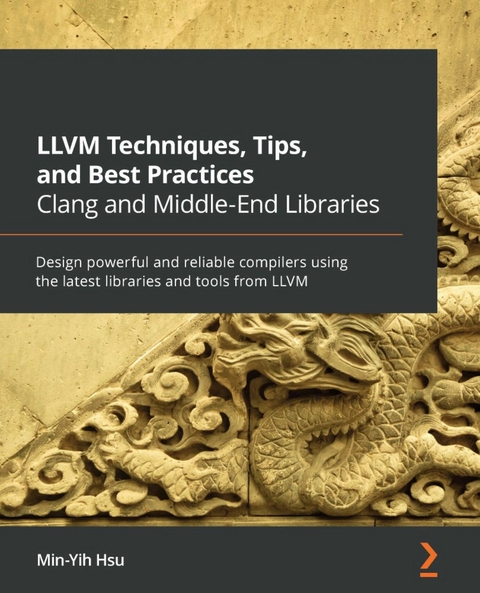
LLVM Techniques, Tips, and Best Practices Clang and Middle-End Libraries (eBook)
370 Seiten
Packt Publishing (Verlag)
978-1-83882-972-8 (ISBN)
Every programmer or engineer, at some point in their career, works with compilers to optimize their applications. Compilers convert a high-level programming language into low-level machine-executable code. LLVM provides the infrastructure, reusable libraries, and tools needed for developers to build their own compilers. With LLVM's extensive set of tooling, you can effectively generate code for different backends as well as optimize them.
In this book, you'll explore the LLVM compiler infrastructure and understand how to use it to solve different problems. You'll start by looking at the structure and design philosophy of important components of LLVM and gradually move on to using Clang libraries to build tools that help you analyze high-level source code. As you advance, the book will show you how to process LLVM IR - a powerful way to transform and optimize the source program for various purposes. Equipped with this knowledge, you'll be able to leverage LLVM and Clang to create a wide range of useful programming language tools, including compilers, interpreters, IDEs, and source code analyzers.
By the end of this LLVM book, you'll have developed the skills to create powerful tools using the LLVM framework to overcome different real-world challenges.
Learn how you can build the next big programming language, compiler, or source code analyzer using LLVM and ClangKey FeaturesExplore Clang, LLVM's middle-end and backend, in a pragmatic wayDevelop your LLVM skillset and get to grips with a variety of common use casesEngage with real-world LLVM development through various coding examplesBook DescriptionEvery programmer or engineer, at some point in their career, works with compilers to optimize their applications. Compilers convert a high-level programming language into low-level machine-executable code. LLVM provides the infrastructure, reusable libraries, and tools needed for developers to build their own compilers. With LLVM's extensive set of tooling, you can effectively generate code for different backends as well as optimize them. In this book, you'll explore the LLVM compiler infrastructure and understand how to use it to solve different problems. You'll start by looking at the structure and design philosophy of important components of LLVM and gradually move on to using Clang libraries to build tools that help you analyze high-level source code. As you advance, the book will show you how to process LLVM IR - a powerful way to transform and optimize the source program for various purposes. Equipped with this knowledge, you'll be able to leverage LLVM and Clang to create a wide range of useful programming language tools, including compilers, interpreters, IDEs, and source code analyzers. By the end of this LLVM book, you'll have developed the skills to create powerful tools using the LLVM framework to overcome different real-world challenges.What you will learnFind out how LLVM's build system works and how to reduce the building resourceGet to grips with running custom testing with LLVM's LIT frameworkBuild different types of plugins and extensions for ClangCustomize Clang's toolchain and compiler flagsWrite LLVM passes for the new PassManagerDiscover how to inspect and modify LLVM IRUnderstand how to use LLVM's profile-guided optimizations (PGO) frameworkCreate custom compiler sanitizersWho this book is forThis book is for software engineers of all experience levels who work with LLVM. If you are an academic researcher, this book will help you learn useful LLVM skills in a short time and enable you to build your prototypes and projects quickly. Programming language enthusiasts will also find this book useful for building a new programming language with the help of LLVM.
| Erscheint lt. Verlag | 22.4.2021 |
|---|---|
| Sprache | englisch |
| Themenwelt | Mathematik / Informatik ► Informatik ► Programmiersprachen / -werkzeuge |
| ISBN-10 | 1-83882-972-5 / 1838829725 |
| ISBN-13 | 978-1-83882-972-8 / 9781838829728 |
| Informationen gemäß Produktsicherheitsverordnung (GPSR) | |
| Haben Sie eine Frage zum Produkt? |
 EPUB (Ohne DRM)
Digital Rights Management: ohne DRM
Dieses eBook enthält kein DRM oder Kopierschutz. Eine Weitergabe an Dritte ist jedoch rechtlich nicht zulässig, weil Sie beim Kauf nur die Rechte an der persönlichen Nutzung erwerben.
Dateiformat: EPUB (Electronic Publication)
EPUB ist ein offener Standard für eBooks und eignet sich besonders zur Darstellung von Belletristik und Sachbüchern. Der Fließtext wird dynamisch an die Display- und Schriftgröße angepasst. Auch für mobile Lesegeräte ist EPUB daher gut geeignet.
Systemvoraussetzungen:
PC/Mac: Mit einem PC oder Mac können Sie dieses eBook lesen. Sie benötigen dafür die kostenlose Software Adobe Digital Editions.
eReader: Dieses eBook kann mit (fast) allen eBook-Readern gelesen werden. Mit dem amazon-Kindle ist es aber nicht kompatibel.
Smartphone/Tablet: Egal ob Apple oder Android, dieses eBook können Sie lesen. Sie benötigen dafür eine kostenlose App.
Geräteliste und zusätzliche Hinweise
Buying eBooks from abroad
For tax law reasons we can sell eBooks just within Germany and Switzerland. Regrettably we cannot fulfill eBook-orders from other countries.
aus dem Bereich


