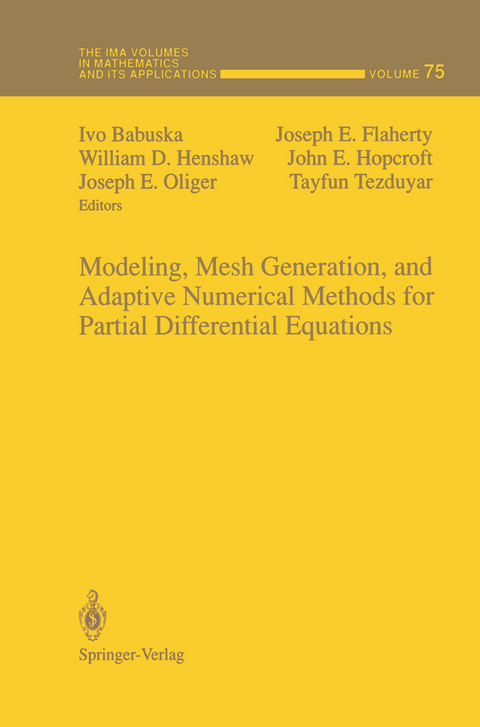
Modeling, Mesh Generation, and Adaptive Numerical Methods for Partial Differential Equations
Springer-Verlag New York Inc.
9780387945422 (ISBN)
This IMA Volume in Mathematics and its Applications MODELING, MESH GENERATION, AND ADAPTIVE NUMERICAL METHODS FOR PARTIAL DIFFERENTIAL EQUATIONS is based on the proceedings of the 1993 IMA Summer Program "Modeling, Mesh Generation, and Adaptive Numerical Methods for Partial Differential Equations." We thank Ivo Babuska, Joseph E. Flaherty, William D. Hen- shaw, John E. Hopcroft, Joseph E. Oliger, and Tayfun Tezduyar for orga- nizing the workshop and editing the proceedings. We also take this oppor- tunity to thank those agencies whose financial support made the summer program possible: the National Science Foundation (NSF), the Army Re- search Office (ARO) the Department of Energy (DOE), the Minnesota Su- percomputer Institute (MSI), and the Army High Performance Computing Research Center (AHPCRC). A vner Friedman Willard Miller, Jr. xiii PREFACE Mesh generation is one of the most time consuming aspects of com- putational solutions of problems involving partial differential equations. It is, furthermore, no longer acceptable to compute solutions without proper verification that specified accuracy criteria are being satisfied.
Mesh gen- eration must be related to the solution through computable estimates of discretization errors. Thus, an iterative process of alternate mesh and so- lution generation evolves in an adaptive manner with the end result that the solution is computed to prescribed specifications in an optimal, or at least efficient, manner. While mesh generation and adaptive strategies are becoming available, major computational challenges remain. One, in particular, involves moving boundaries and interfaces, such as free-surface flows and fluid-structure interactions.
Week 1.- NURBS and grid generation.- Coping with degeneracies in Delaunay triangulation.- Geometric approaches to mesh generation.- Refining quadrilateral and brick element meshes.- Automatic meshing of curved three—dimensional domains: Curving finite elements and curvature-based mesh control.- Week 2.- Optimization of tetrahedral meshes.- A class of error estimators based on interpolating the finite element solutions for reaction-diffusion equations.- Accuracy-based time step criteria for solving parabolic equations.- Week 3.- Adaptive domain decomposition methods for advection-diffusion problems.- LP-posteriori error analysis of mixed methods for linear and quasilinear elliptic problems.- A characteristic-Galerkin method for the Navier-Stokes equations in thin domains with free boundaries.- Parallel partitioning strategies for the adaptive solution of conservation laws.- Adaptive multi-grid method for a periodic heterogeneous medium in 1 ? D.- A knowledge-based approach to the adaptive finite element analysis.- An asymptotically exact, pointwise, a posteriori error estimator for the finite element method with super convergence properties.- A mesh-adaptive collocation technique for the simulation of advection-dominated single- and multiphase transport phenomena in porous media.- Three-step H-P adaptive strategy for the incompressible Navier-Stokes equations.- Applications of automatic mesh generation and adaptive methods in computational medicine.- Solution of elastic-plastic stress analysis problems by the p-version of the finite element method.- Adaptive finite volume methods for time-dependent P.D.E.S.- Superconvergence of the derivative patch recovery technique and a posteriori error estimation.
| Erscheint lt. Verlag | 14.7.1995 |
|---|---|
| Reihe/Serie | The IMA Volumes in Mathematics and its Applications ; 75 |
| Zusatzinfo | LII, 450 p. |
| Verlagsort | New York, NY |
| Sprache | englisch |
| Maße | 155 x 235 mm |
| Themenwelt | Mathematik / Informatik ► Informatik ► Theorie / Studium |
| Mathematik / Informatik ► Mathematik ► Analysis | |
| Mathematik / Informatik ► Mathematik ► Angewandte Mathematik | |
| ISBN-13 | 9780387945422 / 9780387945422 |
| Zustand | Neuware |
| Informationen gemäß Produktsicherheitsverordnung (GPSR) | |
| Haben Sie eine Frage zum Produkt? |
aus dem Bereich