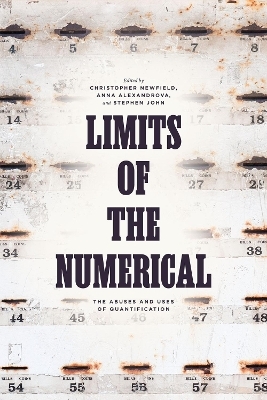
Limits of the Numerical
University of Chicago Press (Verlag)
978-0-226-81715-6 (ISBN)
Numbers are both controlling and fragile. They drive public policy, figuring into everything from college rankings to vaccine efficacy rates. At the same time, they are frequent objects of obfuscation, manipulation, or outright denial. This timely collection by a diverse group of humanists and social scientists challenges undue reverence or skepticism toward quantification and offers new ideas about how to harmonize quantitative with qualitative forms of knowledge.
Limits of the Numerical focuses on quantification in several contexts: climate change; university teaching and research; and health, medicine, and well-being more broadly. This volume shows the many ways that qualitative and quantitative approaches can productively interact—how the limits of the numerical can be overcome through equitable partnerships with historical, institutional, and philosophical analysis. The authors show that we can use numbers to hold the powerful to account, but only when those numbers are themselves democratically accountable.
Christopher Newfield is director of research at the Independent Social Research Foundation, London. Anna Alexandrova is professor of philosophy of science in the Department of History and Philosophy of Science at the University of Cambridge, where she is also a fellow of King’s College. Stephen John is the Hatton Lecturer in the Philosophy of Public Health in the Department of History and Philosophy of Science at the University of Cambridge, where he is also a fellow of Pembroke College.
List of Figures, Tables, and Box
Introduction: The Changing Fates of the Numerical
Christopher Newfield, Anna Alexandrova, and Stephen John
Part I
Expert Sources of the Revolt against Experts
1. Numbers without Experts: The Populist Politics of Quantification
Elizabeth Chatterjee
2. The Role of the Numerical in the Decline of Expertise
Christopher Newfield
Part II
Can Narrative Fix Numbers?
3. Audit Narratives: Making Higher Education Manageable in Learning Assessment Discourse
Heather Steffen
4. The Limits of “The Limits of the Numerical”: Rare Diseases and the Seductions of Qualification
Trenholme Junghans
5. Reading Numbers: Literature, Case Histories, and Quantitative Analysis
Laura Mandell
Part III
When Bad Numbers Have Good Social Effects
6. Why Five Fruit and Veg a Day? Communicating, Deceiving, and Manipulating with Numbers
Stephen John
7. Are Numbers Really as Bad as They Seem? A Political-Philosophy Perspective
Gabriele Badano
Part IV
The Uses of the Numerical for Qualitative Ends
8. When Well-Being Becomes a Number
Anna Alexandrova and Ramandeep Singh
9. Aligning Social Goals and Scientific Numbers: An Ethical-Epistemic Analysis of Extreme Weather Attribution
Greg Lusk
10. The Purposes and Provisioning of Higher Education: Can Economics and Humanities Perspectives Be Reconciled?
Aashish Mehta and Christopher Newfield
Acknowledgments
References
Contributors
Index
| Erscheinungsdatum | 30.05.2022 |
|---|---|
| Zusatzinfo | 2 halftones, 5 tables |
| Sprache | englisch |
| Maße | 152 x 229 mm |
| Gewicht | 399 g |
| Themenwelt | Mathematik / Informatik ► Mathematik |
| Sozialwissenschaften | |
| ISBN-10 | 0-226-81715-6 / 0226817156 |
| ISBN-13 | 978-0-226-81715-6 / 9780226817156 |
| Zustand | Neuware |
| Informationen gemäß Produktsicherheitsverordnung (GPSR) | |
| Haben Sie eine Frage zum Produkt? |
aus dem Bereich