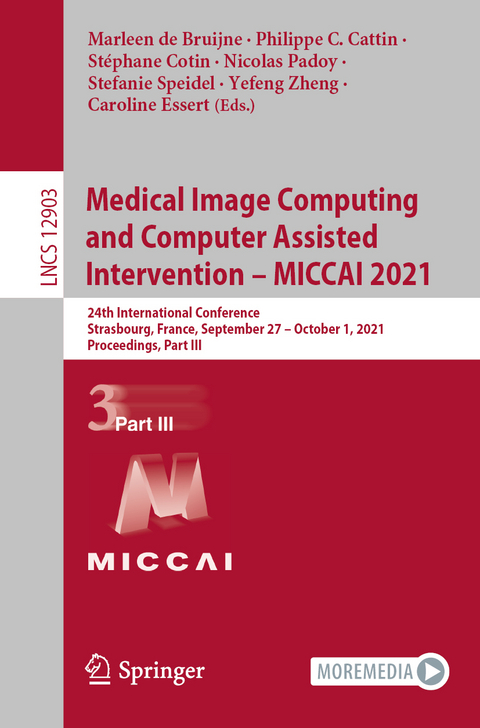
Medical Image Computing and Computer Assisted Intervention – MICCAI 2021
Springer International Publishing (Verlag)
978-3-030-87198-7 (ISBN)
The 531 revised full papers presented were carefully reviewed and selected from 1630 submissions in a double-blind review process. The papers are organized in the following topical sections:
Part I: image segmentation
Part II: machine learning - self-supervised learning; machine learning - semi-supervised learning; and machine learning - weakly supervised learning
Part III: machine learning - advances in machine learning theory; machine learning - attention models; machine learning - domain adaptation; machine learning - federated learning; machine learning - interpretability / explainability; and machine learning - uncertainty
Part IV: image registration; image-guided interventions and surgery; surgical data science; surgical planning and simulation; surgical skill and work flow analysis; and surgical visualization and mixed, augmented and virtual reality
Part V: computer aided diagnosis; integration of imaging with non-imaging biomarkers; and outcome/disease prediction
Part VI: image reconstruction; clinical applications - cardiac; and clinical applications - vascular
Part VII: clinical applications - abdomen; clinical applications - breast; clinical applications - dermatology; clinical applications - fetal imaging; clinical applications - lung; clinical applications - neuroimaging - brain development; clinical applications - neuroimaging - DWI and tractography; clinical applications - neuroimaging - functional brain networks; clinical applications - neuroimaging - others; and clinical applications - oncology
Part VIII: clinical applications - ophthalmology; computational (integrative) pathology; modalities - microscopy; modalities - histopathology; and modalities - ultrasound
*The conference was held virtually.
Machine Learning - Advances in Machine Learning Theory.- Towards Robust General Medical Image Segmentation.- Joint Motion Correction and Super Resolution for Cardiac Segmentation via Latent Optimisation.- Targeted Gradient Descent: A Novel Method for Convolutional Neural Networks Fine-tuning and Online-learning.- A Hierarchical Feature Constraint to CamouflageMedical Adversarial Attacks.- Group Shift Pointwise Convolution for Volumetric Medical Image Segmentation.- Machine Learning - Attention models.- UTNet: A Hybrid Transformer Architecture for Medical Image Segmentation.- AlignTransformer: Hierarchical Alignment of Visual Regions and Disease Tags for Medical Report Generation.- Continuous-Time Deep Glioma Growth Models.- Spine-Transformers: Vertebra Detection and Localization in Arbitrary Field-of-View Spine CT with Transformers.- Multi-view analysis of unregistered medical images using cross-view transformers.- Machine Learning - Domain Adaptation.- Stain Mix-up: Unsupervised Domain Generalization for Histopathology Images.- A Unified Hyper-GAN Model for Unpaired Multi-contrast MR Image Translation.- Generative Self-training for Cross-domain Unsupervised Tagged-to-Cine MRI Synthesis.- Cooperative Training and Latent Space Data Augmentation for Robust Medical Image Segmentation.- Controllable cardiac synthesis via disentangled anatomy arithmetic.- CoTr: Efficiently Bridging CNN and Transformer for 3D Medical Image Segmentation.- Harmonization with Flow-based Causal Inference.- Uncertainty-Aware Label Rectification for Domain Adaptive Mitochondria Segmentation.- Semantic Consistent Unsupervised Domain Adaptation for Cross-modality Medical Image Segmentation.- Anatomy of Domain Shift Impact on U-Net Layers in MRI Segmentation.- FoldIt: Haustral Folds Detection and Segmentation in Colonoscopy Videos.- Reference-Relation Guided Autoencoder with Deep CCA Restriction for Awake-to-Sleep Brain Functional Connectome Prediction.- Domain Composition and Attention for Unseen-Domain Generalizable Medical Image Segmentation.- Fully Test-time Adaptation for Image Segmentation.- OLVA: Optimal Latent Vector Alignment for Unsupervised Domain Adaptation in Medical Image Segmentation.- Prototypical Interaction Graph for Unsupervised Domain Adaptation in Surgical Instrument Segmentation.- Unsupervised Domain Adaptation for Small Bowel Segmentation using Disentangled Representation.- Data-driven mapping between functional connectomes using optimal transport.- EndoUDA: A modality independent segmentation approach for endoscopy imaging.- Style Transfer Using Generative Adversarial Networks for Multi-Site MRI Harmonization.- Machine Learning - Federated Learning.- Federated Semi-supervised Medical Image Classification via Inter-client Relation Matching.- FedPerl: Semi-Supervised Peer Learning for Skin Lesion Classification.- Personalized Retrogress-Resilient Framework for Real-World Medical Federated Learning.- Federated Whole Prostate Segmentation in MRI with Personalized Neural Architectures.- Federated Contrastive Learning for Volumetric Medical Image Segmentation.- Federated Contrastive Learning for Decentralized Unlabeled Medical Images.- Machine Learning - Interpretability / Explainability.- Explaining COVID-19 and Thoracic Pathology Model Predictions by Identifying Informative Input Features.- Demystifying T1-MRI to FDG18-PET Image Translation via Representational Similarity.- Fairness in Cardiac MR Image Analysis: An Investigation of Bias Due to Data Imbalance in Deep Learning Based Segmentation.- An Interpretable Approach to Automated Severity Scoring in Pelvic Trauma.- Scalable, Axiomatic Explanations of Deep Alzheimer's Diagnosis from Heterogeneous Data.- SPARTA: An Integrated Stability, Discriminability, and Sparsity based Radiomic Feature Selection Approach.- The Power of Proxy Data and Proxy Networks for Hyper-Parameter Optimization for Medical Image Segmentation.- Fighting Class Imbalance with ContrastiveL
| Erscheinungsdatum | 25.09.2021 |
|---|---|
| Reihe/Serie | Image Processing, Computer Vision, Pattern Recognition, and Graphics | Lecture Notes in Computer Science |
| Zusatzinfo | XXXVI, 648 p. 200 illus., 185 illus. in color. |
| Verlagsort | Cham |
| Sprache | englisch |
| Maße | 155 x 235 mm |
| Gewicht | 1032 g |
| Themenwelt | Informatik ► Grafik / Design ► Digitale Bildverarbeitung |
| Informatik ► Theorie / Studium ► Künstliche Intelligenz / Robotik | |
| Schlagworte | Applications • Artificial Intelligence • Bioinformatics • color image processing • Computer Aided Diagnosis • computer assisted interventions • Computer Science • computer vision • conference proceedings • Deep learning • Image Analysis • Image Processing • Image Quality • image reconstruction • Image Segmentation • Informatics • machine learning • Medical Image Analysis • Medical Images • Neural networks • Object recognition • pattern recognition • Research |
| ISBN-10 | 3-030-87198-3 / 3030871983 |
| ISBN-13 | 978-3-030-87198-7 / 9783030871987 |
| Zustand | Neuware |
| Informationen gemäß Produktsicherheitsverordnung (GPSR) | |
| Haben Sie eine Frage zum Produkt? |
aus dem Bereich