


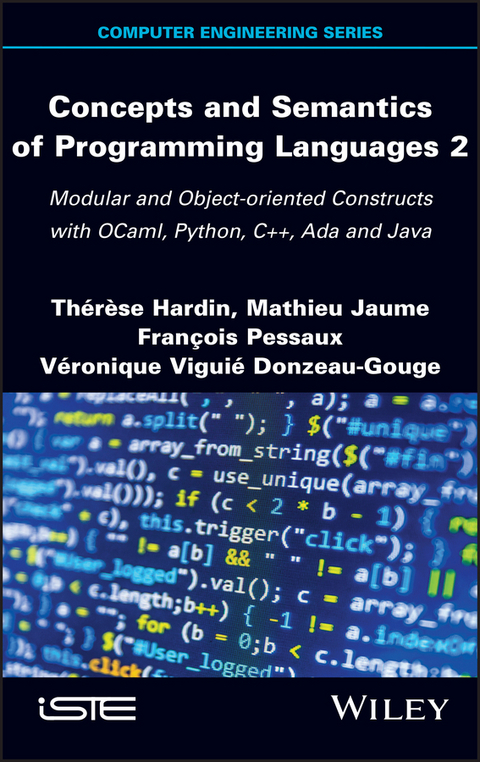
Concepts and Semantics of Programming Languages 2 (eBook)
272 Seiten
John Wiley & Sons (Verlag)
978-1-119-85118-9 (ISBN)
Concepts and Semantics of Programming Languages 2 presents an original semantic model, collectively taking into account all of the constructs and operations of modules and classes: visibility, import, export, delayed definitions, parameterization by types and values, extensions, etc. The model serves for the study of Ada and OCaml modules, as well as C header files. It can be deployed to model object and class features, and is thus used to describe Java, C++, OCaml and Python classes.
This book is intended not only for computer science students and teachers but also seasoned programmers, who will find a guide to reading reference manuals and the foundations of program verification.
Therese Hardin is Professor Emeritus at the Laboratoire d'Informatique de Paris 6 (LIP6), Sorbonne University, France. Mathieu Jaume is a lecturer at the Laboratoire d'Informatique de Paris 6 (LIP6), Sorbonne University, France. François Pessaux is Associate Professor in the Computer Science and Systems Engineering Unit (U2IS) of ENSTA Paris, France. Veronique Viguie Donzeau-Gouge is Professor Emeritus at the Centre d'études et de recherche en informatique (CEDRIC) of the Conservatoire national des arts et métiers (Cnam Paris), France.
Foreword ix
Preface xi
Chapter 1. Namespaces: Model and Operations 1
1.1. Reusing, dividing, confining 2
1.1.1. Analysis of some developer needs 2
1.1.2. Meeting developer needs 3
1.2. Namespaces 5
1.2.1. Namespaces definition 6
1.2.2. Extending notions of environment and binding 8
1.3. kit development 12
1.3.1. Namespace of a kit 14
1.3.2. Order of fields introduction 15
1.3.3. Typing kits 15
1.3.4. kit values 18
1.3.5. kit export, confining fields 22
1.3.6. kits import 28
1.3.7. Stages of kit development 32
1.4. Incomplete kits 33
1.4.1. Type and value of an incomplete kit 34
1.4.2. Completion of an incomplete kit 34
1.4.3. Confining an incomplete kit 36
1.5. Parameterized kits 36
1.5.1. kits parameterized by a type 36
1.5.2. kits parameterized by types and values 41
1.5.3. Confinement, parametrization, incomplete kits and export 45
1.6. Functors of kits 46
1.7. kit extension 49
1.7.1. Presentation of extension 49
1.7.2. Confinement and extension 55
1.8. Conclusion 59
Chapter 2. Modules 61
2.1. Modules in Ada 62
2.1.1. Developing modules 62
2.1.2. Export and confinement 65
2.1.3. Nesting modules 66
2.1.4. Importing a module 66
2.1.5. Flattening an import 67
2.1.6. Generic modules 68
2.1.7. Modules and separate compilation 71
2.2. Modules in OCaml 71
2.2.1. Module definition 72
2.2.2. Export and confinement 73
2.2.3. Confinement of type definitions 78
2.2.4. Functors 82
2.3. Modularity, namespaces and W-kit 85
2.3.1. Declaration interfaces 85
2.3.2. W-kits 86
2.3.3. Modularity and header files in C 86
Chapter 3. Class and Object Features 93
3.1. Object-oriented features 93
3.1.1. Objects 94
3.1.2. Classes 95
3.2. kits and object features 104
3.2.1. Modeling classes 104
3.2.2. Modeling objects 107
3.2.3. Inheritance, redefinition and late binding 109
3.2.4. Incomplete C-kits, parameterized C-kits 113
3.2.5. Subclassing, subtyping 115
3.2.6. Type languages, classes and objects 119
Chapter 4. Classes in Selected Languages 123
4.1. Classes in Java 123
4.1.1. General presentation 123
4.1.2. Modules and packages 124
4.1.3. Classes 125
4.1.4. Marks 131
4.1.5. Developing classes 134
4.2. Classes in C++ 144
4.2.1. Header files, namespaces, confinement 145
4.2.2. Classes 148
4.2.3. Inheritance and confinement 155
4.2.4. Overloading in C++ 165
4.2.5. Parameterized classes 168
4.3. Classes in OCaml 174
4.3.1. Presentation 174
4.3.2. An overview of classes 174
4.3.3. Marks, incomplete classes, parametrization 181
4.3.4. Objects 186
4.3.5. Class signatures: confinement and inheritance 192
4.3.6. Multiple inheritance 195
4.3.7. Other features 197
4.4. Presentation of Python 197
4.4.1. Getting started 198
4.4.2. An overview of classes, modules and types 199
4.4.3. Names and assignment 208
4.4.4. Assignment and typechecking 211
4.4.5. Overloading 213
4.4.6. Modules and packages 217
4.4.7. Confinement 218
4.4.8. Inheritance 219
4.4.9. Incomplete C-kits and abstract classes 221
4.4.10. Other features 222
Appendix: Questions to Guide Learning 225
List of Notations 229
References 231
Index 233
| Erscheint lt. Verlag | 6.8.2021 |
|---|---|
| Sprache | englisch |
| Themenwelt | Mathematik / Informatik ► Informatik ► Programmiersprachen / -werkzeuge |
| Schlagworte | Computer Science • Informatik • Programmiersprache • Programmierung u. Software-Entwicklung • Programming & Software Development • Semantik |
| ISBN-10 | 1-119-85118-1 / 1119851181 |
| ISBN-13 | 978-1-119-85118-9 / 9781119851189 |
| Informationen gemäß Produktsicherheitsverordnung (GPSR) | |
| Haben Sie eine Frage zum Produkt? |
 EPUB (Adobe DRM)
Kopierschutz: Adobe-DRM
Adobe-DRM ist ein Kopierschutz, der das eBook vor Mißbrauch schützen soll. Dabei wird das eBook bereits beim Download auf Ihre persönliche Adobe-ID autorisiert. Lesen können Sie das eBook dann nur auf den Geräten, welche ebenfalls auf Ihre Adobe-ID registriert sind.
Details zum Adobe-DRM
Dateiformat: EPUB (Electronic Publication)
EPUB ist ein offener Standard für eBooks und eignet sich besonders zur Darstellung von Belletristik und Sachbüchern. Der Fließtext wird dynamisch an die Display- und Schriftgröße angepasst. Auch für mobile Lesegeräte ist EPUB daher gut geeignet.
Systemvoraussetzungen:
PC/Mac: Mit einem PC oder Mac können Sie dieses eBook lesen. Sie benötigen eine
eReader: Dieses eBook kann mit (fast) allen eBook-Readern gelesen werden. Mit dem amazon-Kindle ist es aber nicht kompatibel.
Smartphone/Tablet: Egal ob Apple oder Android, dieses eBook können Sie lesen. Sie benötigen eine
Geräteliste und zusätzliche Hinweise
Buying eBooks from abroad
For tax law reasons we can sell eBooks just within Germany and Switzerland. Regrettably we cannot fulfill eBook-orders from other countries.
aus dem Bereich


