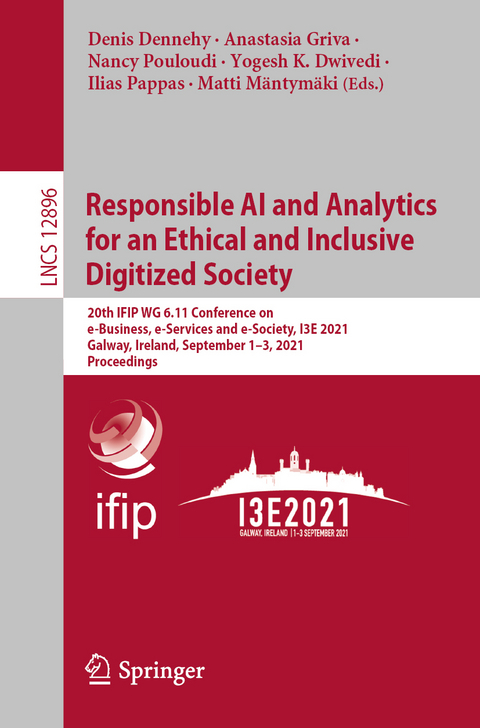
Responsible AI and Analytics for an Ethical and Inclusive Digitized Society
Springer International Publishing (Verlag)
978-3-030-85446-1 (ISBN)
This volume constitutes the proceedings of the 20th IFIP WG 6.11 Conference on e-Business, e-Services, and e-Society, I3E 2021, held in Galway, Ireland, in September 2021.*
The total of 57 full and 8 short papers presented in these volumes were carefully reviewed and selected from 141 submissions. The papers are organized in the following topical sections: AI for Digital Transformation and Public Good; AI & Analytics Decision Making; AI Philosophy, Ethics & Governance; Privacy & Transparency in a Digitized Society; Digital Enabled Sustainable Organizations and Societies; Digital Technologies and Organizational Capabilities; Digitized Supply Chains; Customer Behavior and E-business; Blockchain; Information Systems Development; Social Media & Analytics; and Teaching & Learning.
*The conference was held virtually due to the COVID-19 pandemic.
Part I: Adopting AI for Digital Transformation & Public Good.- Affordances in Human-chatbot Interaction: A Review of the Literature.- AI in the Workplace: Exploring Emotions on Chatbot Use in IT services.- Chatbots at Work: A Taxonomy of Chatbots in Organisations.- A Process Model of Artificial Intelligence Implementation Leading to Proper Decision Making.- AI: Opportunities and Challenges - The Optimal Exploitation of (Telecom) Corporate Data.- Electronic Procurement Practices in the Public Sector: The Case of an Inter-organizational Information System in Ghana.- Adopting Artificial Intelligence in the Saudi Arabian Public Sector: Preliminary Findings.- Achieving Digital-driven Patient Agility in the Era of Big Data.- Responsible Machine Learning Pilot Test Projects: A Medical Coding Case Study.- Part II. AI & Analytics Decision Making.- Wise Data-Driven Decision-Making.- Data-driven Collaborative Human-AI Decision Making.- Always Trust the Advice of AIin Difficulties? Perceptions Around AI in Decision Making.- Big Data Analytics Affordances for Social innovation: a Theoretical Framework.- COVID-19 Discrepancies Rising from Population Density in the USA.- Part III. AI Philosophy, Ethics & Governance.- Ethics and AI Issues: Old Container with New Wine?.- Governing Artificial Intelligence and Algorithmic Decision Making: Human Rights and Beyond.- Analysing AI via Husserl & Kuhn: How a Phenomenological Approach to Artificial Intelligence Imposes a Paradigm Shift.- The Ethical Implications of Lawtech.- Deploying AI Governance Practices: A Revelatory case Study.- Towards Ecosystems for Responsible AI: Expectations on Sociotechnical Systems, Agendas and Networks in EU Documents.- Software Developmental and Philosophical Perspective.- Part IV. Privacy & Transparency in a Digitised Society.- Stop Ordering Machine Learning Algorithms by their Explainability! An Empirical Investigation of the Tradeoff between Performance and Explainability.- Gender Bias in AI: Implications for Managerial Practices.- A Systematic Review of Fairness in Artificial Intelligence Algorithms.- Is Downloading this App Consistent with my Values? Conceptualizing a Value-Centered Privacy Assistant.- Operationalizing a Glass Box Approach by Means of Visualization: Applied to a GA-profiling Application.- Part V. Digital Enabled Sustainable Organisations and Societies.- Artificial Intelligence and the Evolution of Managerial Skills: An Exploratory Study.- The Diffusion of Innovation Experience: Leveraging the Human Factor to Improve Technological Adoption Within an Organisation.- Exploring the Link Between Digitalization and Sustainable Development: Research Agendas.- Research Trends, Theories and Concepts on the Utilization of Digital Platforms in Agriculture: A Scoping Review.- The Impact of Industry 4.0 on the Business Models of Small and Medium Enterprises: A Systematic Literature Review.- VI. Digital Technologiesand Organisational Capabilities.- To Study BIM as Boundary Objects from the Knowledge-As-Practice Perspective in the Construction Project - A Conceptual Framework.- Understanding How Enterprise Architecture Contributes to Organizational Alignment.- How Dynamic Capabilities Enable Agility: The Mediating Role of Digital Project Benefits.- ICT-based Inter-organisational Knowledge Exchange: A Narrative Literature Review Approach.- Industry 4.0 and Organisations: Key Organisational Capabilities.- Part VII. Digitised Supply Chains.- How Does IOS-enabled Business Intelligence Enhance Supply Chain Performance?.- A Review of AI in the Supply Chain Industry: Preliminary Findings.- A Dynamic Capability Lens to Investigate Big Data Analytics and Supply Chain Agility: Antecedents and Outcomes.- The Effect of Data-driven Culture on Customer Development and Firm Performance: The Role of Supply Chain Information Sharing and Supply Chain Information quality.- Part VIII. Customer Behaviorand E-business.- T
| Erscheinungsdatum | 18.08.2021 |
|---|---|
| Reihe/Serie | Information Systems and Applications, incl. Internet/Web, and HCI | Lecture Notes in Computer Science |
| Zusatzinfo | XXI, 788 p. 129 illus., 70 illus. in color. |
| Verlagsort | Cham |
| Sprache | englisch |
| Maße | 155 x 235 mm |
| Gewicht | 1205 g |
| Themenwelt | Mathematik / Informatik ► Informatik |
| Wirtschaft ► Allgemeines / Lexika | |
| Wirtschaft ► Betriebswirtschaft / Management ► Marketing / Vertrieb | |
| Schlagworte | Applications • Artificial Intelligence • Cloud Computing • Computer Hardware • Computer Networks • Computer Science • Computer systems • conference proceedings • Data Security • e-government • Electronic Commerce • Human-Computer Interaction (HCI) • Informatics • information systems • Information Technology • mobile computing • Mobile Devices • Network Protocols • Research • Signal Processing • Social Networks • Telecommunication networks • ubiquitous computing • User Interfaces |
| ISBN-10 | 3-030-85446-9 / 3030854469 |
| ISBN-13 | 978-3-030-85446-1 / 9783030854461 |
| Zustand | Neuware |
| Informationen gemäß Produktsicherheitsverordnung (GPSR) | |
| Haben Sie eine Frage zum Produkt? |
aus dem Bereich