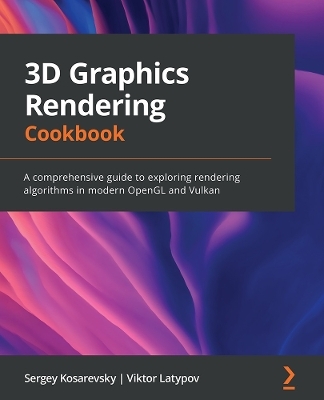
3D Graphics Rendering Cookbook
Packt Publishing Limited (Verlag)
978-1-83898-619-3 (ISBN)
Key Features
Learn to integrate modern rendering techniques into a single performant 3D rendering engine
Leverage Vulkan to render 3D content, use AZDO in OpenGL applications, and understand modern real-time rendering methods
Implement a physically based rendering pipeline from scratch in Vulkan and OpenGL
Book DescriptionOpenGL is a popular cross-language, cross-platform application programming interface (API) used for rendering 2D and 3D graphics, while Vulkan is a low-overhead, cross-platform 3D graphics API that targets high-performance applications. 3D Graphics Rendering Cookbook helps you learn about modern graphics rendering algorithms and techniques using C++ programming along with OpenGL and Vulkan APIs.
The book begins by setting up a development environment and takes you through the steps involved in building a 3D rendering engine with the help of basic, yet self-contained, recipes. Each recipe will enable you to incrementally add features to your codebase and show you how to integrate different 3D rendering techniques and algorithms into one large project. You'll also get to grips with core techniques such as physically based rendering, image-based rendering, and CPU/GPU geometry culling, to name a few. As you advance, you'll explore common techniques and solutions that will help you to work with large datasets for 2D and 3D rendering. Finally, you'll discover how to apply optimization techniques to build performant and feature-rich graphics applications.
By the end of this 3D rendering book, you'll have gained an improved understanding of best practices used in modern graphics APIs and be able to create fast and versatile 3D rendering frameworks.What you will learn
Improve the performance of legacy OpenGL applications
Manage a substantial amount of content in real-time 3D rendering engines
Discover how to debug and profile graphics applications
Understand how to use the Approaching Zero Driver Overhead (AZDO) philosophy in OpenGL
Integrate various rendering techniques into a single application
Find out how to develop Vulkan applications
Implement a physically based rendering pipeline from scratch
Integrate a physics library with your rendering engine
Who this book is forThis book is for 3D graphics developers who are familiar with the mathematical fundamentals of 3D rendering and want to gain expertise in writing fast rendering engines with advanced techniques using C++ libraries and APIs. A solid understanding of C++ and basic linear algebra, as well as experience in creating custom 3D applications without using premade rendering engines is required.
Sergey Kosarevsky is a rendering lead at Ubisoft RedLynx. He worked in the mobile industry at SPB Software, Yandex, Layar and Blippar, TWNKLS, and DAQRI, where he designed and implemented real-time rendering technology. He has more than 18 years of software development experience and more than 10 years of mobile and embedded 3D graphics experience. In his Ph.D. thesis, Sergey employed computer vision to solve mechanical engineering problems. He has co-authored several books on mobile software development in C++ Viktor Latypov is a software engineer and mathematician with experience in compiler development, device drivers, robotics, and high-performance computing and with a personal interest in 3D graphics and mobile technology. Surrounded by computers for more than 20 years, he enjoys every bit of developing and designing software for anything with a CPU inside. Viktor holds a PhD in applied mathematics from Saint-Petersburg State University.
Table of Contents
Establishing a Build Environment
Using Essential Libraries
Getting Started with OpenGL and Vulkan
Adding User Interaction and Productivity Tools
Working with Geometry Data
Physically Based Rendering Using the glTF2 Shading Model
Graphics Rendering Pipeline
Image-based Techniques
Working with Scene Graphs
Advanced Rendering Techniques and Optimizations
| Erscheinungsdatum | 26.08.2021 |
|---|---|
| Verlagsort | Birmingham |
| Sprache | englisch |
| Maße | 191 x 235 mm |
| Themenwelt | Mathematik / Informatik ► Informatik ► Grafik / Design |
| ISBN-10 | 1-83898-619-7 / 1838986197 |
| ISBN-13 | 978-1-83898-619-3 / 9781838986193 |
| Zustand | Neuware |
| Informationen gemäß Produktsicherheitsverordnung (GPSR) | |
| Haben Sie eine Frage zum Produkt? |
aus dem Bereich