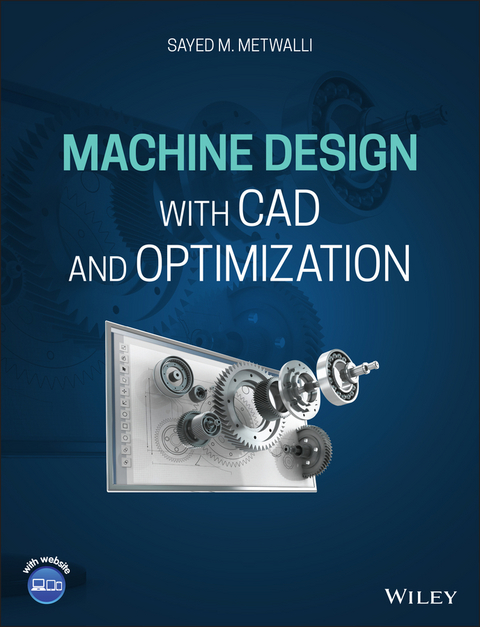
A guide to the new CAD and optimization tools and skills to generate real design synthesis of machine elements and systems
Machine Design with CAD and Optimization offers the basic tools to design or synthesize machine elements and assembly of prospective elements in systems or products. It contains the necessary knowledge base, computer aided design, and optimization tools to define appropriate geometry and material selection of machine elements. A comprehensive text for each element includes: a chart, excel sheet, a MATLAB® program, or an interactive program to calculate the element geometry to guide in the selection of the appropriate material.
The book contains an introduction to machine design and includes several design factors for consideration. It also offers information on the traditional rigorous design of machine elements. In addition, the author reviews the real design synthesis approach and offers material about stresses and material failure due to applied loading during intended performance. This comprehensive resource also contains an introduction to computer aided design and optimization. This important book:
- Provides the tools to perform a new direct design synthesis rather than design by a process of repeated analysis
- Contains a guide to knowledge-based design using CAD tools, software, and optimum component design for the new direct design synthesis of machine elements
- Allows for the initial suitable design synthesis in a very short time
- Delivers information on the utility of CAD and Optimization
- Accompanied by an online companion site including presentation files
Written for students of engineering design, mechanical engineering, and automotive design. Machine Design with CAD and Optimization contains the new CAD and Optimization tools and defines the skills needed to generate real design synthesis of machine elements and systems on solid ground for better products and systems.
SAYED M. METWALLI, is Professor Emeritus of Machine Design and past Chair of Mechanical Design and Production Department, Cairo University, Egypt. He received a BS (Mech. Eng.) with honor from Cairo University (1965) and MS and PhD (Mech. Eng.) from State University of New York at Buffalo, USA, (1970) and (1973) respectively. Metwalli has conducted research and taught at North Carolina State University, the University of Central Florida, USA, and Kuwait University, and holds a US patent. His research interests are in design optimization theory, developing algorithms, and CAD/CAM software, with particular emphasis on optimum synthesis of mechanical components and systems including dynamics and controls for multitude of applications. He has conducted sponsored research with DOD/NRL, UNESCO, IBM-UK, NSF, EPA, USAID, and CU and has published more than 150 papers in journals and peer reviewed international conferences. His work with various manufacturers successfully implemented CAD and design optimization in their product design and development. He is an ASME Life Fellow, registered mechanical design consultant, and has been a registered PE in Florida.
MACHINE DESIGN WITH CAD AND OPTIMIZATION A guide to the new CAD and optimization tools and skills to generate real design synthesis of machine elements and systemsMachine Design with CAD and Optimization offers the basic tools to design or synthesize machine elements and assembly of prospective elements in systems or products. It contains the necessary knowledge base, computer aided design, and optimization tools to define appropriate geometry and material selection of machine elements. A comprehensive text for each element includes: a chart, excel sheet, a MATLAB program, or an interactive program to calculate the element geometry to guide in the selection of the appropriate material.The book contains an introduction to machine design and includes several design factors for consideration. It also offers information on the traditional rigorous design of machine elements. In addition, the author reviews the real design synthesis approach and offers material about stresses and material failure due to applied loading during intended performance. This comprehensive resource also contains an introduction to computer aided design and optimization. This important book:Provides the tools to perform a new direct design synthesis rather than design by a process of repeated analysisContains a guide to knowledge-based design using CAD tools, software, and optimum component design for the new direct design synthesis of machine elementsAllows for the initial suitable design synthesis in a very short timeDelivers information on the utility of CAD and OptimizationAccompanied by an online companion site including presentation filesWritten for students of engineering design, mechanical engineering, and automotive design. Machine Design with CAD and Optimization contains the new CAD and Optimization tools and defines the skills needed to generate real design synthesis of machine elements and systems on solid ground for better products and systems.
SAYED M. METWALLI, is Professor Emeritus of Machine Design and past Chair of Mechanical Design and Production Department, Cairo University, Egypt. He received a BS (Mech. Eng.) with honor from Cairo University (1965) and MS and PhD (Mech. Eng.) from State University of New York at Buffalo, USA, (1970) and (1973) respectively. Metwalli has conducted research and taught at North Carolina State University, the University of Central Florida, USA, and Kuwait University, and holds a US patent. His research interests are in design optimization theory, developing algorithms, and CAD/CAM software, with particular emphasis on optimum synthesis of mechanical components and systems including dynamics and controls for multitude of applications. He has conducted sponsored research with DOD/NRL, UNESCO, IBM-UK, NSF, EPA, USAID, and CU and has published more than 150 papers in journals and peer reviewed international conferences. His work with various manufacturers successfully implemented CAD and design optimization in their product design and development. He is an ASME Life Fellow, registered mechanical design consultant, and has been a registered PE in Florida.
Preface
This book intends to provide the tools to “really design” or “synthesize” machine elements and assembly of prospective machine elements in systems or products. It employs knowledge base, computer-aided design (CAD), and optimization tools to directly define appropriate geometry and material selection of machine elements. The treatment is set in both US and international (SI) units.
For each machine element, there is a chart, a simple Excel sheet or a Tablet, a MATLAB program, or an interactive program to calculate the element geometry and to help in selecting suitable material.
The book is divided into three main parts:
- Introduction and Design Considerations.
- Knowledge-Based Design: Introduction to the new machine element synthesis for a real design intent, which includes bases for computer-aided techniques. Overviews are dedicated for CAD and optimization fields. Bases for stresses, deformations, and deflections in addition to materials static and dynamic strength are given as cornerstones to synthesis of machine elements. These knowledge-based tools are utilized in the initial synthesis of machine elements and system.
- Detailed Design of Machine Elements: Rigorous traditional detailed design requirements are given for basic joints and machine elements such as screws fasteners and permanent joins, springs, rolling bearings, and journal bearings. This part of the text also covers power transmission elements such as spur gears; helical, bevel, and worm gears; flexible elements; shafts; and clutches, breaks, and flywheel.
These parts include the following outline of chapters and enlightening pivotal details:
- The first part covers a basic introduction to machine design and presents several design factors to consider. It introduces an overview of the design process and the necessary background knowledge and information that is needed to make sound judgments in decision making.
The introduction discusses the main goal of the text and argues that it is intended to generate or create designs directly through synthesis rather than designs by repeated analysis. This process is implemented in designing machine elements. For system or product design, conceptual considerations and innovations are cited to generate better products or systems that include assembly of some of those machine elements. It necessitates exposure to the necessary phases of design, basic mechanical functions, codes and standards, design factors, and proper design approach to end up with a sound design assembly. It is also important to realize that for any product there is a product life cycle. The design should consider important business measures, economics of scale, technology adoption, and the research and development process in the product cycle. Teamwork for complex product or large system design is indispensable to get the job done in an effective way and on schedule. Design and development case studies are used to demonstrate the concepts covered in this introduction.
The designer will need to use mathematical modeling tools. Appropriate calculation resources must be at hand to accomplish a good design. Manufacturing means and needed tolerance limits and surface quality must be matched to effectively produce the intended design and guarantee its performance. The designer should be aware of available standards, sets of original equipment manufacturer (OEM), and standard components to effectively use them in the total construction of the design. The design procedure should also account for possible uses of reverse engineering tools as exemplar knowledge so as not to reinvent the wheel particularly for starters or design modifications of products or systems. The designer should also be aware of units, codes, and standards particularly if the design is intended for a foreign client or a certain field with specific operating codes to abide by.
- In the knowledge-based design part of the text, certain introduction to CAD and optimization is presented. It is necessary to have a thorough overview of these indispensable fields since they are utilized throughout the book and for being common practice to design engineers nowadays. A thorough understanding of the subject and techniques provides a solid foundation to use the tools efficiently and without ambiguity or pitfalls.
The ability of using CAD software is very essential to completing the design process of products or systems. It increases the usage proficiency, allows the assembly of elements in 3D, avoiding interference of geometry, and allows the utility of exporting elements for finite element (FE) analysis, 3D printing, and CNC code generation. CAD is used effectively in photo realistic design viewing and presentation. The applications of virtual reality render even more help in that regard particularly if more complex geometry variations exist. A demonstration to this effect is also presented.
Optimization understanding is an important factor in the last stage of redesign. It allows the best design to be implemented rather than the last iteration without a specific objective. The application of optimization tools provides a strong performance of the iteration process without reaching unrealistic solutions. The proper use of optimization successfully allows the optimum design of numerous machine elements for some specific objective or multiple objectives. These optimum elements are offered as a better datum, initial design synthesis, and further reference to other objectives.
Detailed coverage in those fields with sufficient mathematical treatments is provided in the defined chapters. Please refer to the table of contents for characterization of these details.
- The real design synthesis approach is introduced in the Knowledge-Based Design part of the book. The necessary knowledge in design foundation is presented. Knowledge about induced stresses and material failure due to applied loading during intended performance is of a paramount importance. This knowledge is used to synthesize the element geometry and select its material. These are the necessary characteristics of element design synthesis.
Stress, deformation, and deflection knowledge are essential for full understanding of machine element withstanding of real loading conditions and defining geometry to do that. Different means of loading calculations and estimations are introduced including random load variations to appropriately find representative internal shear and moments inside elements. Stress and deflection considerations are then accounted for and properly evaluated. Simple and combined stresses are considered in evaluating the right state of stress in the element. Simple straight members representing elements or more complex curved members are considered to evaluate stresses and deflections in some machine elements. Strain energy means are also used to find deflections in more complex elements. Some special loading considerations are covered in elements such as columns, variable section members, and thermal effects due to temperature variations. Stress concentration ensued by existing holes, notches, fillets, shoulders, and grooves must be considered in effectively evaluating the rise of internal stresses inside the machine elements. The ability of using FE programs is then very essential in evaluating internal stresses and different deformations due to complex geometry variations and complex loading conditions. Effective coverage of the finite element technique guarantees the suitable evaluation of machine element responses to loading conditions. A demonstration to this effect is also provided. The finite element process can be used effectively after defining both the geometry and the material that are explained in the subsequent chapters for different machine elements.
Knowledge of material properties facilitates the appropriate selection of the material, which is a significant characteristic of element design synthesis. Materials are defined by specific designation depending on established standards. Knowledge of designation allows the identification of material properties that are presented including structure and failure modes. A large scope of material variations is provided to allow the consideration of a wide variety of applications. Special groups of materials that are more suitable for specific machine elements are predetermined in categories. With this knowledge, the selection of the material for that element is then focused and narrowed down to a few possible choices. Hardness and strength relations provide support to an even narrower selection of the material. Distinction between static and fatigue failure theories allows the distinct definition of the course of action to home in more on the most suitable material to be used. If the case requires contemplation for toughness due to inevitable notch existence, a fracture mechanics approach is provided to account for appropriate safety. Cases of safety consideration and strength variations are examined for failure prevention.
With the knowledge of generated stress and the material selection process, the initial design synthesis approach of major machine elements is introduced. The intended initial design encompasses the definition of geometry and the appropriate material of the machine element. CAD and optimization means are employed with this focused knowledge to directly generate tools...
| Erscheint lt. Verlag | 22.4.2021 |
|---|---|
| Sprache | englisch |
| Themenwelt | Informatik ► Weitere Themen ► CAD-Programme |
| Technik ► Maschinenbau | |
| Schlagworte | CAD • chemical engineering • Chemische Verfahrenstechnik • Computational / Numerical Methods • Computer-aided Engineering • Computergestützte Verfahrenstechnik • Maschinenbau • Maschinenbau - Entwurf • mechanical engineering • Mechanical Engineering - Design • Rechnergestützte / Numerische Verfahren im Maschinenbau |
| ISBN-13 | 9781119156666 / 9781119156666 |
| Informationen gemäß Produktsicherheitsverordnung (GPSR) | |
| Haben Sie eine Frage zum Produkt? |
 EPUB (Adobe DRM)
Kopierschutz: Adobe-DRM
Adobe-DRM ist ein Kopierschutz, der das eBook vor Mißbrauch schützen soll. Dabei wird das eBook bereits beim Download auf Ihre persönliche Adobe-ID autorisiert. Lesen können Sie das eBook dann nur auf den Geräten, welche ebenfalls auf Ihre Adobe-ID registriert sind.
Details zum Adobe-DRM
Dateiformat: EPUB (Electronic Publication)
EPUB ist ein offener Standard für eBooks und eignet sich besonders zur Darstellung von Belletristik und Sachbüchern. Der Fließtext wird dynamisch an die Display- und Schriftgröße angepasst. Auch für mobile Lesegeräte ist EPUB daher gut geeignet.
Systemvoraussetzungen:
PC/Mac: Mit einem PC oder Mac können Sie dieses eBook lesen. Sie benötigen eine
eReader: Dieses eBook kann mit (fast) allen eBook-Readern gelesen werden. Mit dem amazon-Kindle ist es aber nicht kompatibel.
Smartphone/Tablet: Egal ob Apple oder Android, dieses eBook können Sie lesen. Sie benötigen eine
Geräteliste und zusätzliche Hinweise
Buying eBooks from abroad
For tax law reasons we can sell eBooks just within Germany and Switzerland. Regrettably we cannot fulfill eBook-orders from other countries.
aus dem Bereich