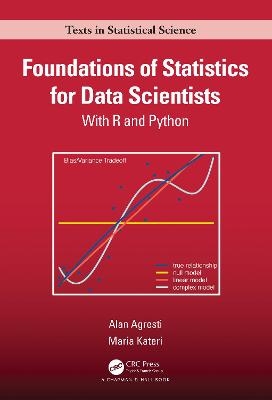
Foundations of Statistics for Data Scientists
CRC Press (Verlag)
978-0-367-74843-2 (ISBN)
- Titel wird leider nicht erscheinen
- Artikel merken
The book also introduces modern topics that do not normally appear in mathematical statistics texts but are highly relevant for data scientists, such as Bayesian inference, generalized linear models for non-normal responses (e.g., logistic regression and Poisson loglinear models), and regularized model fitting. The nearly 500 exercises are grouped into "Data Analysis and Applications" and "Methods and Concepts." Appendices introduce R and Python and contain solutions for odd-numbered exercises. The book's website has expanded R, Python, and Matlab appendices and all data sets from the examples and exercises.
Alan Agresti, Distinguished Professor Emeritus at the University of Florida, is the author of seven books, including Categorical Data Analysis (Wiley) and Statistics: The Art and Science of Learning from Data (Pearson), and has presented short courses in 35 countries. His awards include an honorary doctorate from De Montfort University (UK) and the Statistician of the Year from the American Statistical Association (Chicago chapter). Maria Kateri, Professor of Statistics and Data Science at the RWTH Aachen University, authored the monograph Contingency Table Analysis: Methods and Implementation Using R (Birkhauser/Springer) and a textbook on mathematics for economists (in German). She has a long-term experience in teaching statistics courses to students of Data Science, Mathematics, Statistics, Computer Science, and Business Administration and Engineering.
"The main goal of this textbook is to present foundational statistical methods and theory that are relevant in the field of data science. The authors depart from the typical approaches taken by many conventional mathematical statistics textbooks by placing more emphasis on providing the students with intuitive and practical interpretations of those methods with the aid of R programming codes...I find its particular strength to be its intuitive presentation of statistical theory and methods without getting bogged down in mathematical details that are perhaps less useful to the practitioners" (Mintaek Lee, Boise State University)
"The aspects of this manuscript that I find appealing: 1. The use of real data. 2. The use of R but with the option to use Python. 3. A good mix of theory and practice. 4. The text is well-written with good exercises. 5. The coverage of topics (e.g. Bayesian methods and clustering) that are not usually part of a course in statistics at the level of this book." (Jason M. Graham, University of Scranton)
Alan Agresti, Distinguished Professor Emeritus at the University of Florida, is the author of seven books, including Categorical Data Analysis (Wiley) and Statistics: The Art and Science of Learning from Data (Pearson), and has presented short courses in 35 countries. His awards include an honorary doctorate from De Montfort University (UK) and the Statistician of the Year from the American Statistical Association (Chicago chapter). Maria Kateri, Professor of Statistics and Data Science at the RWTH Aachen University, authored the monograph Contingency Table Analysis: Methods and Implementation Using R (Birkhauser/Springer) and a textbook on mathematics for economists (in German). She has a long-term experience in teaching statistics courses to students of Data Science, Mathematics, Statistics, Computer Science, and Business Administration and Engineering. "The main goal of this textbook is to present foundational statistical methods and theory that are relevant in the field of data science. The authors depart from the typical approaches taken by many conventional mathematical statistics textbooks by placing more emphasis on providing the students with intuitive and practical interpretations of those methods with the aid of R programming codes...I find its particular strength to be its intuitive presentation of statistical theory and methods without getting bogged down in mathematical details that are perhaps less useful to the practitioners" (Mintaek Lee, Boise State University) "The aspects of this manuscript that I find appealing: 1. The use of real data. 2. The use of R but with the option to use Python. 3. A good mix of theory and practice. 4. The text is well-written with good exercises. 5. The coverage of topics (e.g. Bayesian methods and clustering) that are not usually part of a course in statistics at the level of this book." (Jason M. Graham, University of Scranton)
Table of Contents: Foundations of Statistical Science for Data Scientists
Alan Agresti and Maria Kateri
1. Introduction to Statistical Science
1.1 Statistical science: Description and inference
Design, descriptive statistics, and inferential statistics
Populations and samples
Parameters: Numerical summaries of the population
Defining populations: actual and conceptual
1.2 Types of data and variables
Data files
Example: The General Social Survey (GSS)
Variables
Quantitative variables and categorical variables
Discrete variables and continuous variables
Associations: response variables and explanatory variables
1.3 Data collection and randomization
Randomization
Collecting data with a sample survey
Collecting data with an experiment
Collecting data with an observational study
Establishing cause and effect: observational versus experimental studies
1.4 Descriptive statistics: Summarizing data
Example: Carbon dioxide emissions in European nations
Frequency distribution and histogram graphic
Describing the center of the data: mean and median
Describing data variability: standard deviation and variance
Describing position: percentiles, quantiles, and box plots
1.5 Descriptive statistics: Summarizing multivariate data
Bivariate quantitative data: The scatterplot, correlation, and
regression
Bivariate categorical data: Contingency tables
Descriptive statistics for samples and for populations
1.6 Chapter summary
Exercises
2. Probability Distributions
2.1 Introduction to probability
Probabilities and long-run relative frequencies
Sample spaces and events
Probability axioms and implied probability rules
Example: Diagnostics for disease screening
Bayes' theorem
Multiplicative law of probability, and independent events
2.2 Random variables and probability distributions
Probability distributions for discrete random variables
Example: Geometric probability distribution
Probability distributions for continuous random variables
Example: Uniform distribution
Probability functions (pdf, pmf) and cumulative distribution
function (cdf)
Example: Exponential random variable
Families of probability distributions indexed by parameters
2.3 Expectations of random variables
Expected value and variability of a discrete random variable
Expected values for continuous random variables
Example: Mean and variability for uniform random variable
Higher moments: Skewness
Expectations of linear functions of random variables
Standardizing a random variable
2.4 Discrete probability distributions
Binomial distribution
Example: Hispanic composition of jury list
Mean, variability, and skewness of binomial distribution
Example: Predicting results of a sample survey
The sample proportion as a scaled binomial random variable
Poisson distribution
Poisson variability and overdispersion
2.5 Continuous probability distributions
The normal distribution
The standard normal distribution
Examples: Finding normal probabilities and percentiles
The gamma distribution
The exponential distribution and Poisson processes
Quantiles of a probability distribution
Using the uniform to randomly generate a continuous random variable
2.6 Joint and conditional distributions and independence
Joint and marginal probability distributions
Example: Joint and marginal distributions of happiness and family income
Conditional probability distributions
Trials with multiple categories: the multinomial distribution
Expectations of sums of random variables
Independence of random variables
Markov chain dependence and conditional independence
2.7 Correlation between random variables
Covariance and correlation
Example: Correlation between income and happiness
Independence implies zero correlation, but not converse
Bivariate normal distribution *
2.8 Chapter summary
Exercises
3. Sampling Distributions
3.1 Sampling distributions: Probability distributions for statistics
Example: Predicting an election result from an exit poll
Sampling distribution: Variability of a statistic's value among samples
Constructing a sampling distribution
Example: Simulating to estimate mean restaurant sales
3.2 Sampling distributions of sample means
Mean and variance of sample mean of random variables
Standard error of a statistic
Example: Standard error of sample mean sales
Example: Standard error of sample proportion in exit poll
Law of large numbers: Sample mean converges to population mean
Normal, binomial, and Poisson sums of random variables have the same distribution
3.3 Central limit theorem: Normal sampling distribution for large samples
Sampling distribution of sample mean is approximately normal
Simulations illustrate normal sampling distribution in CLT
Summary: Population, sample data, and sampling distributions
3.4 Large-sample normal sampling distributions for many statistics *
Delta method
Delta method applied to root Poisson stabilizes the variance
Simulating sampling distributions of other statistics
The key role of sampling distributions in statistical inference
3.5 Chapter summary
Exercises
4. Statistical Inference: Estimation
4.1 Point estimates and confidence intervals
Properties of estimators: Unbiasedness, consistency, efficiency
Evaluating properties of estimators
Interval estimation: Confidence intervals for parameters
4.2 The likelihood function and maximum likelhood estimation
The likelihood function
Maximum likelihood method of estimation
Properties of maximum likelihood estimators
Example: Variance of ML estimator of binomial parameter
Example: Variance of ML estimator of Poisson mean
Sufficiency and invariance for ML estimators
4.3 Constructing confidence intervals
Using a pivotal quantity to induce a confidence interval
A large-sample confidence interval for the mean
Confidence intervals for proportions
Example: Atheists and agnostics in Europe
Using simulation to illustrate long-run performance of CIs
Determining the sample size before collecting the data
Example: Sample size for evaluating an advertising strategy
4.4 Confidence intervals for means of normal populations
The $t$ distribution
Confidence interval for a mean using the $t$ distribution
Example: Estimating mean weight change for anorexic girls
Robustness for violations of normal population assumption
Construction of $t$ distribution using chi-squared and standard normal
Why does the pivotal quantity have the $t$ distribution?
Cauchy distribution: t distribution with df=1 has unusual behavior
4.5 Comparing two population means or proportions
A model for comparing means: Normality with common variability
A standard error and confidence interval for comparing means
Example: Comparing a therapy to a control group
Confidence interval comparing two proportions
Example: Does prayer help coronary surgery patients?
4.6 The bootstrap
Computational resampling and bootstrap confidence intervals
Example: Confidence intervals for library data
4.7 The Bayesian approach to statistical inference
Bayesian prior and posterior distributions
Bayesian binomial inference: Beta prior distributions
Example: Belief in hell
Interpretation: Bayesian versus classical intervals
Bayesian posterior interval comparing proportions
Highest posterior density (HPD) posterior intervals
4.8 Bayeian inference for means
Bayesian inference for a normal mean
Example: Bayesian analysis for anorexia therapy
Bayesian inference for normal means with improper priors
Predicting a future observation: Bayesian predictive distribution
The Bayesian perspective, and empirical Bayes and hierarchical Bayes extensions
4.9 Why maximum likelihood and Bayes estimators perform well *
ML estimators have large-sample normal distributions
Asymptotic efficiency of ML estimators same as best unbiased estimators
Bayesian estimators also have good large-sample performance
The likelihood principle
4.10 Chapter summary
Exercises
5. Statistical Inference: Significance Testing
5.1 The elements of a significance test
Example: Testing for bias in selecting managers
Assumptions, hypotheses, test statistic, P-value and conclusion
5.2 Significance tests for proportions and means
The elements of a significance test for a proportion
Example: Climate change a major threat?
One-sided significance tests
The elements of a significance test for a mean
Example: Significance test about political ideology
5.3 Significance tests comparing means
Significance tests for the difference between two means
Example: Comparing a therapy to a control group
Effect size for comparison of two means
Bayesian inference for comparing means
Example: Bayesian comparison of therapy and control groups
5.4 Significance tests comparing proportions
Significance test for the difference between two proportions
Example: Comparing prayer and non-prayer surgery patients
Bayesian inference for comparing two proportions
Chi-squared tests for multiple proportions in contingency table
Example: Happiness and marital status
Standardized residuals: Describing the nature of an association
5.5 Significance test decisions and errors
The alpha-level: Making a decision based on the P-value
Never ``accept H_0'' in a significance test
Type I and Type II errors
As P(Type I error) decreases, P(Type II error) increases
Example: Testing whether astrology has some truth
The power of a test
Making decisions versus reporting the P-value
5.6 Duality between significance tests and confidence intervals
Connection between two-sided tests and confidence intervals
Effect of sample size: Statistical versus practical significance
Significance tests are less useful than confidence intervals
Significance tests and P-values can be misleading
5.7 Likelihood-ratio tests and confidence intervals *
The likelihood-ratio and a chi-squared test statistic
Likelihood-ratio test and confidence interval for a proportion
Likelihood-ratio, Wald, score test triad
5.8 Nonparametric tests
A permutation test to compare two groups
Example: Petting versus praise of dogs
Wilcoxon test: Comparing mean ranks for two groups
Comparing survival time distributions with censored data
5.9 Chapter summary
Exercises
6. Linear Models and Least Squares
6.1 The linear regression model and its least squares fit
The linear model describes a conditional expectation
Describing variation around the conditional expectation
Least squares model fitting
Example: Linear model for Scottish hill races
The correlation
Regression toward the mean in linear regression models
Linear models and reality
6.2 Multiple regression: Linear models with multiple explanatory variables
Interpreting effects in multiple regression models
Example: Multiple regression for Scottish hill races
Association and causation
Confounding, spuriousness, and conditional independence
Example: Modeling the crime rate in Florida
Equations for least squares estimates in multiple regression
Interaction between explanatory variables in their effects
Cook's distance: Checking for unusual observations
6.3 Summarizing variability in linear regression models
The error variance and chi-squared for linear models
Decomposing variability into model explained and unexplained parts
R-squared and the multiple correlation
Example: R-squared for modeling Scottish hill races
6.4 Statistical inference for normal linear models
The F distribution: Testing that all effects equal 0
Example: Linear model for mental impairment
t tests and confidence intervals for individual effects
Multicollinearity: Nearly redundant explanatory variables
Confidence interval for E(Y) and prediction interval for Y
The F test that all effects equal 0 is a likelihood-ratio test *
6.5 Categorical explanatory variables in linear models
Indicator variables for categories
Example: Comparing mean incomes of racial-ethnic groups
Analysis of variance (ANOVA): An F test comparing several means
Multiple comparisons of means: Bonferroni and Tukey methods
Models with both categorical and quantitative explanatory variables Comparing two nested normal linear models
Interaction with categorical and quantitative explanatory variables
6.6 Bayesian inference for normal linear models
Prior and posterior distributions for normal linear models
Example: Bayesian linear model for mental impairment
Bayesian approach to the normal one-way layout
6.7 Matrix formulation of linear models
The model matrix
Least squares estimates and standard errors
The hat matrix and the leverage
Alternatives to least squares: Robust regression and regularization
Restricted optimality of least squares: Gauss--Markov theorem
Matrix formulation of Bayesian normal linear model
6.8 Chapter summary
Exercises
7. Generalized Linear Models
7.1 Introduction to generalized linear models
The three components of a generalized linear model
GLMs for normal, binomial, and Poisson responses
Example: GLMs for house selling prices
The deviance
Likelihood-ratio model comparison uses deviance difference
Model selection: AIC and the bias/variance tradeoff
Advantages of GLMs versus transforming the data
Example: Normal and gamma GLMs for Covid-19 data
7.2 Logistic regression for binary data
Logistic regression: Model expressions
Interpreting beta_j: effects on probabilities and odds
Example: Dose-response study for flour beetles
Grouped and ungrouped binary data: Effects on estimates and deviance
Example: Modeling Italian employment with logit and identity links Complete separation and infinite logistic parameter estimates
7.3 Bayesian inference for generalized linear models
Normal prior distributions for GLM parameters
Example: Bayesian logistic regression for endometrial cancer patients7.4 Poisson loglinear models for count data
Poisson loglinear models
Example: Modeling horseshoe crab satellite counts
Modeling rates: Including an offset in the model
Example: Lung cancer survival
7.5 Negative binomial models for overdispersed count data *
Increased variance due to heterogeneity
Negative binomial: Gamma mixture of Poisson distributions
Example: Negative binomial modeling of horseshoe crab data
7.6 Iterative GLM model fitting *
The Newton--Raphson method
Newton--Raphson fitting of logistic regression model
Covariance matrix of parameter estimates and Fisher scoring
Likelihood equations and covariance matrix for Poisson GLMs
7.7 Regularization with large numbers of parameters
Penalized likelihood methods
Penalized likelihood methods: The lasso
Example: Predicting opinions with student survey data
Why shrink ML estimates toward 0?
Dimension reduction: Principal component analysis
Bayesian inference with a large number of parameters
Huge n: Handling big data
7.8 Chapter summary
Exercises
%
8. Classification and Clustering
8.1 Classification: Linear Discriminant Analysis and Graphical Trees
Classification with Fisher's linear discriminant function
Example: Predicting whether horseshoe crabs have satellites
Summarizing predictive power: Classification tables and ROC curves
Classification trees: Graphical prediction
Logistic regression versus linear discriminant analysis and classification trees
Other methods for classification: k-nearest neighbors and neural networks
prediction
8.2 Cluster Analysis
Measuring dissimilarity between observations on binary responses
Hierarchical clustering algorithm and its dendrogram
Example: Clustering states on presidential election outcomes
8.3 Chapter summary
Exercises
9. Statistical Science: A Historical Overview
9.1 The evolution of statistical science
Evolution of probability
Evolution of descriptivev and inferential statistics
9.2 Pillars of statistical wisdom and practice
Stigler's seven pillars of statistical wisdom
Seven pillars of wisdom for practicing data science
Appendix A: Using R in Statistical Science
Appendix B: Using Python in Statistical Science
Appendix C: Brief Solutions to Odd-Numbered Exercises
Bibliography
Example
Subject Index
| Erscheint lt. Verlag | 15.9.2021 |
|---|---|
| Reihe/Serie | Chapman & Hall/CRC Texts in Statistical Science |
| Zusatzinfo | 104 Halftones, color; 3 Halftones, black and white; 104 Illustrations, color; 3 Illustrations, black and white |
| Verlagsort | London |
| Sprache | englisch |
| Maße | 178 x 254 mm |
| Themenwelt | Mathematik / Informatik ► Mathematik ► Statistik |
| ISBN-10 | 0-367-74843-6 / 0367748436 |
| ISBN-13 | 978-0-367-74843-2 / 9780367748432 |
| Zustand | Neuware |
| Informationen gemäß Produktsicherheitsverordnung (GPSR) | |
| Haben Sie eine Frage zum Produkt? |
aus dem Bereich