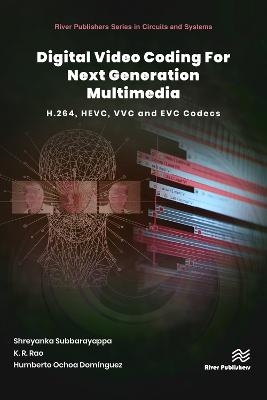
Digital Video Coding for Next Generation Multimedia
River Publishers (Verlag)
978-87-7022-421-5 (ISBN)
Advances in video compression technology reduce the utilization of system resources, like processing time, memory use, network bandwidth and battery life. This is possible by reducing the complexity of the video codecs without compromising on the output video quality. There are two distinct lines in the future video coding technology development work. Essential Video Coding (EVC) driven by MPEG team and Versatile Video Codec (VVC) driven by Joint Video Exploration Team (JVET). These codecs are the extended versions with advances in compression technologies when compared to the prior video codecs or reference codecs like H.264 and HEVC.
This book is devoted to the theory and design of different algorithms used in the video codecs to obtain efficient implementation and reconstruction of codec outputs. It also addresses the most recent codecs being developed, i.e., VVC and EVC along with the reference codecs, i.e., H.264 and HEVC. It also summarises the study results achieved by the international research community across four decades for different codecs and provides a comparison of their outputs. The book also emphasises the various algorithmic developments in the encoder and decoder blocks of the respective video codecs: motion estimation, motion vectors, motion compensation, block representation, transform domain, quantization, entropy coding methods for each codec. This book also touches on the practical aspects of different codecs along with projects at the end of each chapter which act as a good reference for the implementation of the codec software.
Dr. Shreyanka Subbarayappa received her B.E. degree in Telecommunication Engineering from Ramaiah Institute of Technology, Bangalore, India in 2009. She received her M.S. and Ph.D. degree in Electrical Engineering from The University of Texas at Arlington, Texas, U.S.A. in 2012 and 2020. She is currently serving as an assistant professor at Ramaiah University of Applied Sciences, Bangalore India in electronics and communication department since January 2018. Prior to this, she has had 5 years of research and industry experience, working for Intel Corporation in US, UK and India as a Team Lead in the graphics driver development for Windows, Linux and Android operating systems. She has delivered many lectures on “Data Compression” nationally and internationally. She has also worked as a visiting faculty at University of Texas at Arlington for a period of one year from 2019 to 2020 taking masters level courses. She was hired as a ‘Subject Expert’ by Google LLC, U.S.A. for advising the attorney on patent litigation cases on video codecs algorithms. She has served as a reviewer for many masters and Ph.D. thesis. Her passion and research interests are in the field of Multimedia Processing, Video Pre/Post Processing, Video Codecs, Image Pre/Post Processing, Image Codecs and Audio Codecs. Dr. K. R. Rao received the Ph.D. degree in electrical engineering from The University of New Mexico, Albuquerque, USA in 1966. He received M.Sc. degree in nuclear engineering and electrical engineering from the University of Florida, Florida, U.S.A. in the year 1960 and 1959. Since 1966, he has been with the University of Texas at Arlington, Texas, U.S.A where he is currently a professor of electrical engineering department. He, along with two other researchers introduced the Discrete Cosine Transform in 1975, which has since become very popular in digital signal processing. DCT, INTDCT, directional DCT and MDCT (modified DCT) have been adopted in several international video/image/audio coding standards such as JPEG/MPEG/H.26X series and also by SMPTE (VC-1) and by AVS China. He has authored and co-authored several books on video algorithms and video codecs. He has mentored more than hundred masters and Ph.D. students. He has been consulting several industries, academia (domestic and international) and law firms in the field of Multimedia. Humberto Ochoa Domínguez received the Ph. D. degree in electrical engineering from The University of Texas, Arlington in 2004. He is currently working as a professor of computer and electrical engineering in the University of Ciudad Juárez, (UACJ) México. Humberto has published extensively and is a reviewer for referred journals and has published (coauthored) 3 books. Also, he is an IEEE member and a consultant for the academy and the industry in the Machine Learning field. He has supervised several Masters and doctoral students and served as external examiner for several M.S. and Ph. D. students. He is also a reviewer of research proposals from the industry.
Preface; 1. Introduction to data compression; 2. H.264/MPEG4-Part10; 3. HEVC – High Efficiency Video Coding; 4. VVC – Versatile Video Coding; 5. EVC – Essential Video Coding; 6. Comparative analysis of H264, HEVC, VVC and EVC; Annex – Evaluation metrics
| Erscheinungsdatum | 02.08.2021 |
|---|---|
| Reihe/Serie | River Publishers Series in Signal, Image and Speech Processing |
| Verlagsort | Gistrup |
| Sprache | englisch |
| Maße | 156 x 234 mm |
| Themenwelt | Mathematik / Informatik ► Informatik ► Theorie / Studium |
| ISBN-10 | 87-7022-421-8 / 8770224218 |
| ISBN-13 | 978-87-7022-421-5 / 9788770224215 |
| Zustand | Neuware |
| Informationen gemäß Produktsicherheitsverordnung (GPSR) | |
| Haben Sie eine Frage zum Produkt? |
aus dem Bereich