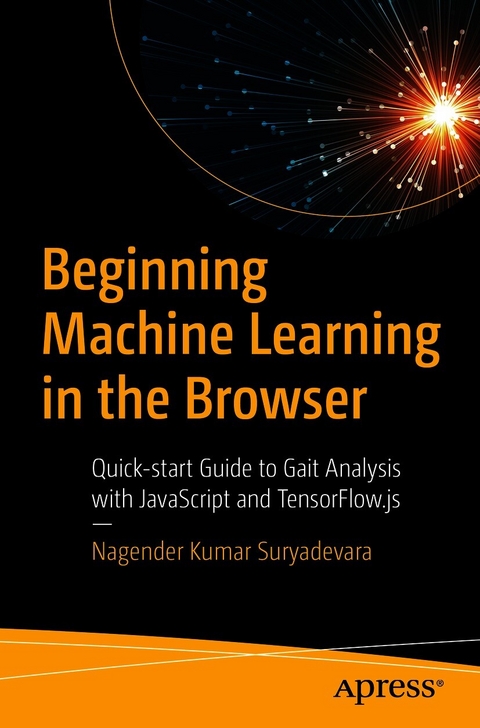
Beginning Machine Learning in the Browser (eBook)
XIV, 182 Seiten
Apress (Verlag)
978-1-4842-6843-8 (ISBN)
Apply Artificial Intelligence techniques in the browser or on resource constrained computing devices. Machine learning (ML) can be an intimidating subject until you know the essentials and for what applications it works. This book takes advantage of the intricacies of the ML processes by using a simple, flexible and portable programming language such as JavaScript to work with more approachable, fundamental coding ideas.
Using JavaScript programming features along with standard libraries, you'll first learn to design and develop interactive graphics applications. Then move further into neural systems and human pose estimation strategies. For training and deploying your ML models in the browser, TensorFlow.js libraries will be emphasized.
After conquering the fundamentals, you'll dig into the wilderness of ML. Employ the ML and Processing (P5) libraries for Human Gait analysis. Building up Gait recognition with themes, you'll come to understand a variety of ML implementation issues. For example, you'll learn about the classification of normal and abnormal Gait patterns.
With Beginning Machine Learning in the Browser, you'll be on your way to becoming an experienced Machine Learning developer.
What You'll Learn
- Work with ML models, calculations, and information gathering
- Implement TensorFlow.js libraries for ML models
- Perform Human Gait Analysis using ML techniques in the browser
Who This Book Is For
Computer science students and research scholars, and novice programmers/web developers in the domain of Internet Technologies
Nagender Kumar Suryadevara received his Ph.D. from the School of Engineering and Advanced Technology, Massey University, New Zealand, in 2014. He has authored two books and over 45 publications in different international journals, conferences, and book chapters. His research interests lie in the domains of wireless sensor networks, Internet of Things technologies, and time-series data mining.
Apply Artificial Intelligence techniques in the browser or on resource constrained computing devices. Machine learning (ML) can be an intimidating subject until you know the essentials and for what applications it works. This book takes advantage of the intricacies of the ML processes by using a simple, flexible and portable programming language such as JavaScript to work with more approachable, fundamental coding ideas. Using JavaScript programming features along with standard libraries, you'll first learn to design and develop interactive graphics applications. Then move further into neural systems and human pose estimation strategies. For training and deploying your ML models in the browser, TensorFlow.js libraries will be emphasized.After conquering the fundamentals, you'll dig into the wilderness of ML. Employ the ML and Processing (P5) libraries for Human Gait analysis. Building up Gait recognition with themes, you'll come to understand a variety of MLimplementation issues. For example, you ll learn about the classification of normal and abnormal Gait patterns. With Beginning Machine Learning in the Browser, you ll be on your way to becoming an experienced Machine Learning developer.What You ll LearnWork with ML models, calculations, and information gatheringImplement TensorFlow.js libraries for ML modelsPerform Human Gait Analysis using ML techniques in the browserWho This Book Is ForComputer science students and research scholars, and novice programmers/web developers in the domain of Internet Technologies
| Erscheint lt. Verlag | 1.4.2021 |
|---|---|
| Zusatzinfo | XIV, 182 p. 71 illus. |
| Sprache | englisch |
| Themenwelt | Informatik ► Theorie / Studium ► Künstliche Intelligenz / Robotik |
| Schlagworte | Deep learning • gait analysis • JavaScript • JSON • machine learning • ML5 • neural network • posenet • TensorFlow.js |
| ISBN-10 | 1-4842-6843-1 / 1484268431 |
| ISBN-13 | 978-1-4842-6843-8 / 9781484268438 |
| Informationen gemäß Produktsicherheitsverordnung (GPSR) | |
| Haben Sie eine Frage zum Produkt? |
 PDF (Wasserzeichen)
DRM: Digitales Wasserzeichen
Dieses eBook enthält ein digitales Wasserzeichen und ist damit für Sie personalisiert. Bei einer missbräuchlichen Weitergabe des eBooks an Dritte ist eine Rückverfolgung an die Quelle möglich.
Dateiformat: PDF (Portable Document Format)
Mit einem festen Seitenlayout eignet sich die PDF besonders für Fachbücher mit Spalten, Tabellen und Abbildungen. Eine PDF kann auf fast allen Geräten angezeigt werden, ist aber für kleine Displays (Smartphone, eReader) nur eingeschränkt geeignet.
Systemvoraussetzungen:
PC/Mac: Mit einem PC oder Mac können Sie dieses eBook lesen. Sie benötigen dafür einen PDF-Viewer - z.B. den Adobe Reader oder Adobe Digital Editions.
eReader: Dieses eBook kann mit (fast) allen eBook-Readern gelesen werden. Mit dem amazon-Kindle ist es aber nicht kompatibel.
Smartphone/Tablet: Egal ob Apple oder Android, dieses eBook können Sie lesen. Sie benötigen dafür einen PDF-Viewer - z.B. die kostenlose Adobe Digital Editions-App.
Buying eBooks from abroad
For tax law reasons we can sell eBooks just within Germany and Switzerland. Regrettably we cannot fulfill eBook-orders from other countries.
aus dem Bereich