


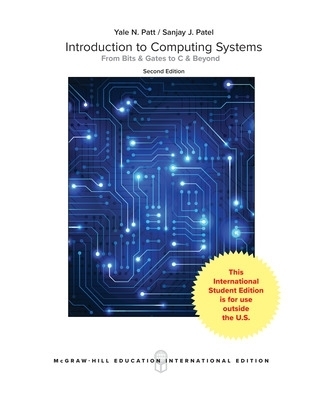
Introduction to Computing Systems: From Bits and Gates to C and Beyond (Int'l Ed)
Seiten
2003
|
2nd edition
McGraw Hill Higher Education (Verlag)
978-0-07-121503-9 (ISBN)
McGraw Hill Higher Education (Verlag)
978-0-07-121503-9 (ISBN)
- Titel erscheint in neuer Auflage
- Artikel merken
Zu diesem Artikel existiert eine Nachauflage

Highlights the logic structures and architecture of a computer, and the application software that runs on it. This book is based on the premise that starting with a high level programming language is not the best approach, and from this basic notion evolves the motivated bottom-up approach found in this text.
This book is based on the premise that starting with a high level programming language is not the best approach. The reason most students are unsuccessful using a programming language when they encounter it in their first course is because they are forced to memorize a lot of technical details without having any idea why these details are necessary. That is, they do not understand the basic underpinnings of how a computer works.From this basic notion evolves the motivated bottom-up approach found in Patt/Patel’s Introduction To Computing Systems, now in a second edition. The text starts with the logic structures and architecture of a computer and moves up to the application software that runs on it. Every treatment that purports to start at the bottom and work up begins with some abstraction. For Patt/Patel, that abstraction is the switch level behavior of an MOS transistor. From a very short treatment of that abstraction, the book covers in turn: Logic Gates, latches, logic structures (MUX, Decoder, Adder, gated latches), finally culminating in an implementation of memory. From there, the book moves on to the Von Neumann model of execution, then a simple computer (the LC-3), machine language programming, assembly language and how an assembler works, and then assembly language programming of the LC-3. The LC-3 treatment concludes with a substantial treatment of Physical I/O, including both polling and interrupt-driven I/O, the nature of traps and subroutine calls/returns. The book then moves to the high-level language C, covering recursion, pointers, and finally elementary data structures. The book establishes a foundation that every subsequent course in the computer science or computer engineering curriculum can benefit from and build on.
This book is based on the premise that starting with a high level programming language is not the best approach. The reason most students are unsuccessful using a programming language when they encounter it in their first course is because they are forced to memorize a lot of technical details without having any idea why these details are necessary. That is, they do not understand the basic underpinnings of how a computer works.From this basic notion evolves the motivated bottom-up approach found in Patt/Patel’s Introduction To Computing Systems, now in a second edition. The text starts with the logic structures and architecture of a computer and moves up to the application software that runs on it. Every treatment that purports to start at the bottom and work up begins with some abstraction. For Patt/Patel, that abstraction is the switch level behavior of an MOS transistor. From a very short treatment of that abstraction, the book covers in turn: Logic Gates, latches, logic structures (MUX, Decoder, Adder, gated latches), finally culminating in an implementation of memory. From there, the book moves on to the Von Neumann model of execution, then a simple computer (the LC-3), machine language programming, assembly language and how an assembler works, and then assembly language programming of the LC-3. The LC-3 treatment concludes with a substantial treatment of Physical I/O, including both polling and interrupt-driven I/O, the nature of traps and subroutine calls/returns. The book then moves to the high-level language C, covering recursion, pointers, and finally elementary data structures. The book establishes a foundation that every subsequent course in the computer science or computer engineering curriculum can benefit from and build on.
Part I 1 Welcome Aboard! 2 Bits, Data Types, and Operations 3 Digital Logic Structures 4 The Von Neumann Model 5 The LC-3 6 Programming 7 Assembly Language 8 I/O 9 TRAP Routines and Subroutines 10 And, Finally... Part II 11 Introduction to Programming in C 12 Variables and Operators 13 Control Structures 14 Functions 15 Debugging 16 Recursion 17 Pointers and Arrays 18 I/O in C 19 Data Structures Appendix A The LC-3 ISA Appendix B From LC-3 to x86 Appendix C The Microarchitecture of the LC-3 Appendix D The C Programming Language Appendix E Extending C to C++ Appendix F Useful Tables
| Erscheint lt. Verlag | 16.9.2003 |
|---|---|
| Zusatzinfo | Illustrations |
| Verlagsort | London |
| Sprache | englisch |
| Maße | 196 x 241 mm |
| Gewicht | 1157 g |
| Themenwelt | Mathematik / Informatik ► Informatik ► Theorie / Studium |
| ISBN-10 | 0-07-121503-4 / 0071215034 |
| ISBN-13 | 978-0-07-121503-9 / 9780071215039 |
| Zustand | Neuware |
| Informationen gemäß Produktsicherheitsverordnung (GPSR) | |
| Haben Sie eine Frage zum Produkt? |
Mehr entdecken
aus dem Bereich

aus dem Bereich
was jeder über Informatik wissen sollte
Buch | Softcover (2024)
Springer Vieweg (Verlag)
CHF 53,15
Grundlagen – Anwendungen – Perspektiven
Buch | Softcover (2022)
Springer Vieweg (Verlag)
CHF 53,15
Teil 2 der gestreckten Abschlussprüfung Fachinformatiker/-in …
Buch | Softcover (2025)
Europa-Lehrmittel (Verlag)
CHF 37,90


