


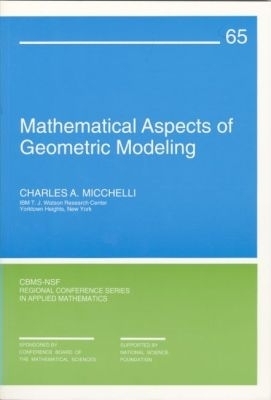
Mathematical Aspects of Geometric Modelling
Seiten
1994
Society for Industrial & Applied Mathematics,U.S. (Verlag)
978-0-89871-331-2 (ISBN)
Society for Industrial & Applied Mathematics,U.S. (Verlag)
978-0-89871-331-2 (ISBN)
- Titel z.Zt. nicht lieferbar
- Versandkostenfrei
- Auch auf Rechnung
- Artikel merken
Examines in detail certain concepts that are useful for the modeling of curves and surfaces and emphasizes the mathematical theory that underlies these ideas. The two principal themes of the text are the use of piecewise polynomial representation (this theme appears in one form or another in every chapter), and iterative refinement, also called subdivision.
This monograph examines in detail certain concepts that are useful for the modeling of curves and surfaces and emphasizes the mathematical theory that underlies these ideas. The two principal themes of the text are the use of piecewise polynomial representation (this theme appears in one form or another in every chapter), and iterative refinement, also called subdivision. Here, simple iterative geometric algorithms produce, in the limit, curves with complex analytic structure.
In the first two chapters, the de Casteljau subdivision for Bernstein-Bézier curves is used to introduce matrix subdivision, and the Lane-Riesenfield algorithm for computing cardinal splines is tied into stationary subdivision. This ultimately leads to the construction of prewavelets of compact support. Chapters three and four deal with concepts of ""visual smoothness"" of curves, and the intriguing idea of generating smooth multivariate piecewise polynomials as volumes of ""slices"" of polyhedra. The final chapter discusses recursive algorithms for the evaluation of polynomials. Each chapter contains introductory material as well as more advanced results.
This monograph examines in detail certain concepts that are useful for the modeling of curves and surfaces and emphasizes the mathematical theory that underlies these ideas. The two principal themes of the text are the use of piecewise polynomial representation (this theme appears in one form or another in every chapter), and iterative refinement, also called subdivision. Here, simple iterative geometric algorithms produce, in the limit, curves with complex analytic structure.
In the first two chapters, the de Casteljau subdivision for Bernstein-Bézier curves is used to introduce matrix subdivision, and the Lane-Riesenfield algorithm for computing cardinal splines is tied into stationary subdivision. This ultimately leads to the construction of prewavelets of compact support. Chapters three and four deal with concepts of ""visual smoothness"" of curves, and the intriguing idea of generating smooth multivariate piecewise polynomials as volumes of ""slices"" of polyhedra. The final chapter discusses recursive algorithms for the evaluation of polynomials. Each chapter contains introductory material as well as more advanced results.
Preface
A Brief Overview
Chapter 1: Matrix Subdivision
Chapter 2: Stationary Subdivision
Chapter 3: Piecewise Polynomial Curves
Chapter 4: Geometric Methods for Piecewise Polynomial Surfaces
Chapter 5: Recursive Algorithms for Polynomial Evaluation.
| Erscheint lt. Verlag | 30.11.1994 |
|---|---|
| Reihe/Serie | CBMS-NSF Regional Conference Series in Applied Mathematics |
| Verlagsort | New York |
| Sprache | englisch |
| Maße | 151 x 228 mm |
| Gewicht | 450 g |
| Themenwelt | Mathematik / Informatik ► Mathematik ► Geometrie / Topologie |
| ISBN-10 | 0-89871-331-5 / 0898713315 |
| ISBN-13 | 978-0-89871-331-2 / 9780898713312 |
| Zustand | Neuware |
| Informationen gemäß Produktsicherheitsverordnung (GPSR) | |
| Haben Sie eine Frage zum Produkt? |
Mehr entdecken
aus dem Bereich


aus dem Bereich
Gekrümmte Kurven und Flächen
Buch | Softcover (2024)
De Gruyter (Verlag)
CHF 76,90
Anwendungen in Natur und Technik
Buch | Softcover (2021)
Springer Berlin (Verlag)
CHF 55,95


