


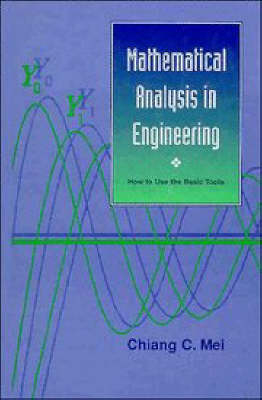
Mathematical Analysis in Engineering
How to Use the Basic Tools
Seiten
1995
Cambridge University Press (Verlag)
978-0-521-46053-8 (ISBN)
Cambridge University Press (Verlag)
978-0-521-46053-8 (ISBN)
- Titel erscheint in neuer Auflage
- Artikel merken
This user-friendly 1995 text on applied mathematics is for beginning graduate students in engineering. Rather than follow the traditional approach of stating mathematical principles and then citing physical examples, the book puts applications at centre stage; that is, it starts with the problem, finds the mathematics that suits it and ends with a mathematical analysis of the physics.
This user-friendly 1995 text shows how to use mathematics to formulate, solve and analyse physical problems. Rather than follow the traditional approach of stating mathematical principles and then citing some physical examples for illustration, the book puts applications at centre stage; that is, it starts with the problem, finds the mathematics that suits it and ends with a mathematical analysis of the physics. Physical examples are selected primarily from applied mechanics. Among topics included are Fourier series, separation of variables, Bessel functions, Fourier and Laplace transforms, Green's functions and complex function theories. Also covered are advanced topics such as Riemann–Hilbert techniques, perturbation methods, and practical topics such as symbolic computation. Engineering students, who often feel more awe than confidence and enthusiasm toward applied mathematics, will find this approach to mathematics goes a long way toward a sharper understanding of the physical world.
This user-friendly 1995 text shows how to use mathematics to formulate, solve and analyse physical problems. Rather than follow the traditional approach of stating mathematical principles and then citing some physical examples for illustration, the book puts applications at centre stage; that is, it starts with the problem, finds the mathematics that suits it and ends with a mathematical analysis of the physics. Physical examples are selected primarily from applied mechanics. Among topics included are Fourier series, separation of variables, Bessel functions, Fourier and Laplace transforms, Green's functions and complex function theories. Also covered are advanced topics such as Riemann–Hilbert techniques, perturbation methods, and practical topics such as symbolic computation. Engineering students, who often feel more awe than confidence and enthusiasm toward applied mathematics, will find this approach to mathematics goes a long way toward a sharper understanding of the physical world.
Preface; Achnowledgments; 1. Formulation of physical problems; 2. Classification of equations; 3. One-dimensional waves; 4. Finite domains and separation of variables; 5. Elements of Fourier series; 6. Introduction to Green's functions; 7. Unbounded domains and Fourier transforms; 8. Bessel functions and circular domains; 9. Complex variables; 10. Laplace transform and initial value problems; 11. Conformal mapping and hydrodynamics; 12. Riemann–Hilbert problems in hydrodynamics and elasticity; 13. Perturbation methods - the art of approximation; 14. Computer algebra for perturbation analysis; Appendices; Bibliography; Index.
| Erscheint lt. Verlag | 31.3.1995 |
|---|---|
| Zusatzinfo | 118 Line drawings, unspecified |
| Verlagsort | Cambridge |
| Sprache | englisch |
| Maße | 157 x 237 mm |
| Gewicht | 753 g |
| Themenwelt | Mathematik / Informatik ► Mathematik ► Angewandte Mathematik |
| Technik ► Maschinenbau | |
| ISBN-10 | 0-521-46053-0 / 0521460530 |
| ISBN-13 | 978-0-521-46053-8 / 9780521460538 |
| Zustand | Neuware |
| Informationen gemäß Produktsicherheitsverordnung (GPSR) | |
| Haben Sie eine Frage zum Produkt? |
Mehr entdecken
aus dem Bereich


aus dem Bereich
Buch | Softcover (2025)
Springer Vieweg (Verlag)
CHF 62,95
Buch | Softcover (2025)
Springer Fachmedien Wiesbaden (Verlag)
CHF 69,95
Buch | Softcover (2024)
Springer Vieweg (Verlag)
CHF 53,15


