


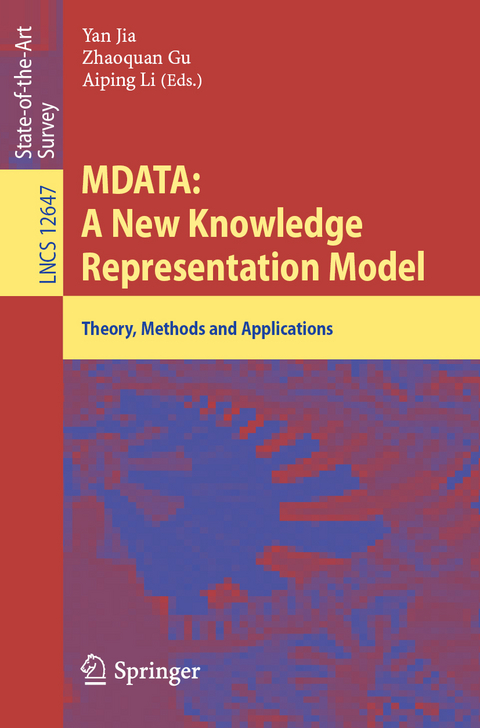
MDATA: A New Knowledge Representation Model
Springer International Publishing (Verlag)
978-3-030-71589-2 (ISBN)
This book introduces a new knowledge representation model called MDATA (Multi-dimensional Data Association and inTelligent Analysis). By modifying the representation of entities and relations in knowledge graphs, dynamic knowledge can be efficiently described with temporal and spatial characteristics. The MDATA model can be regarded as a high-level temporal and spatial knowledge graph model, which has strong capabilities for knowledge representation. This book introduces some key technologies in the MDATA model, such as entity recognition, relation extraction, entity alignment, and knowledge reasoning with spatiotemporal factors. The MDATA model can be applied in many critical applications and this book introduces some typical examples, such as network attack detection, social network analysis, and epidemic assessment.
The MDATA model should be of interest to readers from many research fields, such as database, cyberspace security, and social network, as the need for the knowledge representation arises naturally in many practical scenarios.
Introduction to the MDATA Model.- The Framework of the MDATA Computing Model.- Spatiotemporal Data Cleaning and Knowledge Fusion.- Chinese Named Entity Recognition: Applications and Challenges.- Joint Extraction of Entities and Relations: An Advanced BERT-based Decomposition Method.- Entity Alignment: Optimization by Seed Selection.- Knowledge Extraction: Automatic Classification of Matching Rules.- Network Embedding Attack: An Euclidean Distance based Method.- Few-Shot Knowledge Reasoning: An Attention Mechanism based Method.- Applications of Knowledge Representation Learning.- Detection and Defense Methods of Cyber Attacks.- A Distributed Framework for APT Attack Analysis.- Social Unrest Events Prediction by Contextual Gated Graph Convolutional Networks.- Information Cascading in Social Networks.
| Erscheinungsdatum | 08.04.2021 |
|---|---|
| Reihe/Serie | Information Systems and Applications, incl. Internet/Web, and HCI | Lecture Notes in Computer Science |
| Zusatzinfo | X, 255 p. 23 illus. |
| Verlagsort | Cham |
| Sprache | englisch |
| Maße | 155 x 235 mm |
| Gewicht | 415 g |
| Themenwelt | Mathematik / Informatik ► Informatik ► Datenbanken |
| Mathematik / Informatik ► Informatik ► Netzwerke | |
| Schlagworte | Applications • Artificial Intelligence • cognitive model • Computer Science • conference proceedings • Databases • Data Mining • entity alignment • entity recognition • Informatics • information extraction • Information Retrieval • Knowledge-Based System • knowledge fuse • Knowledge graph • knowledge management • Knowledge Representation • machine learning • MDATA • relation extraction • Research • Semantics • Signal Processing |
| ISBN-10 | 3-030-71589-2 / 3030715892 |
| ISBN-13 | 978-3-030-71589-2 / 9783030715892 |
| Zustand | Neuware |
| Informationen gemäß Produktsicherheitsverordnung (GPSR) | |
| Haben Sie eine Frage zum Produkt? |
aus dem Bereich


