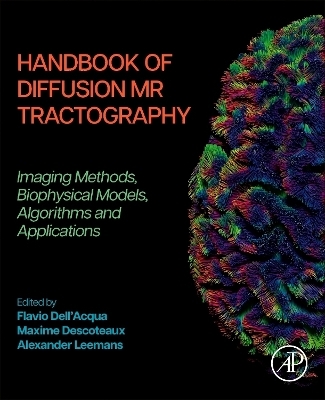
Handbook of Diffusion MR Tractography
Academic Press Inc (Verlag)
978-0-12-818894-1 (ISBN)
An extensive section of the book is devoted to the description of tractography applications in research and clinical settings to give a complete picture of tractography practice today. By focusing on technology, models, and applications, this handbook will be an indispensable reference for researchers and students with backgrounds in computer science, mathematics, physics, neuroscience, and medical science.
Flavio Dell'Acqua is Associate Professor and Reader in Translational Neuroimaging at the Institute of Psychiatry, Psychology and Neuroscience, King's College London, UK. A biomedical engineer and neuroscientist, Dr. Dell'Acqua's research interests span MR physics and medical image analysis. His work focuses on developing and applying advanced diffusion imaging and tractography methods for neuroscience, psychiatric, and clinical research. Dr. Dell'Acqua has co-authored over 100 papers, and his methods have been successfully applied in numerous tractography studies published in high-impact journals including Science, Nature Neuroscience, Nature Communication, Brain, and PNAS. He is a co-founder of the NatBrainLab, a multidisciplinary laboratory dedicated to the study of human neuroanatomy and tractography research. Committed to education in the field, Dr. Dell'Acqua has led educational courses on Diffusion Imaging for the Organization for Human Brain Mapping (OHBM) for multiple years. He is an active member of the International Society for Magnetic Resonance in Medicine (ISMRM) where he has lectured in educational courses, workshops and has served on the Diffusion Study Group committee. In 2023, he was a co-founder of the International Society for Tractography (IST). The investigator Maxime Descôteaux is a member of the Medical Imaging Axis of the Centre de recherche du CHUS, professor of the Computer Science Department, Faculty of Science, Université de Sherbrooke, Director of the Imaging and Visualization Platform (PAVI, pavi.dinf.usherbrooke.ca) and Director of the Sherbrooke Connectivity Imaging Laboratory (SCIL, scil.dinf.usherbrooke.ca). He is a leader in diffusion Magnetic Resonance Imaging (MRI) acquisition, processing and visualization to infer white matter connectivity of the brain. The goal of his research is to develop state-of-the-art fiber tractography tools to better understand functional coupling between cortical and sub-cortical regions of the brain and study connectivity properties of white matter to characterize fiber integrity. This field is now named ‘’connectomics’’. His most important contributions are in the fields of fundamental diffusion MRI processing and white matter fiber tract reconstruction and visualization. Recently, his tools have made the transfer to clinical applications for neurosurgical planning and interventions. He is a member of the editorial board of several important journals in neuroscience and co-founder of the company Imeka Solution Inc (www.imeka.ca). Alexander Leemans is a physicist who received his Ph.D. in 2006 at the University of Antwerp, Belgium. From 2007 to 2009, he worked as a postdoctoral researcher at the Cardiff University Brain Research Imaging Center (CUBRIC), Cardiff University, Wales, United Kingdom. In 2009, he joined the Image Sciences Institute (ISI), University Medical Center Utrecht, the Netherlands, where he currently holds a tenured faculty position as Associate Professor. His current research interests include modeling, processing, visualizing and analyzing diffusion MRI data for investigating microstructural and architectural tissue organization. He heads the PROVIDI Lab and is the developer of ExploreDTI, which is a graphical toolbox for investigating diffusion MRI data
PART I: From Anatomy to Tractography
1. The Brain and its Pathways
2. Neurobiology of Connections
3. Past and Present of Mapping Brain Connections
4. From Brownian motion to the brain connectome: My perspective and historical view of Diffusion MRI
PART II: Diffusion MRI
5. Physics of Diffusion Imaging: Fundamentals
6. Diffusion MRI acquisition for tractography: diffusion encoding
7. Diffusion MRI acquisition for tractography: Diffusion sequences
8. Diffusion MRI acquisition for tractography: Beyond the in vivo adult human brain
9. Artifacts and Diffusion MRI Processing
10. Single Shell Models: from DTI to HARDI
11. Multi-shell Models
12. From Diffusion Models to Fiber Orientations
PART III: Tractography Algorithms
13. Deterministic Tractography
14. Probabilistic Tractography
15. Shortest Path Tractography
16. Global Tractography
17. Machine Learning in Tractography
18. Improving Tractography with Multimodal Integration & Anatomical Priors
19. Tractography in normal and pathological anatomy : practical considerations
20. Tractography Visualization
PART IV: From Streamlines to Tracts
21. Dissecting White Matter Pathways : A Neuroanatomical Approach
22. Dissecting White Matter Pathways : Automatic Approaches
23. Methods and statistics for diffusion MRI tractometry
24. Connectivity and Connectomics
25. Tractography Validation Part 1: what needs validation, numerical simulations, and phantoms
26. Tractography Validation Part 2: The use of anatomical model systems and measures for validation
27. Tractography Validation Part 3: Lessons Learned through validation studies
28. Current challenges and opportunities for tractography
PART V: Tractography Applications
29. Tractography: Applications to Neurodevelopment, Ageing and Plasticity
30. Tractography: Linking Behavior with White Matter Networks
31. Tractography as a Clinical Tool
32. Ex-vivo and Preclinical Tractography: Techniques and Applications at High Field
33. "Multicenter Studies and Harmonization: Problems, Solutions, and Open Challenges"
PART VI: Appendix
A. Vectors and Tensors
B. Numerical Integration
C. Interpolation, Splines and Smoothing
D. Spherical Harmonics
| Erscheinungsdatum | 02.07.2021 |
|---|---|
| Verlagsort | San Diego |
| Sprache | englisch |
| Maße | 216 x 276 mm |
| Gewicht | 1000 g |
| Themenwelt | Informatik ► Grafik / Design ► Digitale Bildverarbeitung |
| ISBN-10 | 0-12-818894-4 / 0128188944 |
| ISBN-13 | 978-0-12-818894-1 / 9780128188941 |
| Zustand | Neuware |
| Informationen gemäß Produktsicherheitsverordnung (GPSR) | |
| Haben Sie eine Frage zum Produkt? |
aus dem Bereich