


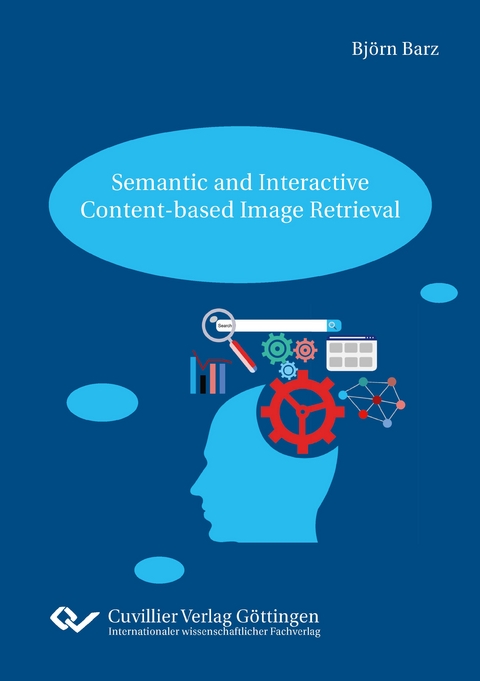
Semantic and Interactive Content-based Image Retrieval
Seiten
2020
Cuvillier Verlag
9783736973466 (ISBN)
Cuvillier Verlag
9783736973466 (ISBN)
- Keine Verlagsinformationen verfügbar
- Artikel merken
Content-based image retrieval (CBIR) aims for finding images in large databases such as the internet based on their content. Given an exemplary query image provided by the user, the retrieval system provides a ranked list of similar images. Most contemporary CBIR systems compare images solely by means of their visual similarity, i.e., the occurrence of similar textures and the composition of colors. However, visual similarity does not necessarily coincide with semantic similarity. For example, images of butterflies and caterpillars can be considered as similar, because the caterpillar turns into a butterfly at some point in time. Visually, however, they do not have much in common.
In this work, we propose to integrate such human prior knowledge about the semantics of the world into deep learning techniques. Class hierarchies serve as a source for this knowledge, which are readily available for a plethora of domains and encode is-a relationships (e.g., a poodle is a dog is an animal etc.). Our hierarchy-based semantic embeddings improve the semantic consistency of CBIR results substantially compared to conventional image representations and features.
We furthermore present three different mechanisms for interactive image retrieval by incorporating user feedback to resolve the inherent semantic ambiguity present in the query image. One of the proposed methods reduces the required user feedback to a single click using clustering, while another keeps the human in the loop by actively asking for feedback regarding those images which are expected to improve the relevance model the most. The third method allows the user to select particularly interesting regions in images. These techniques yield more relevant results after a few rounds of feedback, which reduces the total amount of retrieved images the user needs to inspect to find relevant ones.
In this work, we propose to integrate such human prior knowledge about the semantics of the world into deep learning techniques. Class hierarchies serve as a source for this knowledge, which are readily available for a plethora of domains and encode is-a relationships (e.g., a poodle is a dog is an animal etc.). Our hierarchy-based semantic embeddings improve the semantic consistency of CBIR results substantially compared to conventional image representations and features.
We furthermore present three different mechanisms for interactive image retrieval by incorporating user feedback to resolve the inherent semantic ambiguity present in the query image. One of the proposed methods reduces the required user feedback to a single click using clustering, while another keeps the human in the loop by actively asking for feedback regarding those images which are expected to improve the relevance model the most. The third method allows the user to select particularly interesting regions in images. These techniques yield more relevant results after a few rounds of feedback, which reduces the total amount of retrieved images the user needs to inspect to find relevant ones.
| Erscheinungsdatum | 06.01.2021 |
|---|---|
| Verlagsort | Göttingen |
| Sprache | englisch |
| Maße | 148 x 210 mm |
| Themenwelt | Mathematik / Informatik ► Informatik ► Theorie / Studium |
| Schlagworte | Active learning • aktives Lernen • Anwender • Artificial Intelligence • Artificial Neural Networks • average • Benutzerverhalten • Bilddaten • Category Retrieval • class hierarchies • classification • Clusterbildung • Clustering • computer vision • content-based image retrieval • contrastive loss • convolutional neural networks • Data • Databases • data storage • Datenbanken • Datenspeicherung • Datenübermittlung • Deep learning • Deep Metric Learning • Durchschnitt • Feature Transformation • Gaussian process • Gaussian processes • Gaußscher Prozess • Hierarchiebasierte semantische Bildmerkmale • Hierarchy-based Semantic Embeddings • Image • Image Data • Image Retrieval • Information • Information Retrieval • Inhaltsbasierte Bildsuche • Interactive Image Retrieval • Interaktive Bildabfrage • Internet • Keywords • Klassenhierarchien • Klassifikation • Knowledge Integration • Kontrastverlust • Künstliche neuronale Netzwerke • Lernen von Bildrepräsentationen • machine learning • Maschinelles Lernen • Merkmalsumwandlung • metric learning • Mustererkennung • Online • overstimulation • pattern recognition • Reizüberflutung • relevance feedback • representation learning • Rückmeldung • Search • Semantic Image Embeddings • semantic image retrieval • semantic similarity • Semantische Ähnlichkeitsmaße • Sensoren • sensors • social-media-plattformen • Stichwörter • Taxonomien • taxonomies • Tiefe Lernverfahren • überwachte Lokalisierung • User • User behaviour • Weakly Supervised Localization • Web • Web documents • Webdokument • Wissensintegration |
| ISBN-13 | 9783736973466 / 9783736973466 |
| Zustand | Neuware |
| Informationen gemäß Produktsicherheitsverordnung (GPSR) | |
| Haben Sie eine Frage zum Produkt? |
Mehr entdecken
aus dem Bereich



aus dem Bereich
was jeder über Informatik wissen sollte
Buch | Softcover (2024)
Springer Vieweg (Verlag)
CHF 53,15
Grundlagen – Anwendungen – Perspektiven
Buch | Softcover (2022)
Springer Vieweg (Verlag)
CHF 53,15
Teil 2 der gestreckten Abschlussprüfung Fachinformatiker/-in …
Buch | Softcover (2025)
Europa-Lehrmittel (Verlag)
CHF 37,90


