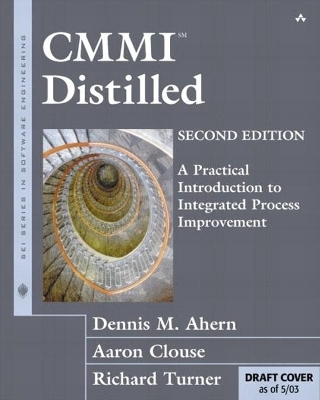
CMMI Distilled
Addison-Wesley Educational Publishers Inc (Verlag)
978-0-321-18613-3 (ISBN)
- Titel erscheint in neuer Auflage
- Artikel merken
When the first edition of this book was published in 2001, CMMI (Capability Maturity Model Integration) was largely viewed as a standard that was "on the horizon." In the past two years, CMMI has -- pardon the pun -- matured greatly. CMMI is now a recognized and widely-adopted model. This new edition reflects CMMI version 1.1 (the first edition was based on version 1.0). The book contains expanded coverage on the realized return on investment that can be attained through process improvement with CMMI, and the pioneer case studies have been replaced with broader CMMI-specific experience that will enable the reader to more easily adopt this model. The authors also share their understanding of how the CMMI will continue to adapt and remain relevant for years to come. The result is a handy book that is informative, useful, and appropriate to the reader's needs.
Dennis M. Ahern is an advisory engineer at Northrop Grumman Corporation. Previously, he taught at Yale University and the University of Maryland. He was the deputy project manager of the CMMI Product Development Team and a co-leader of the CMMI Editor Team. He is also an author of CMMI. Aaron Clouse is an engineering fellow at Raytheon Company. He was a member of the CMMI Editor Team and is an author of CMMI. Richard Turner, a research professor in engineering management and systems engineering at the George Washington University, approaches balanced software development and acquisition with broad industry and government experience and a skeptical attitude toward best practices. In support of the U.S. Department of Defense, he is responsible for identifying and transitioning new software technology into the development and acquisition of complex, software-intensive defense systems. Dr. Turner was on the original author team for Capability Maturity Model Integration (CMMI) and is coauthor off CMMI Distilled, Second Edition (Addison-Wesley, 2004).
Figure List.
Preface.
I. INTEGRATED PROCESS IMPROVEMENT.
1. Why Integrated Process Improvement?
The Engineering Environment of the Twenty-First Century.
Concurrent Engineering and the Cross-Discipline Team.
A Proliferation of Models and Standards.
The Benefits of Integrated Process Improvement.
Conclusions.
2. Implementing Integrated Process Improvement.
Starting Integrated Process Improvement.
Building an Integrated Improvement Infrastructure.
Integrating Legacy Processes and Initiatives.
Using Assessments.
Integrated Process Improvement Examples.
II. THE CMMI MODELS.
3. The CMMI Concept.
CMMI Project Organization.
CMMI Objectives.
The Three Source Models.
Process Areas.
An Extensible Framework.
4. CMMI Content.
Content Classification.
Required Materials.
Expected Materials.
Informative Materials.
Document Map.
5. CMMI Representations.
Staged Models.
Continuous Models.
CMMI Model Representations.
6. CMMI Dimensions for Measuring Improvement.
Capability Dimension.
Maturity Dimension.
Generic Practices in the Capability Dimension.
Generic Practices in the Maturity Dimension.
Organizational Capability Evolution.
7. CMMI Process Areas.
Process Management Process Areas.
Project Management Process Areas.
Engineering Process Areas.
Support Process Areas.
Integrated Product and Process Development Process Areas.
Acquisition Process Areas.
Relationships with CMMI Components.
III. USING CMMI.
8. Selecting the Appropriate Disciplines.
The Discipline Dilemma.
Your Situation.
The IPPD Extension.
The Acquisition Extension.
Selecting the Appropriate Model.
9. Picking a Representation.
Reasons for Liking Staged Models.
Reasons for Liking Continuous Models.
Reasons for Choosing a CMMI Representation.
10. Appraisals with CMMI.
Assessment Requirements for CMMI.
Standard CMMI Assessment Method for Process Improvement.
Using Assessments in Process Improvement.
Making a CMMI Model Your Own (Tailoring).
IV. THE FUTURE OF CMMI.
11. Evolving CMMI.
Single Versus Dual Representations.
Collection of Issues for Version 1.1 and Beyond.
Afterword.
The Charge of the CMMI Product Team.
Appendix A. Summary of CMMI-SE/SW/IPPD Models: Summary of Continuous Representation.
Appendix B. Summary of CMMISE/SW/IPPD Models: Summary of Staged Representation.
Appendix C. References.
Appendix D. Resources.
The Maven.
Index.
| Erscheint lt. Verlag | 23.9.2003 |
|---|---|
| Reihe/Serie | SEI Series in Software Engineering |
| Verlagsort | New Jersey |
| Sprache | englisch |
| Maße | 236 x 232 mm |
| Gewicht | 644 g |
| Themenwelt | Mathematik / Informatik ► Informatik ► Software Entwicklung |
| ISBN-10 | 0-321-18613-3 / 0321186133 |
| ISBN-13 | 978-0-321-18613-3 / 9780321186133 |
| Zustand | Neuware |
| Informationen gemäß Produktsicherheitsverordnung (GPSR) | |
| Haben Sie eine Frage zum Produkt? |
aus dem Bereich