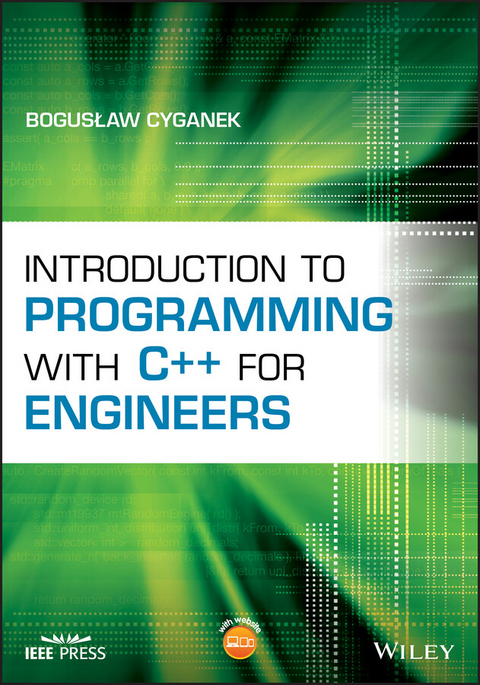
A complete textbook and reference for engineers to learn the fundamentals of computer programming with modern C++
Introduction to Programming with C++ for Engineers is an original presentation teaching the fundamentals of computer programming and modern C++ to engineers and engineering students.
Professor Cyganek, a highly regarded expert in his field, walks users through basics of data structures and algorithms with the help of a core subset of C++ and the Standard Library, progressing to the object-oriented domain and advanced C++ features, computer arithmetic, memory management and essentials of parallel programming, showing with real world examples how to complete tasks. He also guides users through the software development process, good programming practices, not shunning from explaining low-level features and the programming tools.
Being a textbook, with the summarizing tables and diagrams the book becomes a highly useful reference for C++ programmers at all levels.
Introduction to Programming with C++ for Engineers teaches how to program by:
- Guiding users from simple techniques with modern C++ and the Standard Library, to more advanced object-oriented design methods and language features
- Providing meaningful examples that facilitate understanding of the programming techniques and the C++ language constructions
- Fostering good programming practices which create better professional programmers
- Minimizing text descriptions, opting instead for comprehensive figures, tables, diagrams, and other explanatory material
- Granting access to a complementary website that contains example code and useful links to resources that further improve the reader's coding ability
- Including test and exam question for the reader's review at the end of each chapter
Engineering students, students of other sciences who rely on computer programming, and professionals in various fields will find this book invaluable when learning to program with C++.
Prof. Boguslaw Cyganek, Department of Electronics, AGH, University of Science and Technology, Krakow, Poland. Boguslaw Cyganek obtained his Ph.D. degree cum laude in 2001 with a thesis on correlation of stereo images, and D.Sc. degree in 2011 with a thesis on methods and algorithms of object recognition in digital images. During recent years, Dr. Cyganek has been cooperating with many scientific centers in development of computer vision systems. He has also gained several years of practical experience working as a Software Development Manager and a Senior Software Engineer both in the USA and Poland. He is an author or a co-author of over ninety conference and journal papers and four books including 'An Introduction to 3D Computer Vision Techniques and Algorithms', as well as 'Object Detection and Recognition in Digital Images: Theory and Practice', published by Wiley. Dr. Cyganek is a member of the IEEE, SPIE, IAPR and SIAM.
A complete textbook and reference for engineers to learn the fundamentals of computer programming with modern C++ Introduction to Programming with C++ for Engineers is an original presentation teaching the fundamentals of computer programming and modern C++ to engineers and engineering students. Professor Cyganek, a highly regarded expert in his field, walks users through basics of data structures and algorithms with the help of a core subset of C++ and the Standard Library, progressing to the object-oriented domain and advanced C++ features, computer arithmetic, memory management and essentials of parallel programming, showing with real world examples how to complete tasks. He also guides users through the software development process, good programming practices, not shunning from explaining low-level features and the programming tools. Being a textbook, with the summarizing tables and diagrams the book becomes a highly useful reference for C++ programmers at all levels. Introduction to Programming with C++ for Engineers teaches how to program by: Guiding users from simple techniques with modern C++ and the Standard Library, to more advanced object-oriented design methods and language features Providing meaningful examples that facilitate understanding of the programming techniques and the C++ language constructions Fostering good programming practices which create better professional programmers Minimizing text descriptions, opting instead for comprehensive figures, tables, diagrams, and other explanatory material Granting access to a complementary website that contains example code and useful links to resources that further improve the reader s coding ability Including test and exam question for the reader s review at the end of each chapter Engineering students, students of other sciences who rely on computer programming, and professionals in various fields will find this book invaluable when learning to program with C++.
Prof. Boguslaw Cyganek, Department of Electronics, AGH, University of Science and Technology, Krakow, Poland. Boguslaw Cyganek obtained his Ph.D. degree cum laude in 2001 with a thesis on correlation of stereo images, and D.Sc. degree in 2011 with a thesis on methods and algorithms of object recognition in digital images. During recent years, Dr. Cyganek has been cooperating with many scientific centers in development of computer vision systems. He has also gained several years of practical experience working as a Software Development Manager and a Senior Software Engineer both in the USA and Poland. He is an author or a co-author of over ninety conference and journal papers and four books including "An Introduction to 3D Computer Vision Techniques and Algorithms", as well as "Object Detection and Recognition in Digital Images: Theory and Practice", published by Wiley. Dr. Cyganek is a member of the IEEE, SPIE, IAPR and SIAM.
1
Introduction
Success is not final, failure is not fatal: it is the courage to continue that counts.
Winston Churchill
This book arose as a result of my fascination with computers and programming with the C++ language. It is also a result of my over 20 years of teaching the basics of computer science and particularly the C++ language to the students of the faculties of electrical engineering as well as mechanical engineering and robotics at AGH University of Science and Technology in Krakow, Poland. I have also worked as a programmer and consultant to several companies, becoming a senior software engineer and software designer, and have led groups of programmers and served as a teacher for younger colleagues.
Learning programming with a computer language is and should be fun, but learning it well can be difficult. Teaching C++ is also much more challenging than it was a decade ago. The language has grown up significantly and provided new exciting features, which we would like to understand and use to increase our productivity. As of the time of writing, C++20 will be released soon. In the book, we use many features of C++17, as well as show some of C++20. On the other hand, in many cases, it is also good to know at least some of the old features as well, since these are ubiquitous in many software projects, libraries, frameworks, etc. For example, once I was working on a C++ project for video processing. While adjusting one of the versions of the JPEG IO libraries, I discovered memory leaks. Although the whole project was in modern C++, I had to chase a bug in the old C code. It took me a while, but then I was able to fix the problem quickly.
The next problem is that the code we encounter in our daily work is different than what we learn from our courses. Why? There are many reasons. One is legacy code, which is just a different way of saying that the process of writing code usually is long and carries on for years. Moreover, even small projects tend to become large, and they can become huge after years of development. Also, the code is written by different programmers having different levels of understanding, as well as different levels of experience and senses of humor. For example, one of my programmer colleagues started each of his new sources with a poem. As a result, programmers must not only understand, maintain, and debug software as it is, but sometimes also read poems. This is what creates a discrepancy between the nice, polished code snippets presented in classes as compared to “real stuff.” What skills are necessary to become a successful programmer, then?
Why did I write this book, when there are so many programming Internet sites, discussion lists, special interest groups, code examples, and online books devoted to software development? Although all of these frequently are great and highly useful as instant references, it is sometimes difficult to find places or sources that lead us step-by-step through the learning process. It is even more difficult to find good examples that teach key programming techniques and at the same time are short, practical, and meaningful. So, I would like to share with you the synergy of theory descriptions underpinned with project examples that I have collected during my years of programming and teaching.
Let us now look at a short overview of the main subject of this book. The C++ programming language is one of the most influential, commonly used, and fascinating languages, initially developed by Bjarne Stroustrup in the 1980s. In the last decade, it has undergone vast and fundamental changes. The roots of C++ are in the C and Simula programming languages (Stroustrup B., Evolving a language 2007) (Stroustrup B., The C++ Programming Language 2013). As we will see, basic constructions such as expressions and statements, for instance, are almost the same for the two. Also, for years, all C++ compilers have been able to swiftly compile C code. C is the language that greatly influenced our technological revolution, proving to be a key tool in the development of the highly influential Unix operating system, followed by all the other OSs, including Windows, Linux, and Android. Due to its multiplatform compatibility and light footprint, C is still used in embedded systems, field-programmable gate array (FPGA) devices, and graphics cards (graphics processing units GPUs), as well as in code acceleration on parallel platforms. There are also tons of libraries written with C and still in use, such as those with efficient numerical algorithms or for image processing, to name a few. Simula, on the other hand, was one of the first languages equipped with classes, and it fostered the methodology of object-oriented software development. This became a cornerstone of the majority of technological endeavors. Hence, paraphrasing, C++ inherited from these two: from C in public, and from Simula in private.
Although there are many programming languages, learning C++ is worth the effort, especially for people planning to work or already involved in any kind of computer programming, especially for systems and performance. To grasp the main features of C++, it is sufficient to read this book; we will explore them in depth. However, as an introduction here, let us briefly list the most characteristic ones, as follows.
- Programmer freedom and wealth of features – Both low-level and highly abstract constructions can be used in many contexts. As with a Swiss army knife, there is a danger of misuse, but freedom and a wealth of features lead to the highest productivity level in various contexts and broad applications. But most of all – freedom is what we love
- High performance – This has always been a primary goal of the language. The key point in this respect is to be able to adjust many programming features to a particular need without much overhead. C++ was designed to meet this requirement – it can be paraphrased as “Don't pay for what you don't use.” As always, there is a price to pay, though, such as uninitialized variables and un-released resources. However, the new features of modern C++ make these less severe, still placing C++ code in the top-performing league
- System low-level and high-levelobject-oriented programming (OOP) on the same platform – C++ has been used to implement systems requiring low-level access. Many times, C++ is used to construct bridges between other languages: for example, in a numerical domain, to Fortran; and in systems programming, to C and Assembly. On the other hand, the same language has been used to implement high-level applications, such as word processors, CAD platforms, databases, and games. C++ is a strongly object-oriented (OO) language, fulfilling all the OO paradigms such as abstraction, encapsulation, inheritance, polymorphism, operator overloading, etc. These features, augmented with templates and design patterns, constitute strong support in software development, especially for large systems
- Strongly typed language – Each object is characterized by its type. This strong type requirement leads to code that is verified by a compiler, not by a user at runtime, as is the case with some languages that do not possess this feature. Nevertheless, objects can be converted from a type to another type due to built-in or user-provided conversion operators. Also, the relatively new type-deduction mechanism with the
autokeyword has greatly simplified the use of types and simply lets us save on typing - Exception handling – How to handle computational problems at runtime has always been a question. For example, what should be done in code if a file with crucial settings cannot be opened, or a division by zero is encountered? The solid exception handling system, with a built-in stack unwinding mechanism, greatly facilitates management in such situations
- Input-output (IO) – C++ was the first language that beat its competition in providing a clear, extensible, and highly efficient hierarchy of IO objects, as well as getting control over dozens of formatting styles and flags. This feature, although not without some limitations and criticism, can be used to add IO abilities to user-defined types in a fast and elegant way, with the help of overloaded operators
- Move semantics – One of the primary goals of C++ has always been performance. A large number of processed objects negatively affects this, especially if the objects are large and extensively copied. However, in many cases, object copying is not necessary, since data can be simply and efficiently swapped. This is the data-swapping mechanism behind the highly efficient move semantics available in modern C++, which have also increased the quality of the generated code
- Lambda expressions – This relatively new way of writing expression-like functions greatly improved the process of passing specialized actions or traits to algorithms. Together with
auto, lambdas lead to more elegant code and increased productivity - Smart pointers – Although smart pointers are among dozens of programming constructions from the Standard Library (SL), they changed the way C++ operates with system resources. For years, possible memory leaks that could easily happen in carelessly written C or C++ code were claimed as the main reasons against approving C++ code in high-security...
| Erscheint lt. Verlag | 1.12.2020 |
|---|---|
| Reihe/Serie | IEEE Press |
| Wiley - IEEE | Wiley - IEEE |
| Sprache | englisch |
| Themenwelt | Informatik ► Programmiersprachen / -werkzeuge ► C / C++ |
| Mathematik / Informatik ► Informatik ► Software Entwicklung | |
| Schlagworte | C++ • c for beginners • C++ FOR BEGINNERS • C for engineers • C++ for engineers • C++ guide • C++ instruction manual • Computer Engineering • Computer Science • Computertechnik • Design Patterns • Electrical & Electronics Engineering • Elektrotechnik u. Elektronik • Informatik • introduction to C++ introduction to C • Introduction to Programming in C++ for Engineers • intro programming • object-oriented programming • parallel programming, computer arithmetic • Programmierung • Programmierung / C u. C++ • Programming / C & C++ • programming for beginners • Systems Engineering & Management • Systemtechnik • Systemtechnik u. -management |
| ISBN-10 | 1-119-43113-1 / 1119431131 |
| ISBN-13 | 978-1-119-43113-8 / 9781119431138 |
| Informationen gemäß Produktsicherheitsverordnung (GPSR) | |
| Haben Sie eine Frage zum Produkt? |
 EPUB (Adobe DRM)
Kopierschutz: Adobe-DRM
Adobe-DRM ist ein Kopierschutz, der das eBook vor Mißbrauch schützen soll. Dabei wird das eBook bereits beim Download auf Ihre persönliche Adobe-ID autorisiert. Lesen können Sie das eBook dann nur auf den Geräten, welche ebenfalls auf Ihre Adobe-ID registriert sind.
Details zum Adobe-DRM
Dateiformat: EPUB (Electronic Publication)
EPUB ist ein offener Standard für eBooks und eignet sich besonders zur Darstellung von Belletristik und Sachbüchern. Der Fließtext wird dynamisch an die Display- und Schriftgröße angepasst. Auch für mobile Lesegeräte ist EPUB daher gut geeignet.
Systemvoraussetzungen:
PC/Mac: Mit einem PC oder Mac können Sie dieses eBook lesen. Sie benötigen eine
eReader: Dieses eBook kann mit (fast) allen eBook-Readern gelesen werden. Mit dem amazon-Kindle ist es aber nicht kompatibel.
Smartphone/Tablet: Egal ob Apple oder Android, dieses eBook können Sie lesen. Sie benötigen eine
Geräteliste und zusätzliche Hinweise
Buying eBooks from abroad
For tax law reasons we can sell eBooks just within Germany and Switzerland. Regrettably we cannot fulfill eBook-orders from other countries.
aus dem Bereich