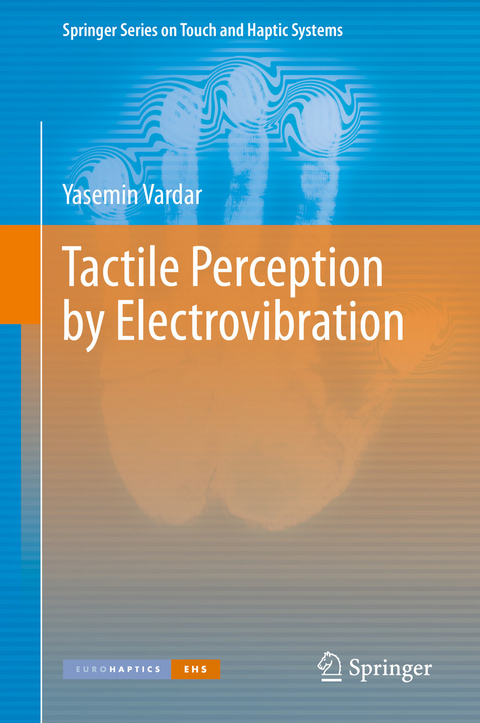
Tactile Perception by Electrovibration (eBook)
XV, 141 Seiten
Springer International Publishing (Verlag)
978-3-030-52252-0 (ISBN)
This book explains the mechanisms underpinning the tactile perception of electrovibration and lays the groundwork for delivering realistic haptic feedback on touchscreens via this method. Effective utilization of electrovibration can only be accomplished by simultaneously investigating both the physical and perceptual aspects of the finger-touchscreen interaction. Towards this goal, present work blends the available knowledge on electromechanical properties of the human finger and human tactile perception with the results of new psychophysical experiments and physical measurements. By following such an approach that combines both theoretical and experimental information, the study proposes new methods and insights on generating realistic haptic effects, such as textures and edges on these displays. Besides, state-of-the-art research on the field is reviewed, and future work is discussed. The presented interdisciplinary methods and insights can interest students, broad communities of haptics, neuroscience, engineering, physics, and cognitive sciences, as well as user-interaction experts and product designers from the industry.
Yasemin Vardar is currently a Postdoctoral Researcher in the Haptic Intelligence Department of the Max Planck Institute for Intelligent Systems. She is joining the Cognitive Robotics Department of the Delft University of Technology as an Assistant Professor in September 2020. She earned her Ph.D. in Mechanical Engineering from Koç University in 2018, her M.Sc. from in Systems and Control from the Eindhoven University of Technology in 2012, and her B.Sc. in Mechatronics Engineering from Sabanci University in 2010. She worked as a Control Engineer at the Additive Manufacturing Department of TNO before her doctoral studies. Her research focuses on designing haptic devices and applications by considering the capabilities of human haptic perception. Yasemin has published her research at the top venues such as IEEE Transactions on Haptics and Frontiers in Neuroscience and has won prestigious awards, including the Eurohaptics Best Ph.D. Thesis Award in Haptics (2018) and TUBITAK Graduate Scholarship (2013)
| Erscheint lt. Verlag | 9.11.2020 |
|---|---|
| Reihe/Serie | Springer Series on Touch and Haptic Systems | Springer Series on Touch and Haptic Systems |
| Zusatzinfo | XV, 141 p. 75 illus., 56 illus. in color. |
| Sprache | englisch |
| Themenwelt | Mathematik / Informatik ► Informatik ► Betriebssysteme / Server |
| Schlagworte | Electrovibration • Haptic Technology • Psychophysics • Surface Haptics • Tactile Perception |
| ISBN-10 | 3-030-52252-0 / 3030522520 |
| ISBN-13 | 978-3-030-52252-0 / 9783030522520 |
| Informationen gemäß Produktsicherheitsverordnung (GPSR) | |
| Haben Sie eine Frage zum Produkt? |
 PDF (Wasserzeichen)
DRM: Digitales Wasserzeichen
Dieses eBook enthält ein digitales Wasserzeichen und ist damit für Sie personalisiert. Bei einer missbräuchlichen Weitergabe des eBooks an Dritte ist eine Rückverfolgung an die Quelle möglich.
Dateiformat: PDF (Portable Document Format)
Mit einem festen Seitenlayout eignet sich die PDF besonders für Fachbücher mit Spalten, Tabellen und Abbildungen. Eine PDF kann auf fast allen Geräten angezeigt werden, ist aber für kleine Displays (Smartphone, eReader) nur eingeschränkt geeignet.
Systemvoraussetzungen:
PC/Mac: Mit einem PC oder Mac können Sie dieses eBook lesen. Sie benötigen dafür einen PDF-Viewer - z.B. den Adobe Reader oder Adobe Digital Editions.
eReader: Dieses eBook kann mit (fast) allen eBook-Readern gelesen werden. Mit dem amazon-Kindle ist es aber nicht kompatibel.
Smartphone/Tablet: Egal ob Apple oder Android, dieses eBook können Sie lesen. Sie benötigen dafür einen PDF-Viewer - z.B. die kostenlose Adobe Digital Editions-App.
Buying eBooks from abroad
For tax law reasons we can sell eBooks just within Germany and Switzerland. Regrettably we cannot fulfill eBook-orders from other countries.
aus dem Bereich