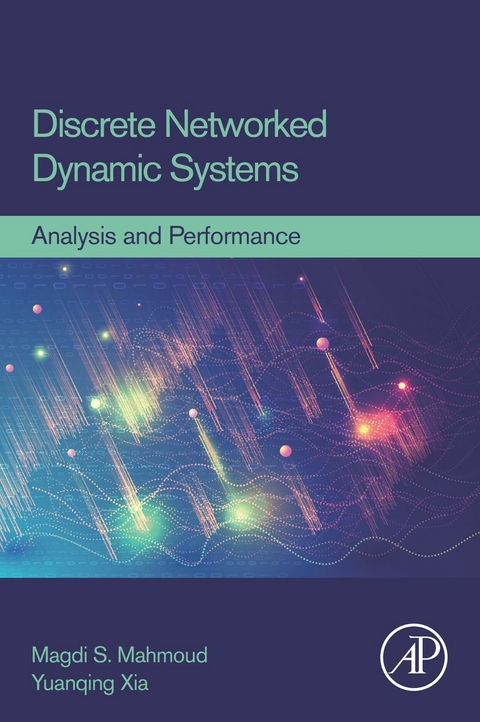
Discrete Networked Dynamic Systems (eBook)
484 Seiten
Elsevier Science (Verlag)
978-0-12-823699-4 (ISBN)
Magdi S. Mahmoud is a distinguished professor at King Fahd University of Petroleum and Minerals (KFUPM), Saudi Arabia. He has been faculty member at different universities worldwide including Egypt (CU, AUC), Kuwait (KU), UAE (UAEU), UK (UMIST), USA (Pitt, Case Western), Singapore (Nanyang), and Australia (Adelaide). He lectured in Venezuela (Caracas), Germany (Hanover), UK (Kent), USA (UoSA), Canada (Montreal) and China (BIT, Yanshan). He is the principal author of 51 books, inclusive book-chapters, and author/co-author of more than 610 peer-reviewed papers. He is a fellow of the IEE and a senior member of the IEEE, the CEI (UK). He is currently actively engaged in teaching and research in the development of modern methodologies to distributed control and filtering, networked control systems, fault-tolerant systems, cyberphysical systems, and information technology.
Discrete Networked Dynamic Systems: Analysis and Performance provides a high-level treatment of a general class of linear discrete-time dynamic systems interconnected over an information network, exchanging relative state measurements or output measurements. It presents a systematic analysis of the material and provides an account to the math development in a unified way. The topics in this book are structured along four dimensions: Agent, Environment, Interaction, and Organization, while keeping global (system-centered) and local (agent-centered) viewpoints. The focus is on the wide-sense consensus problem in discrete networked dynamic systems. The authors rely heavily on algebraic graph theory and topology to derive their results. It is known that graphs play an important role in the analysis of interactions between multiagent/distributed systems. Graph-theoretic analysis provides insight into how topological interactions play a role in achieving coordination among agents. Numerous types of graphs exist in the literature, depending on the edge set of G. A simple graph has no self-loop or edges. Complete graphs are simple graphs with an edge connecting any pair of vertices. The vertex set in a bipartite graph can be partitioned into disjoint non-empty vertex sets, whereby there is an edge connecting every vertex in one set to every vertex in the other set. Random graphs have fixed vertex sets, but the edge set exhibits stochastic behavior modeled by probability functions. Much of the studies in coordination control are based on deterministic/fixed graphs, switching graphs, and random graphs. - This book addresses advanced analytical tools for characterization control, estimation and design of networked dynamic systems over fixed, probabilistic and time-varying graphs- Provides coherent results on adopting a set-theoretic framework for critically examining problems of the analysis, performance and design of discrete distributed systems over graphs- Deals with both homogeneous and heterogeneous systems to guarantee the generality of design results
| Erscheint lt. Verlag | 22.10.2020 |
|---|---|
| Sprache | englisch |
| Themenwelt | Informatik ► Theorie / Studium ► Künstliche Intelligenz / Robotik |
| Technik ► Bauwesen | |
| Technik ► Maschinenbau | |
| ISBN-10 | 0-12-823699-X / 012823699X |
| ISBN-13 | 978-0-12-823699-4 / 9780128236994 |
| Informationen gemäß Produktsicherheitsverordnung (GPSR) | |
| Haben Sie eine Frage zum Produkt? |
 EPUB (Adobe DRM)
Kopierschutz: Adobe-DRM
Adobe-DRM ist ein Kopierschutz, der das eBook vor Mißbrauch schützen soll. Dabei wird das eBook bereits beim Download auf Ihre persönliche Adobe-ID autorisiert. Lesen können Sie das eBook dann nur auf den Geräten, welche ebenfalls auf Ihre Adobe-ID registriert sind.
Details zum Adobe-DRM
Dateiformat: EPUB (Electronic Publication)
EPUB ist ein offener Standard für eBooks und eignet sich besonders zur Darstellung von Belletristik und Sachbüchern. Der Fließtext wird dynamisch an die Display- und Schriftgröße angepasst. Auch für mobile Lesegeräte ist EPUB daher gut geeignet.
Systemvoraussetzungen:
PC/Mac: Mit einem PC oder Mac können Sie dieses eBook lesen. Sie benötigen eine
eReader: Dieses eBook kann mit (fast) allen eBook-Readern gelesen werden. Mit dem amazon-Kindle ist es aber nicht kompatibel.
Smartphone/Tablet: Egal ob Apple oder Android, dieses eBook können Sie lesen. Sie benötigen eine
Geräteliste und zusätzliche Hinweise
Buying eBooks from abroad
For tax law reasons we can sell eBooks just within Germany and Switzerland. Regrettably we cannot fulfill eBook-orders from other countries.
aus dem Bereich