


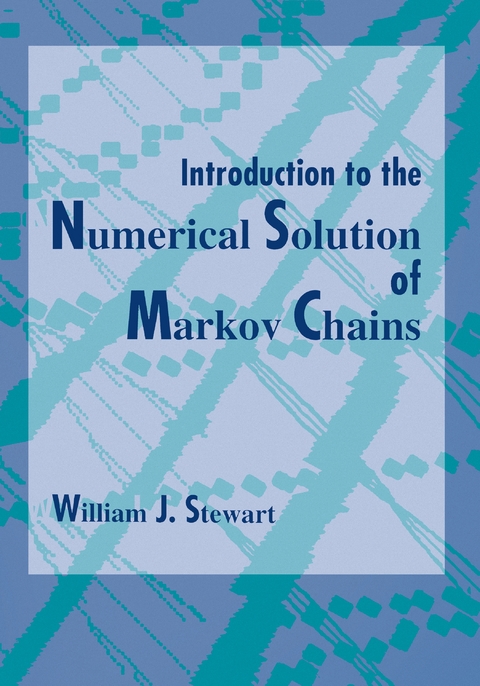
Introduction to the Numerical Solution of Markov Chains (eBook)
Princeton University Press (Verlag)
978-0-691-22338-4 (ISBN)
| Erscheint lt. Verlag | 12.1.2021 |
|---|---|
| Zusatzinfo | 41 line drawings 74 tables |
| Sprache | englisch |
| Themenwelt | Mathematik / Informatik ► Informatik ► Theorie / Studium |
| Mathematik / Informatik ► Mathematik ► Wahrscheinlichkeit / Kombinatorik | |
| Schlagworte | Absorbing Markov chain • Absorbing state • algorithm • analysis of algorithms • Approximation • Arnoldi method • Arnoldi process • Asymptotic convergence rate • Block Gauss-Seidel • Block splitting • block triangular matrix • Calculation • Chapman–Kolmogorov equation • ChapmanЋolmogorov equation • Chebyshev approximation • Coefficient matrix • Computation • computational complexity theory • conditional probabilities • Conditioning • Conjugate Gradient Method • Connected vertices • Consistently ordered matrix • Continuity equation • continuous-time Markov chain • Continuous-time stochastic process • convergence • Convergence factors • convergence properties • Courtois problem • Cyclic tendencies • Decompositional methods • Decomposition method (constraint satisfaction) • Diagonal blocks • Diagram (category theory) • differential equation • directed graph • Direct Methods • Discretization parameter • domain decomposition methods • eigenvalues • Eigenvalues and Eigenvectors • Eigenvectors • Elliptic partial differential equation • Ephemeral states • Equation • ergodic theory • Erlang law • Error analysis (Mathematics) • Euler methods • Euler polygon • Explicit method • Factorization • Family of solution curves • Fixed-point theorem • Full pivoting • Function (mathematics) • Galerkin condition • Gaussian elimination • Gauss–Seidel method • Gauss transformation • GaussГeidel method • geometric distribution • Gerschgorin theorem • Guard vectors • hash function • Hermitian matrices • Hessenberg Matrices • Identity matrix • Indicator function • Infinitesimal generator (stochastic processes) • Initial Value Problem • Inverse iteration • Invertible matrix • Iteration • Iterative Method • Iterative process • Jacobian matrix and determinant • Jacobi method • Krylov subspace methods • Lanczos algorithm • Lanczos methods • linear differential equation • linear equation • Linear multistep method • Lipschitz continuity • Load-dependent • Lower Hessenberg matrix • Low-stepping transitions • Machine epsilon • Marca ordering • Markov Chain • markov chains • Markov model • Markov process • Markov Property • Markov reward model • Mathematical Optimization • Matrix (mathematics) • mean value analysis • Memoryless property • M-matrix • Multiple (mathematics) • Near-breakdown • Newton's method • Norm (mathematics) • Numerical analysis • Numerical Integration • Numerical Stability • Optimality property • ordinary differential equation • Orthogonal complement • Orthonormal basis • Overrelaxation • Parameter (computer programming) • partial differential equation • Permutation Matrix • Perron–Frobenius theorem • PerronІrobenius theorem • Poisson distribution • Poisson Point Process • Power iteration • Preconditioner • Predictor–corrector method • PredictorУorrector method • Probability • Probability Distribution • Probability space • Projection (linear algebra) • Projection method (fluid dynamics) • Proportionality (mathematics) • QR algorithm • QR decomposition • Queueing Theory • rate function • Rate of Convergence • Recurrence relation • Recursion (computer science) • renormalization • result • Scale factor (computer science) • Series (mathematics) • Sign (mathematics) • Simultaneous Equations • State-space Representation • stochastic • Stochastic matrix • stochastic petri net • Summation • Synchronization (computer science) • system of linear equations • Theorem • time complexity • transformation matrix • Transition rate matrix • Truncation error (numerical integration) • Variable (computer science) |
| ISBN-10 | 0-691-22338-6 / 0691223386 |
| ISBN-13 | 978-0-691-22338-4 / 9780691223384 |
| Informationen gemäß Produktsicherheitsverordnung (GPSR) | |
| Haben Sie eine Frage zum Produkt? |
 PDF (Adobe DRM)
Kopierschutz: Adobe-DRM
Adobe-DRM ist ein Kopierschutz, der das eBook vor Mißbrauch schützen soll. Dabei wird das eBook bereits beim Download auf Ihre persönliche Adobe-ID autorisiert. Lesen können Sie das eBook dann nur auf den Geräten, welche ebenfalls auf Ihre Adobe-ID registriert sind.
Details zum Adobe-DRM
Dateiformat: PDF (Portable Document Format)
Mit einem festen Seitenlayout eignet sich die PDF besonders für Fachbücher mit Spalten, Tabellen und Abbildungen. Eine PDF kann auf fast allen Geräten angezeigt werden, ist aber für kleine Displays (Smartphone, eReader) nur eingeschränkt geeignet.
Systemvoraussetzungen:
PC/Mac: Mit einem PC oder Mac können Sie dieses eBook lesen. Sie benötigen eine
eReader: Dieses eBook kann mit (fast) allen eBook-Readern gelesen werden. Mit dem amazon-Kindle ist es aber nicht kompatibel.
Smartphone/Tablet: Egal ob Apple oder Android, dieses eBook können Sie lesen. Sie benötigen eine
Geräteliste und zusätzliche Hinweise
Buying eBooks from abroad
For tax law reasons we can sell eBooks just within Germany and Switzerland. Regrettably we cannot fulfill eBook-orders from other countries.
aus dem Bereich


