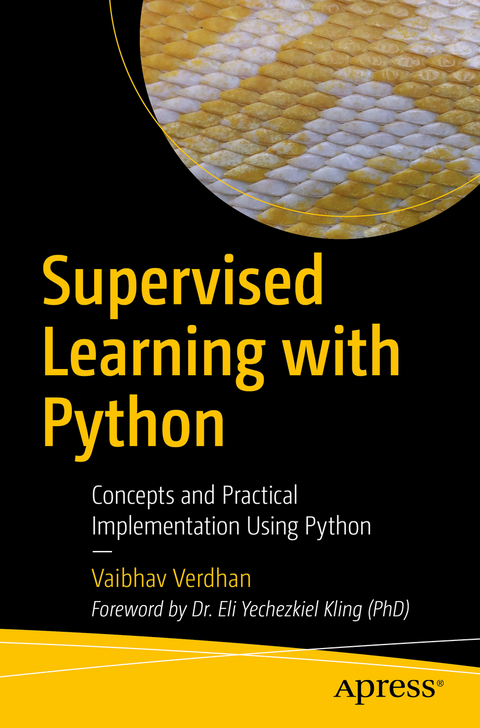
Supervised Learning with Python (eBook)
XX, 372 Seiten
Apress (Verlag)
978-1-4842-6156-9 (ISBN)
Gain a thorough understanding of supervised learning algorithms by developing use cases with Python. You will study supervised learning concepts, Python code, datasets, best practices, resolution of common issues and pitfalls, and practical knowledge of implementing algorithms for structured as well as text and images datasets.
You'll start with an introduction to machine learning, highlighting the differences between supervised, semi-supervised and unsupervised learning. In the following chapters you'll study regression and classification problems, mathematics behind them, algorithms like Linear Regression, Logistic Regression, Decision Tree, KNN, Naïve Bayes, and advanced algorithms like Random Forest, SVM, Gradient Boosting and Neural Networks. Python implementation is provided for all the algorithms. You'll conclude with an end-to-end model development process including deployment and maintenance of the model.After reading Supervised Learning with Python you'll have a broad understanding of supervised learning and its practical implementation, and be able to run the code and extend it in an innovative manner.- Review the fundamental building blocks and concepts of supervised learning using Python
- Develop supervised learning solutions for structured data as well as text and images
- Solve issues around overfitting, feature engineering, data cleansing, and cross-validation for building best fit models
- Understand the end-to-end model cycle from business problem definition to model deployment and model maintenance
- Avoid the common pitfalls and adhere to best practices while creating a supervised learning model using Python
Vaibhav Verdhan has 12+ years of experience in Data Science, Machine Learning and Artificial Intelligence. An MBA with engineering background, he is a hands-on technical expert with acumen to assimilate and analyse data. He has led multiple engagements in ML and AI across geographies and across retail, telecom, manufacturing, energy and utilities domains. Currently he resides in Ireland with his family and is working as a Principal Data Scientist. When he is not working, he enjoys to read, direct plays, write poems and spend time with his family.
Gain a thorough understanding of supervised learning algorithms by developing use cases with Python. You will study supervised learning concepts, Python code, datasets, best practices, resolution of common issues and pitfalls, and practical knowledge of implementing algorithms for structured as well as text and images datasets.You'll start with an introduction to machine learning, highlighting the differences between supervised, semi-supervised and unsupervised learning. In the following chapters you'll study regression and classification problems, mathematics behind them, algorithms like Linear Regression, Logistic Regression, Decision Tree, KNN, Naive Bayes, and advanced algorithms like Random Forest, SVM, Gradient Boosting and Neural Networks. Python implementation is provided for all the algorithms. You'll conclude with an end-to-end model development process including deployment and maintenance of the model.After reading Supervised Learning with Python you'll have a broad understanding of supervised learning and its practical implementation, and be able to run the code and extend it in an innovative manner.What You'll LearnReview the fundamental building blocks and concepts of supervised learning using PythonDevelop supervised learning solutions for structured data as well as text and images Solve issues around overfitting, feature engineering, data cleansing, and cross-validation for building best fit modelsUnderstand the end-to-end model cycle from business problem definition to model deployment and model maintenance Avoid the common pitfalls and adhere to best practices while creating a supervised learning model using PythonWho This Book Is ForData scientists or data analysts interested in best practices and standards for supervised learning, and using classification algorithms and regression techniques to develop predictive models.
| Erscheint lt. Verlag | 7.10.2020 |
|---|---|
| Zusatzinfo | XX, 372 p. 226 illus., 5 illus. in color. |
| Sprache | englisch |
| Themenwelt | Informatik ► Theorie / Studium ► Künstliche Intelligenz / Robotik |
| Schlagworte | Decision Tree • machine learning • neural network • Production • Python • Randon Forest • Regression Analysis • supervised learning |
| ISBN-10 | 1-4842-6156-9 / 1484261569 |
| ISBN-13 | 978-1-4842-6156-9 / 9781484261569 |
| Informationen gemäß Produktsicherheitsverordnung (GPSR) | |
| Haben Sie eine Frage zum Produkt? |
 PDF (Wasserzeichen)
DRM: Digitales Wasserzeichen
Dieses eBook enthält ein digitales Wasserzeichen und ist damit für Sie personalisiert. Bei einer missbräuchlichen Weitergabe des eBooks an Dritte ist eine Rückverfolgung an die Quelle möglich.
Dateiformat: PDF (Portable Document Format)
Mit einem festen Seitenlayout eignet sich die PDF besonders für Fachbücher mit Spalten, Tabellen und Abbildungen. Eine PDF kann auf fast allen Geräten angezeigt werden, ist aber für kleine Displays (Smartphone, eReader) nur eingeschränkt geeignet.
Systemvoraussetzungen:
PC/Mac: Mit einem PC oder Mac können Sie dieses eBook lesen. Sie benötigen dafür einen PDF-Viewer - z.B. den Adobe Reader oder Adobe Digital Editions.
eReader: Dieses eBook kann mit (fast) allen eBook-Readern gelesen werden. Mit dem amazon-Kindle ist es aber nicht kompatibel.
Smartphone/Tablet: Egal ob Apple oder Android, dieses eBook können Sie lesen. Sie benötigen dafür einen PDF-Viewer - z.B. die kostenlose Adobe Digital Editions-App.
Buying eBooks from abroad
For tax law reasons we can sell eBooks just within Germany and Switzerland. Regrettably we cannot fulfill eBook-orders from other countries.
aus dem Bereich