


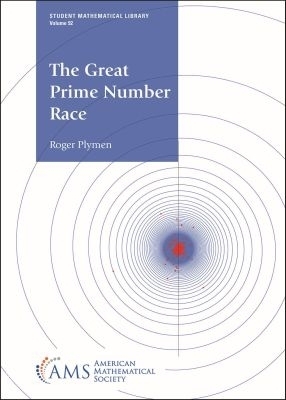
The Great Prime Number Race
Seiten
2021
American Mathematical Society (Verlag)
978-1-4704-6257-4 (ISBN)
American Mathematical Society (Verlag)
978-1-4704-6257-4 (ISBN)
Have you ever wondered about the explicit formulas in analytic number theory? This short book provides a streamlined and rigorous approach to the explicit formulas of Riemann and von Mangoldt. The race between the prime counting function and the logarithmic integral forms a motivating thread through the narrative.
Have you ever wondered about the explicit formulas in analytic number theory? This short book provides a streamlined and rigorous approach to the explicit formulas of Riemann and von Mangoldt. The race between the prime counting function and the logarithmic integral forms a motivating thread through the narrative, which emphasizes the interplay between the oscillatory terms in the Riemann formula and the Skewes number, the least number for which the prime number theorem undercounts the number of primes. Throughout the book, there are scholarly references to the pioneering work of Euler. The book includes a proof of the prime number theorem and outlines a proof of Littlewood's oscillation theorem before finishing with the current best numerical upper bounds on the Skewes number. This book is a unique text that provides all the mathematical background for understanding the Skewes number. Many exercises are included, with hints for solutions. This book is suitable for anyone with a first course in complex analysis. Its engaging style and invigorating point of view will make refreshing reading for advanced undergraduates through research mathematicians.
Have you ever wondered about the explicit formulas in analytic number theory? This short book provides a streamlined and rigorous approach to the explicit formulas of Riemann and von Mangoldt. The race between the prime counting function and the logarithmic integral forms a motivating thread through the narrative, which emphasizes the interplay between the oscillatory terms in the Riemann formula and the Skewes number, the least number for which the prime number theorem undercounts the number of primes. Throughout the book, there are scholarly references to the pioneering work of Euler. The book includes a proof of the prime number theorem and outlines a proof of Littlewood's oscillation theorem before finishing with the current best numerical upper bounds on the Skewes number. This book is a unique text that provides all the mathematical background for understanding the Skewes number. Many exercises are included, with hints for solutions. This book is suitable for anyone with a first course in complex analysis. Its engaging style and invigorating point of view will make refreshing reading for advanced undergraduates through research mathematicians.
Roger Plymen, Manchester University, United Kingdom
| Erscheinungsdatum | 02.11.2020 |
|---|---|
| Reihe/Serie | Student Mathematical Library |
| Verlagsort | Providence |
| Sprache | englisch |
| Gewicht | 190 g |
| Themenwelt | Mathematik / Informatik ► Mathematik ► Arithmetik / Zahlentheorie |
| ISBN-10 | 1-4704-6257-5 / 1470462575 |
| ISBN-13 | 978-1-4704-6257-4 / 9781470462574 |
| Zustand | Neuware |
| Informationen gemäß Produktsicherheitsverordnung (GPSR) | |
| Haben Sie eine Frage zum Produkt? |
Mehr entdecken
aus dem Bereich

aus dem Bereich
Mengeneigenschaften im Muster der Universellen Gleichmäßigkeit im …
Buch | Spiralbindung (2025)
White, J (Verlag)
CHF 208,55
unlock your imagination with the narrative of numbers
Buch | Softcover (2024)
Advantage Media Group (Verlag)
CHF 27,90
Eine logische Beweisführung zur Lösung des 3n + 1-Problems
Buch | Softcover (2025)
BoD – Books on Demand (Verlag)
CHF 13,85


