


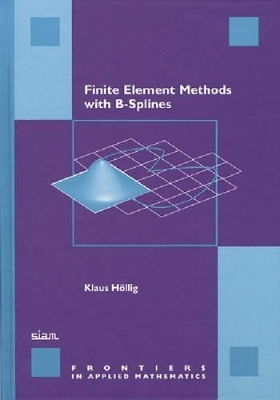
Finite Element Methods with B-Splines-No. 26
Seiten
2003
Society for Industrial & Applied Mathematics,U.S. (Verlag)
978-0-89871-533-0 (ISBN)
Society for Industrial & Applied Mathematics,U.S. (Verlag)
978-0-89871-533-0 (ISBN)
- Titel erscheint in neuer Auflage
- Artikel merken
Zu diesem Artikel existiert eine Nachauflage
An exploration of the new weighted approximation techniques which result from the combination of the finite element method and B-splines.
The finite element method (FEM) has become the most widely accepted general-purpose technique for numerical simulations in engineering and applied mathematics. Principal applications arise in continuum mechanics, fluid flow, thermodynamics and field theory. In these areas, computational methods are essential and benefit strongly from the enormous advances in computer technology. B-splines play an important role in approximation and geometric modeling. They are used in data fitting, computer-aided design (CAD), automated manufacturing (CAM) and computer graphics. Finite Element Methods with B-Splines describes new weighted approximation techniques, combining the computational advantages of B-splines and standard finite elements. In particular, no grid generation is necessary, which eliminates a difficult and often time-consuming preprocessing step. The meshless methods are very efficient and yield highly accurate solutions with relatively few parameters. This is illustrated for typical boundary value problems in fluid flow, heat conduction and elasticity.
The finite element method (FEM) has become the most widely accepted general-purpose technique for numerical simulations in engineering and applied mathematics. Principal applications arise in continuum mechanics, fluid flow, thermodynamics and field theory. In these areas, computational methods are essential and benefit strongly from the enormous advances in computer technology. B-splines play an important role in approximation and geometric modeling. They are used in data fitting, computer-aided design (CAD), automated manufacturing (CAM) and computer graphics. Finite Element Methods with B-Splines describes new weighted approximation techniques, combining the computational advantages of B-splines and standard finite elements. In particular, no grid generation is necessary, which eliminates a difficult and often time-consuming preprocessing step. The meshless methods are very efficient and yield highly accurate solutions with relatively few parameters. This is illustrated for typical boundary value problems in fluid flow, heat conduction and elasticity.
Klaus Höllig gained his PhD from the University of Michigan at Ann Arbor. Since then he has worked at Purdue University and the University of Wisconsin at Madison. He is currently a professor at the University of Stuttgart.
Preface; 1. Introduction; 2. Basic finite element concepts; 3. B-splines; 4. Finite element bases; 5. Approximation with weighted splines; 6. Boundary value problems; 7. Multigrid methods; 8. Implementation; Appendix; Notation and symbols; Bibliography; Index.
| Erscheint lt. Verlag | 31.1.2003 |
|---|---|
| Verlagsort | New York |
| Sprache | englisch |
| Gewicht | 460 g |
| Themenwelt | Mathematik / Informatik ► Mathematik ► Analysis |
| Mathematik / Informatik ► Mathematik ► Angewandte Mathematik | |
| ISBN-10 | 0-89871-533-4 / 0898715334 |
| ISBN-13 | 978-0-89871-533-0 / 9780898715330 |
| Zustand | Neuware |
| Informationen gemäß Produktsicherheitsverordnung (GPSR) | |
| Haben Sie eine Frage zum Produkt? |
Mehr entdecken
aus dem Bereich

aus dem Bereich
Festigkeits- und Verformungslehre, Baudynamik, Wärmeübertragung, …
Buch | Hardcover (2025)
De Gruyter Oldenbourg (Verlag)
CHF 125,90


