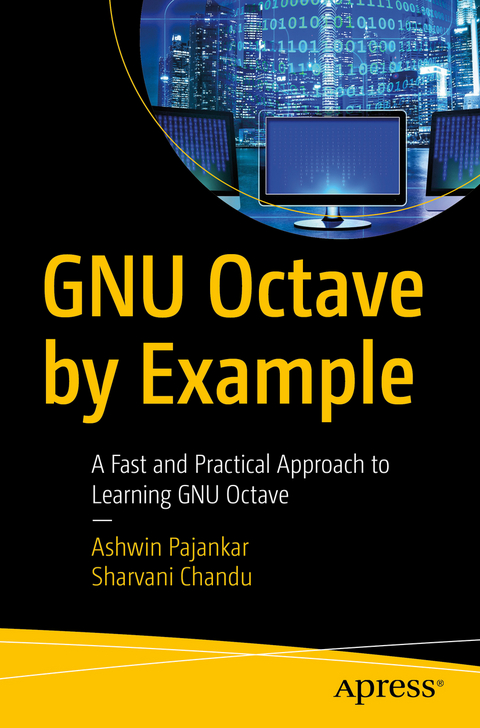
GNU Octave by Example (eBook)
XV, 173 Seiten
Apress (Verlag)
9781484260869 (ISBN)
Get a quick start to learn, understand, and apply GNU Octave using a math- and programming-friendly approach. This book focuses on an end-to-end track to teach mathematical programming, data science, signal processing, and image processing with GNU Octave.
GNU Octave by Example starts with an introduction to GNU Octave, a free and open-source alternative to MATLAB. Next, it explains the processes to install GNU Octave on popular operating systems such as Windows, Ubuntu, Raspberry Pi, and other platforms. Further, it covers hands-on exercises with GNU Octave exploring the basic functionality and command line in interactive mode. This is followed by covering matrices and various operations including how to read and analyze data from various sources. Moving forward, it introduces commonly used programming constructs in data visualization. It explains 2D and 3D data visualization along with data analysis. It also demonstrates the concepts related to geometry and its application with GNU Octave. It concludes with coverage of signal processing followed by image, video, and audio processing techniques.
After reading this book, you will be able to write your own programs for scientific and numerical applications.
What You Will Learn
? Understand the practical aspects of GNU Octave with math and programming-friendly abstractions
? Install GNU Octave on multiple platforms including Windows, Raspberry Pi, and Ubuntu
? Work with GNU Octave using the GUI, the command line, and Jupyter notebooks
? Implement 2D and 3D data visualization and analysis with GNU Octave
Who This Book Is For
Software engineers, data engineers, data science enthusiasts, and computer vision professionals.
Ashwin Pajankar holds a Master of Technology from IIIT Hyderabad. He started programming and tinkering with electronics at the tender age of seven. BASIC was the first programming language he worked with. He was gradually exposed to C programming, 8085, and x86 assembly programming during his higher secondary schooling. He is proficient in x86 assembly, C, Java, Python, and shell programming. He is also proficient with Raspberry Pi, Arduino, and other single board computers and microcontrollers. Ashwin is passionate about training and mentoring. He has trained more than 60,000 students and professionals in live and online training courses. He has published more than a dozen books with many international and Indian publishers. He has also reviewed numerous books and educational video courses. This is his fourth book with Apress and he is working on more books. He regularly conducts programming bootcamps and hands-on training for software companies.
He is also an avid YouTuber with more than 10,000 subscribers to his channel. You can find him on LinkedIn.
Sharvani Chandu holds an MS in Computer Vision from CMU and BTech in Electronics and Communication Engineering from IIIT Hyderabad. She has research experience in the areas of computer vision and machine learning. She currently works for Amazon and has also worked in Bangalore as a software engineer for a couple of years focusing on machine learning and natural language processing. During her undergraduate and graduate studies, she worked as a research intern, teaching assistant, and research assistant. She has also published research papers related to her work. She is enthusiastic about working in the areas of mathematics, computer vision, and programming.
You can find her on LinkedIn.
Get a quick start to learn, understand, and apply GNU Octave using a math- and programming-friendly approach. This book focuses on an end-to-end track to teach mathematical programming, data science, signal processing, and image processing with GNU Octave.GNU Octave by Example starts with an introduction to GNU Octave, a free and open-source alternative to MATLAB. Next, it explains the processes to install GNU Octave on popular operating systems such as Windows, Ubuntu, Raspberry Pi, and other platforms. Further, it covers hands-on exercises with GNU Octave exploring the basic functionality and command line in interactive mode. This is followed by covering matrices and various operations including how to read and analyze data from various sources. Moving forward, it introduces commonly used programming constructs in data visualization. It explains 2D and 3D data visualization along with data analysis. It also demonstrates the concepts related to geometry and its application with GNU Octave. It concludes with coverage of signal processing followed by image, video, and audio processing techniques.After reading this book, you will be able to write your own programs for scientific and numerical applications.What You Will Learn * Understand the practical aspects of GNU Octave with math and programming-friendly abstractions* Install GNU Octave on multiple platforms including Windows, Raspberry Pi, and Ubuntu* Work with GNU Octave using the GUI, the command line, and Jupyter notebooks* Implement 2D and 3D data visualization and analysis with GNU OctaveWho This Book Is For Software engineers, data engineers, data science enthusiasts, and computer vision professionals.
| Erscheint lt. Verlag | 14.9.2020 |
|---|---|
| Zusatzinfo | XV, 173 p. 100 illus., 6 illus. in color. |
| Sprache | englisch |
| Themenwelt | Mathematik / Informatik ► Informatik |
| Schlagworte | data analytics • GNU Octave • Image Processing • MATLAB • numerical computing • Octave |
| ISBN-13 | 9781484260869 / 9781484260869 |
| Informationen gemäß Produktsicherheitsverordnung (GPSR) | |
| Haben Sie eine Frage zum Produkt? |
 PDF (Wasserzeichen)
DRM: Digitales Wasserzeichen
Dieses eBook enthält ein digitales Wasserzeichen und ist damit für Sie personalisiert. Bei einer missbräuchlichen Weitergabe des eBooks an Dritte ist eine Rückverfolgung an die Quelle möglich.
Dateiformat: PDF (Portable Document Format)
Mit einem festen Seitenlayout eignet sich die PDF besonders für Fachbücher mit Spalten, Tabellen und Abbildungen. Eine PDF kann auf fast allen Geräten angezeigt werden, ist aber für kleine Displays (Smartphone, eReader) nur eingeschränkt geeignet.
Systemvoraussetzungen:
PC/Mac: Mit einem PC oder Mac können Sie dieses eBook lesen. Sie benötigen dafür einen PDF-Viewer - z.B. den Adobe Reader oder Adobe Digital Editions.
eReader: Dieses eBook kann mit (fast) allen eBook-Readern gelesen werden. Mit dem amazon-Kindle ist es aber nicht kompatibel.
Smartphone/Tablet: Egal ob Apple oder Android, dieses eBook können Sie lesen. Sie benötigen dafür einen PDF-Viewer - z.B. die kostenlose Adobe Digital Editions-App.
Buying eBooks from abroad
For tax law reasons we can sell eBooks just within Germany and Switzerland. Regrettably we cannot fulfill eBook-orders from other countries.
aus dem Bereich