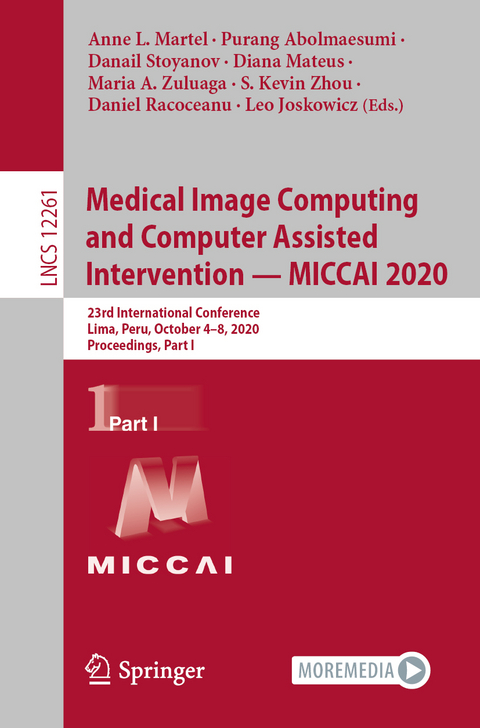
Medical Image Computing and Computer Assisted Intervention – MICCAI 2020
Springer International Publishing (Verlag)
978-3-030-59709-2 (ISBN)
The 542 revised full papers presented were carefully reviewed and selected from 1809 submissions in a double-blind review process. The papers are organized in the following topical sections:
Part I: machine learning methodologies
Part II: image reconstruction; prediction and diagnosis; cross-domain methods and reconstruction; domain adaptation; machine learning applications; generative adversarial networks
Part III: CAI applications; image registration; instrumentation and surgical phase detection; navigation and visualization; ultrasound imaging; video image analysis
Part IV: segmentation; shape models and landmark detection
Part V: biological, optical, microscopic imaging; cell segmentation and stain normalization; histopathology image analysis; opthalmology
Part VI: angiography and vessel analysis; breast imaging; colonoscopy; dermatology; fetal imaging; heart and lung imaging; musculoskeletal imaging
Part VI: brain development and atlases; DWI and tractography; functional brain networks; neuroimaging; positron emission tomography
Machine Learning Methodologies.- Attention, Suggestion and Annotation: A Deep Active Learning Framework for Biomedical Image Segmentation.- Scribble2Label: Scribble-Supervised Cell Segmentation via Self-Generating Pseudo-Labels with Consistency.- Are fast labeling methods reliable? A case study of computer-aided expert annotations on microscopy slides.- Deep Reinforcement Active Learning for Medical Image Classification.- An Effective Data Refinement Approach for Upper Gastrointestinal Anatomy Recognition.- Synthetic Sample Selection via Reinforcement Learning.- Dual-level Selective Transfer Learning for Intrahepatic Cholangiocarcinoma Segmentation in Non-enhanced Abdominal CT.- BiO-Net: Learning Recurrent Bi-directional Connections for Encoder-Decoder Architecture.- Constrain Latent Space for Schizophrenia Classification via Dual Space Mapping Net.- Have you forgotten? A method to assess ifmachine learning models have forgotten data.- Learning and Exploiting Interclass Visual Correlations for Medical Image Classification.- Feature Preserving Smoothing Provides Simple and Effective Data Augmentation for Medical Image Segmentation.- Deep kNN for Medical Image Classification.- Learning Semantics-enriched Representation via Self-discovery, Self-classification, and Self-restoration.- DECAPS: Detail-oriented Capsule Networks.- Federated Simulation for Medical Imaging.- Continual Learning of New Diseases with Dual Distillation and Ensemble Strategy.- Learning to Segment When Experts Disagree.- Deep Disentangled Hashing with Momentum Triplets for Neuroimage Search.- Learning joint shape and appearance representations with metamorphic auto-encoders.- Collaborative Learning of Cross-channel Clinical Attention for Radiotherapy-related Esophageal Fistula Prediction from CT.- Learning Bronchiole-Sensitive Airway Segmentation CNNs by Feature Recalibration and Attention Distillation.- Learning Rich Attention for Pediatric Bone Age Assessment.- Weakly Supervised Organ Localization with Attention Maps Regularized by Local Area Reconstruction.- High-order Attention Networks for Medical Image Segmentation.- NAS-SCAM: Neural Architecture Search-based Spatial and Channel Joint Attention Module for Nuclei Semantic Segmentation and Classification.- Scientific Discovery by Generating Counterfactuals using Image Translation.- Interpretable Deep Models for Cardiac Resynchronisation Therapy Response Prediction.- Encoding Visual Attributes in Capsules for Explainable Medical Diagnoses.- Interpretability-guided Content-based Medical Image Retrieval.- Domain aware medical image classifier interpretation by counterfactual impact analysis.- Towards Emergent Language Symbolic Semantic Segmentation and Model Interpretability.- Meta Corrupted Pixels Mining for Medical Image Segmentation.- UXNet: Searching Multi-level Feature Aggregation for 3D Medical Image Segmentation.- Difficulty-aware Meta-learning for Rare Disease Diagnosis.- Few Is Enough: Task-Augmented Active Meta-Learning for Brain Cell Classification.- Automatic Data Augmentation for 3D Medical Image Segmentation.- MS-NAS: Multi-Scale Neural Architecture Search for Medical Image Segmentation.- Comparing to Learn: Surpassing ImageNet Pretraining on Radiographs By Comparing Image Representations.- Dual-task Self-supervision for Cross-Modality Domain Adaptation.- Dual-Teacher: Integrating Intra-domain and Inter-domain Teachers for Annotation-efficient Cardiac Segmentation.- Test-time Unsupervised Domain Adaptation.- Self domain adapted network.- Entropy Guided Unsupervised Domain Adaptation for Cross-Center Hip Cartilage Segmentation from MRI.- User-Guided Domain Adaptation for Rapid Annotation from User Interactions: A Study on Pathological Liver Segmentation.- SALAD: Self-Supervised Aggregation Learning for Anomaly Detection on X-Rays.- Scribble-based Domain Adaptation via Deep Co-Segmentation.- Source-Relaxed Domain Adaptation for Image Segmentation.- Region-of-interest guided Supervoxel In
| Erscheinungsdatum | 04.10.2020 |
|---|---|
| Reihe/Serie | Image Processing, Computer Vision, Pattern Recognition, and Graphics | Lecture Notes in Computer Science |
| Zusatzinfo | XXXVII, 849 p. 257 illus. |
| Verlagsort | Cham |
| Sprache | englisch |
| Maße | 155 x 235 mm |
| Gewicht | 1335 g |
| Themenwelt | Informatik ► Grafik / Design ► Digitale Bildverarbeitung |
| Informatik ► Theorie / Studium ► Künstliche Intelligenz / Robotik | |
| Schlagworte | Applications • Artificial Intelligence • Bioinformatics • Computer Science • computer vision • conference proceedings • Deep learning • Image Analysis • Image Processing • image reconstruction • Image Segmentation • Imaging Systems • Informatics • learning • machine learning • Medical Images • Neural networks • pattern recognition • Research • segmentation methods |
| ISBN-10 | 3-030-59709-1 / 3030597091 |
| ISBN-13 | 978-3-030-59709-2 / 9783030597092 |
| Zustand | Neuware |
| Informationen gemäß Produktsicherheitsverordnung (GPSR) | |
| Haben Sie eine Frage zum Produkt? |
aus dem Bereich