


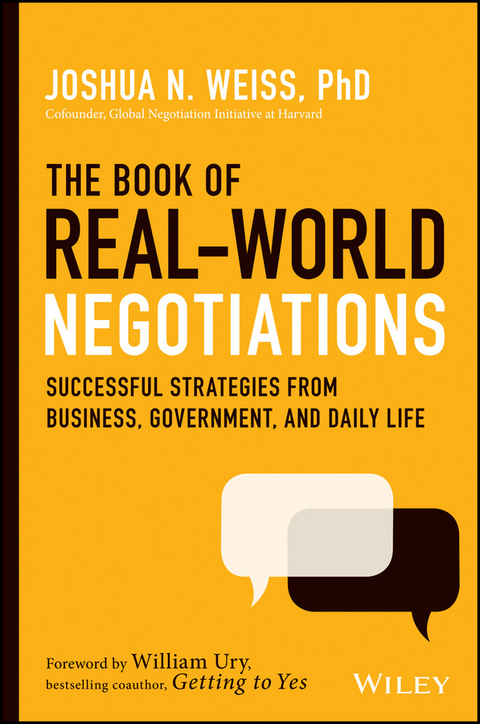
The Book of Real-World Negotiations (eBook)
Real world negotiation examples and strategies from one of the most highly respected authorities in the field
This unique book can help you change your approach to negotiation by learning key strategies and techniques from actual cases. Through hard to find real world examples you will learn exactly how to effectively and productively negotiate. The Book of Real World Negotiations: Successful Strategies from Business, Government and Daily Life shines a light on real world negotiation examples and cases, rather than discussing hypothetical scenarios. It reveals what is possible through preparation, persistence, creativity, and taking a strategic approach to your negotiations. Many of us enter negotiations with skepticism and without understanding how to truly negotiate well. Because we lack knowledge and confidence, we may abandon the negotiating process prematurely or agree to deals that leave value on the table.
The Book of Real World Negotiations will change that once and for all by immersing you in these real world scenarios. As a result, you'll be better able to grasp the true power of negotiation to deal with some of the most difficult problems you face or to put together the best deals possible. This book also shares critical insights and lessons for instructors and students of negotiation, especially since negotiation is now being taught in virtually all law schools, many business schools, and in the field of conflict resolution. Whether you're a student, instructor, or anyone who wants to negotiate successfully, you'll be able to carefully examine real world negotiation situations that will show you how to achieve your objectives in the most challenging of circumstances. The cases are organized by realms-domestic business cases, international business cases, governmental cases and cases that occur in daily life. From these cases you will learn more about:
- Exactly how to achieve Win-Win outcomes
- The critical role of underlying interests
- The kind of thinking that goes into generating creative options
- How to consider your and the other negotiator's Best Alternative to a Negotiated Agreement (BATNA)
- Negotiating successfully in the face of power
- Achieving success when negotiating cross-culturally
Once you come to understand through these cases that negotiation is the art of the possible, you'll stop saying 'a solution is impossible.' With the knowledge and self-assurance you gain from this book, you'll roll up your sleeves and keep negotiating until you reach a mutually satisfactory outcome!
Joshua N. Weiss, PhD (https://www.joshuanweiss.com/) is the co-founder of the Global Negotiation Initiative at Harvard University and a Senior Fellow at the Harvard Negotiation Project. He is also the Director and creator of the Master of Science degree in Leadership and Negotiation at Bay Path University. He received his Ph.D. from the Institute for Conflict Analysis and Resolution at George Mason University in 2002.
Real world negotiation examples and strategies from one of the most highly respected authorities in the field This unique book can help you change your approach to negotiation by learning key strategies and techniques from actual cases. Through hard to find real world examples you will learn exactly how to effectively and productively negotiate. The Book of Real World Negotiations: Successful Strategies from Business, Government and Daily Life shines a light on real world negotiation examples and cases, rather than discussing hypothetical scenarios. It reveals what is possible through preparation, persistence, creativity, and taking a strategic approach to your negotiations. Many of us enter negotiations with skepticism and without understanding how to truly negotiate well. Because we lack knowledge and confidence, we may abandon the negotiating process prematurely or agree to deals that leave value on the table. The Book of Real World Negotiations will change that once and for all by immersing you in these real world scenarios. As a result, you ll be better able to grasp the true power of negotiation to deal with some of the most difficult problems you face or to put together the best deals possible. This book also shares critical insights and lessons for instructors and students of negotiation, especially since negotiation is now being taught in virtually all law schools, many business schools, and in the field of conflict resolution. Whether you re a student, instructor, or anyone who wants to negotiate successfully, you ll be able to carefully examine real world negotiation situations that will show you how to achieve your objectives in the most challenging of circumstances. The cases are organized by realms domestic business cases, international business cases, governmental cases and cases that occur in daily life. From these cases you will learn more about: Exactly how to achieve Win-Win outcomes The critical role of underlying interests The kind of thinking that goes into generating creative options How to consider your and the other negotiator s Best Alternative to a Negotiated Agreement (BATNA) Negotiating successfully in the face of power Achieving success when negotiating cross-culturally Once you come to understand through these cases that negotiation is the art of the possible, you ll stop saying "e;a solution is impossible."e; With the knowledge and self-assurance you gain from this book, you ll roll up your sleeves and keep negotiating until you reach a mutually satisfactory outcome!
JOSHUA N. WEISS, PHD, is the cofounder of the Global Negotiation Initiative at Harvard University and a senior fellow at the Harvard Negotiation Project. He is also the creator and director of the MS in Leadership and Negotiation program at Bay Path University. Weiss' varied contributions to the field include the popular Negotiation Tip of the Week (NTOW) podcast and the audiobook series The Negotiator in You published by the BBC. Weiss speaks, publishes, and gets involved in real world negotiations, mediations, and other efforts to resolve destructive conflict around the world.
Foreword xi
Preface xiii
Introduction: The Power of Stories to Teach About Negotiation 1
1 Mistakes Negotiators Make, and What Do Great Negotiators Do Anyway? 11
I Domestic Business Cases 25
2 Saving a Merger with Creative Thinking 31
3 Congratulations, You Reached Agreement. Now Can You Make It Better? 39
4 You Want What? How to Negotiate Significant Changes to a Relationship - without Destroying It 47
5 How a Bad BATNA, but a Strong Relationship, Sidestepped a Lawsuit and Created a Mutual Gain Solution 59
6 Let's Walk Away, but Before We Do, Would You Consider . . . 67
7 Walking the Negotiation Tightrope between Short-Term Needs and Developing Long-Term Relationships 75
8 Out from behind the Shadows 85
II International Business Cases 93
9 Negotiating Effectively in the Face of a Significant Power Imbalance 99
10 Breaking a Negotiation Deadlock through Intangibles 105
11 Looking under the Hull: How Uncovering Information Led to a New and Better Agreement 115
12 When Rushing to Yes Leads to Bigger Problems - but Then a Solution 123
13 How Interests and Creativity Overcame a Negotiation Gap 131
14 Power Begets Power Begets Power 141
15 All in the Family: Business Negotiations with Baggage 147
16 When You Hit a Problem, Think to Restructure Instead of Walking Away 155
17 Going a Long Way to Make a Deal 165
18 Crossing Cultures and Crossing Wires 173
III Government and Daily Life Cases 181
19 "It All Began with a Crumpled-Up Note" 185
20 The Difference between Stalemate and Solution? A Different Word 197
21 Adaptability in the Face of Uncertainty: Saving the Philippines Peace Process after a Last-Minute Reversal 207
22 Listening Them Down from a Tree 219
23 Onions and Hostage Negotiations: The Many Layers 229
24 What Does Success Look Like for a Hostage Negotiator? 241
25 What's in a Name - and How Do You Negotiate It? 251
26 Gold Ink, Presidential Letterhead, and Agenda Framing in Contract Negotiations 257
Conclusion 267
Glossary 277
Acknowledgments 283
About the Author 285
Index 28
Introduction
The Power of Stories to Teach About Negotiation
“Storytelling is the most powerful way to put ideas into the world.”
– Robert McKee, Professor1
“Tell me a story.” That simple phrase has been at the heart of how conversations between people have begun for millennia and a significant vehicle for how knowledge is passed from one generation to the next. People have a knack for remembering stories, especially those with powerful lessons at their core.
Stories stemming from real-world negotiations are no different. In fact, actual negotiations that happen in business, government, and the world around us stay lodged in our memories better than theories, concepts, or facts. Why are these negotiation stories so powerful? An important part of the reason is because they often challenge our assumptions and preconceptions about what is achievable when people sit down together. As but one small example, consider the following story that a colleague shared with me a number of years ago.2 It is conveyed from her point of view.
Many years ago, I was hired as a negotiation advisor to help a small company with a merger they were seeking to engage in. Initially, I met with the company numerous times to prepare—discussing what their best-case scenario would look like (Aspiration Point), what they really hoped to achieve (Target Point), and at what point the deal no longer made sense and they would walk away (Reservation Point). All pretty standard notions. We also talked about the dynamics, such as power, that were involved in this situation. From our point of view the power issue was fairly balanced between the parties given they were equal in size and net worth. As the negotiations drew closer, the company representatives asked that I sit in the room with them, away from the table, and give them advice during the breaks as the negotiation progressed. I had done this arrangement before, so I agreed.
As the negotiations began, both sides showed up with three negotiators as they had previously agreed. Almost immediately the other company's primary negotiator, named Oliver, took control and started to lay out the agenda in a very aggressive manner. He shared that they had run the numbers and that the offer they were putting on the table was more than fair. In particular, Oliver also claimed that they were bigger in size and brought more value to the table so they wanted control of the company after the merger. They would respect my client's company and their employees would all keep their jobs – for the time being. But that was the deal. Then Oliver said, “Take it or leave it.”
Needless to say, this was not what we expected, but the team I had worked with knew enough that this was not acceptable to them – from both a process and an outcome perspective. The team tried to redirect the negotiation back to a problem-solving process. Oliver was not at all interested in that type of shift, even though it looked like his two colleagues were quite uncomfortable with the stance their team was taking. The two team members were shuffling papers, not making eye contact, and squirming in their seats in a noticeable fashion.
After a few minutes of back and forth with little progress Oliver started to take his papers and jam them, frustratedly, into his briefcase. He glared at our negotiators and simply said, “Well!” Our team said nothing. Oliver vaulted himself from the chair. The other two gentlemen looked puzzled, but began to pack up as well. Oliver, visibly annoyed, did not wait for them. He hurriedly marched across the room, opened the door, walked through it, and slammed it behind him. There was silence. Then laughter burst out from our negotiators and the other two men on the other side of the table. It turns out that Oliver, in his anger, had stormed right into a walk-in closet. But that was hardly the end of the story. Fifteen seconds passed. Then thirty seconds. Nothing happened. Oliver stayed in the closet.
Everyone's laughter turned to amazement the situation continued. After what I imagine was another 10 or 15 seconds, the door began to creak open. Oliver could hear the laughter. He sheepishly crept out of the closet with his proverbial tail between his legs.
One of our team members, named Kurt, regained control of himself and began to engage Oliver's two colleagues. Kurt explained to them that he could see a different way to approach the negotiation and would like to share it with their team. Oliver slinked back into the seat on the end. Before Oliver could reply, a member of his team learned forward and asked Kurt what he had in mind. Kurt explained a few different options, and the two other members of Oliver's team began to engage. Oliver sat on the sideline, not saying anything, eyes firmly planted on the floor.
After a few hours of productive back and forth, working through broad concepts and then the details, the parties were able to reach a tentative deal that was more balanced and reflected a true partnership. The merger eventually happened, worked well, and the new company is still thriving today.
There are many morals to this story. First, emotions, when not properly managed, can lead to big mistakes in negotiation. Interestingly however, in this case, they also led to a breakthrough. Thus, a second moral to be drawn from this story is that negotiation is inherently unpredictable, and anything can happen that can shift and move a process in unexpected ways. Approaching negotiations with a flexible and adaptable mindset, therefore, becomes another key takeaway. I am certain all the negotiators involved in this case will remember these lessons, and perhaps some others.
Coming back to negotiation stories in general, the stark reality is that there is not nearly enough public sharing of negotiation stories that exhibit the power of this process. Negotiations occur daily, but very few people know about them. Confidentiality and sensitive information often block the dissemination of these valuable lessons and anecdotes. However, if these stories are not shared, people won't be able to learn the vast potential of negotiation to forge new relationships, create productive deals, and resolve difficult conflicts.
There is a way to share these valuable stories, while shielding those who need to be protected. Some of the sensitive details found in negotiations are not critical in order to learn the lessons of how negotiators made their way through often improbable obstacles to reach creative solutions. The purpose of this book is to show you exactly how people went about doing this in their negotiations.
Why the Story Arc Is So Memorable for Negotiation
“There's always room for a story that can transport people to another place.”
– J.K. Rowling3
Real-world stories are some of the best ways to learn and remember key ideas and concepts. Nary a person who hears the story of the negotiator and the closet and forgets it. For skeptics of negotiation, of which there are many, real stories are also very difficult to refute given that they actually happened.
The best stories have a memorable arc from beginning to end, overcoming obstacles, conflicts, and controversies, while ultimately conveying a lesson in an easy to understand manner. Let's briefly analyze these components to grasp why they are so compelling and leave an indelible mark in our memories. By doing this you will be able to identify these phases as you read the case studies.
As was mentioned, the best stories have an arc where the scene is set and the characters are introduced, the character's encounter a dilemma or problem to be overcome, and the characters usually land on a solution that very few saw coming. First, when it comes to the scene being set and the characters introduced, contemplate the Harry Potter series. The series begins with Harry's parents dying at the hands of Voldemort with only the infant, Harry, surviving. Harry's dilemma evolves into an epic conflict with Voldemort – good versus evil – that highlights the next part of any effective story.
Second, a story has to have a significant conundrum, dilemma, or conflict to overcome. This apex is where folklores and legends come from. Whether it is Pip in Great Expectations who desperately wants to be in the British upper class but is shunned, the tiny Hobbit Frodo Baggins in the Lord of the Rings who must undergo a virtually impossible journey to destroy the ring of power and save the world, or the simple and apparently meek shepherd boy David in The Book of Samuel, who improbably walks to the bottom of the Valley of Elah to fight the behemoth Goliath when nobody else will do so. This is the moment – unexpected and exhilarating – that keeps our attention and sets the stage for the culmination of the tale.
Third and finally is the finale, the sense of relief that the characters in the story come to a creative solution against all odds or a surprise ending that alters the way we think. The end – sometimes happy, sometimes not – is filled with lessons and morals that stay with us and teach us something that is unforgettable. Dorothy gets back to Kansas in the most improbable of ways, completing the Wizard of Oz saga in epic fashion and teaching us to look within for our strengths. Agatha Christie's And Then There Were None leaves us spellbound and surprised that the end was not all what we expected. Returning to Harry...
| Erscheint lt. Verlag | 24.7.2020 |
|---|---|
| Vorwort | William L. Ury |
| Sprache | englisch |
| Themenwelt | Mathematik / Informatik ► Mathematik |
| Naturwissenschaften | |
| Recht / Steuern ► Allgemeines / Lexika | |
| Recht / Steuern ► EU / Internationales Recht | |
| Sozialwissenschaften ► Politik / Verwaltung ► Europäische / Internationale Politik | |
| Wirtschaft ► Betriebswirtschaft / Management ► Logistik / Produktion | |
| Wirtschaft ► Betriebswirtschaft / Management ► Unternehmensführung / Management | |
| Schlagworte | batna • Business & Management • Law • Management f. Führungskräfte • Management / Leadership • negotiate successfully • negotiating solutions • Negotiation & Conflict Resolution • negotiation cases • negotiation example • negotiation power • negotiation process • negotiation strategies • real world negotiation • Rechtswissenschaft • students of negotiation • underlying interests • Verhandlung • Verhandlungen u. Konfliktlösung • win-win outcomes • Wirtschaft u. Management |
| ISBN-13 | 9781119616221 / 9781119616221 |
| Informationen gemäß Produktsicherheitsverordnung (GPSR) | |
| Haben Sie eine Frage zum Produkt? |
 EPUB (Adobe DRM)
Kopierschutz: Adobe-DRM
Adobe-DRM ist ein Kopierschutz, der das eBook vor Mißbrauch schützen soll. Dabei wird das eBook bereits beim Download auf Ihre persönliche Adobe-ID autorisiert. Lesen können Sie das eBook dann nur auf den Geräten, welche ebenfalls auf Ihre Adobe-ID registriert sind.
Details zum Adobe-DRM
Dateiformat: EPUB (Electronic Publication)
EPUB ist ein offener Standard für eBooks und eignet sich besonders zur Darstellung von Belletristik und Sachbüchern. Der Fließtext wird dynamisch an die Display- und Schriftgröße angepasst. Auch für mobile Lesegeräte ist EPUB daher gut geeignet.
Systemvoraussetzungen:
PC/Mac: Mit einem PC oder Mac können Sie dieses eBook lesen. Sie benötigen eine
eReader: Dieses eBook kann mit (fast) allen eBook-Readern gelesen werden. Mit dem amazon-Kindle ist es aber nicht kompatibel.
Smartphone/Tablet: Egal ob Apple oder Android, dieses eBook können Sie lesen. Sie benötigen eine
Geräteliste und zusätzliche Hinweise
Buying eBooks from abroad
For tax law reasons we can sell eBooks just within Germany and Switzerland. Regrettably we cannot fulfill eBook-orders from other countries.


