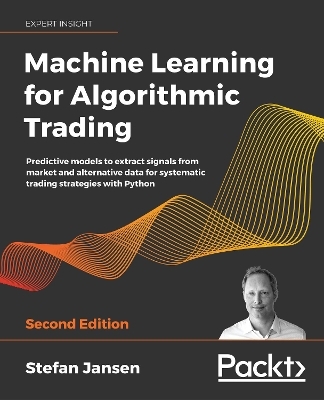
Machine Learning for Algorithmic Trading
Packt Publishing Limited (Verlag)
9781839217715 (ISBN)
Purchase of the print or Kindle book includes a free eBook in the PDF format.
Key Features
Design, train, and evaluate machine learning algorithms that underpin automated trading strategies
Create a research and strategy development process to apply predictive modeling to trading decisions
Leverage NLP and deep learning to extract tradeable signals from market and alternative data
Book DescriptionThe explosive growth of digital data has boosted the demand for expertise in trading strategies that use machine learning (ML). This revised and expanded second edition enables you to build and evaluate sophisticated supervised, unsupervised, and reinforcement learning models.
This book introduces end-to-end machine learning for the trading workflow, from the idea and feature engineering to model optimization, strategy design, and backtesting. It illustrates this by using examples ranging from linear models and tree-based ensembles to deep-learning techniques from cutting edge research.
This edition shows how to work with market, fundamental, and alternative data, such as tick data, minute and daily bars, SEC filings, earnings call transcripts, financial news, or satellite images to generate tradeable signals. It illustrates how to engineer financial features or alpha factors that enable an ML model to predict returns from price data for US and international stocks and ETFs. It also shows how to assess the signal content of new features using Alphalens and SHAP values and includes a new appendix with over one hundred alpha factor examples.
By the end, you will be proficient in translating ML model predictions into a trading strategy that operates at daily or intraday horizons, and in evaluating its performance.What you will learn
Leverage market, fundamental, and alternative text and image data
Research and evaluate alpha factors using statistics, Alphalens, and SHAP values
Implement machine learning techniques to solve investment and trading problems
Backtest and evaluate trading strategies based on machine learning using Zipline and Backtrader
Optimize portfolio risk and performance analysis using pandas, NumPy, and pyfolio
Create a pairs trading strategy based on cointegration for US equities and ETFs
Train a gradient boosting model to predict intraday returns using AlgoSeek s high-quality trades and quotes data
Who this book is forIf you are a data analyst, data scientist, Python developer, investment analyst, or portfolio manager interested in getting hands-on machine learning knowledge for trading, this book is for you. This book is for you if you want to learn how to extract value from a diverse set of data sources using machine learning to design your own systematic trading strategies.
Some understanding of Python and machine learning techniques is required.
Stefan is the founder and CEO of Applied AI. He advises Fortune 500 companies, investment firms, and startups across industries on data & AI strategy, building data science teams, and developing end-to-end machine learning solutions for a broad range of business problems. Before his current venture, he was a partner and managing director at an international investment firm, where he built the predictive analytics and investment research practice. He was also a senior executive at a global fintech company with operations in 15 markets, advised Central Banks in emerging markets, and consulted for the World Bank. He holds Master's degrees in Computer Science from Georgia Tech and in Economics from Harvard and Free University Berlin, and a CFA Charter. He has worked in six languages across Europe, Asia, and the Americas and taught data science at Datacamp and General Assembly.
Table of Contents
Machine Learning for Trading
Market and Fundamental Data
Alternative Data for Finance
Financial Feature Engineering
Portfolio Optimization and Performance Evaluation
The Machine Learning Process
Linear Models
The ML4T Workflow
Time-Series Models for Volatility Forecasts and Statistical Arbitrage
Bayesian ML
Random Forests
Boosting Your Trading Strategy
Data-Driven Risk Factors and Asset Allocation with Unsupervised Learning
Text Data for Trading
Topic Modeling
Word Embeddings for Earnings Calls and SEC Filings
Deep Learning for Trading
CNNs for Financial Time Series and Satellite Images
RNNs for Multivariate Time Series and Sentiment Analysis
Autoencoders for Conditional Risk Factors and Asset Pricing
Generative Adversarial Networks for Synthetic Time-Series Data
Deep Reinforcement Learning
Conclusions and Next Steps
Appendix
| Erscheinungsdatum | 05.08.2020 |
|---|---|
| Verlagsort | Birmingham |
| Sprache | englisch |
| Maße | 191 x 235 mm |
| Themenwelt | Mathematik / Informatik ► Informatik ► Datenbanken |
| Informatik ► Theorie / Studium ► Künstliche Intelligenz / Robotik | |
| ISBN-13 | 9781839217715 / 9781839217715 |
| Zustand | Neuware |
| Informationen gemäß Produktsicherheitsverordnung (GPSR) | |
| Haben Sie eine Frage zum Produkt? |
aus dem Bereich