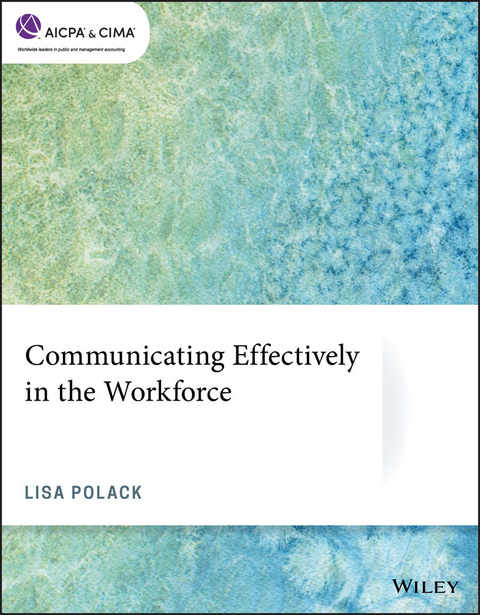
Communicating Effectively in the Workforce (eBook)
144 Seiten
John Wiley & Sons (Verlag)
978-1-119-74623-2 (ISBN)
Lisa Polack (Eureka, CA) has been teaching and writing curriculum for over 25 years in the areas of communication, management skills, and computer software skills. She has conducted courses for city, county, and federal governmental agencies, corporations, colleges, and AICPA. She earned her B.A. in Psychology from York University in Toronto, Canada, and a Masters in Labor and Human Resources from The Ohio State University.
Chapter 1 1-1
Communication Basics 1-1
Apply the principle of Audience First! 1-4
Identify how learning and communication are linked 1-5
Three models of communication 1-8
References 1-15
Exercises and discussion questions 1-17
Chapter 2 2-1
Verbal Communication 2-1
Differentiate the components of the verbal competence model 2-6
Apply the concept of Verbal Judo 2-14
Chapter 2: Verbal Communication 2-17
References 2-18
Exercises and discussion questions 2-20
Chapter 3 3-1
Nonverbal Communication 3-1
Differentiate types of nonverbal communication 3-4
A culture that makes employees feel safe 3-6
Apply nonverbal competence 3-7
Chapter 3: Nonverbal Communication 3-9
References 3-10
Exercise 3-11
Chapter 4 4-1
Styles of Communication 4-1
Communicator style: Three approaches 4-2
Chapter 4: Styles of Communication 4-14
References 4-15
Exercises and discussion questions 4-17
Chapter 5 5-1
Listening 5-1
Recognize the significance and benefits of listening 5-2
Differentiate types of listening 5-7
Determine ways to listen more effectively 5-10
Keywords 5-14
References 5-15
Exercises and discussion questions 5-17
Chapter 6 6-1
Difficult Communication 6-1
Complex situations at work 6-2
Distinguish among difficult communication patterns 6-3
Apply coping techniques for difficult communication patterns 6-6
Identify and respond to verbal aggression and hostile communication patterns 6-8
Identify games played in the workplace 6-11
Vulgar, racist, and sexist communication 6-16
Keywords 6-17
References 6-18
Exercises and discussion questions 6-20
Glossary Glossary 1
Index Index 1
Solutions Solutions 1
Chapter 1 Solutions 1
Chapter 2 Solutions 2
Chapter 3 Solutions 3
Chapter 4 Solutions 4
Chapter 5 Solutions 6
Chapter 6 Solutions 7
| Erscheint lt. Verlag | 29.6.2020 |
|---|---|
| Reihe/Serie | AICPA | AICPA |
| Sprache | englisch |
| Themenwelt | Mathematik / Informatik ► Informatik |
| Wirtschaft ► Betriebswirtschaft / Management | |
| Schlagworte | Computer Science • Informatik • Technical Communication • Technische Dokumentation |
| ISBN-10 | 1-119-74623-X / 111974623X |
| ISBN-13 | 978-1-119-74623-2 / 9781119746232 |
| Informationen gemäß Produktsicherheitsverordnung (GPSR) | |
| Haben Sie eine Frage zum Produkt? |
 EPUB (Adobe DRM)
Kopierschutz: Adobe-DRM
Adobe-DRM ist ein Kopierschutz, der das eBook vor Mißbrauch schützen soll. Dabei wird das eBook bereits beim Download auf Ihre persönliche Adobe-ID autorisiert. Lesen können Sie das eBook dann nur auf den Geräten, welche ebenfalls auf Ihre Adobe-ID registriert sind.
Details zum Adobe-DRM
Dateiformat: EPUB (Electronic Publication)
EPUB ist ein offener Standard für eBooks und eignet sich besonders zur Darstellung von Belletristik und Sachbüchern. Der Fließtext wird dynamisch an die Display- und Schriftgröße angepasst. Auch für mobile Lesegeräte ist EPUB daher gut geeignet.
Systemvoraussetzungen:
PC/Mac: Mit einem PC oder Mac können Sie dieses eBook lesen. Sie benötigen eine
eReader: Dieses eBook kann mit (fast) allen eBook-Readern gelesen werden. Mit dem amazon-Kindle ist es aber nicht kompatibel.
Smartphone/Tablet: Egal ob Apple oder Android, dieses eBook können Sie lesen. Sie benötigen eine
Geräteliste und zusätzliche Hinweise
Buying eBooks from abroad
For tax law reasons we can sell eBooks just within Germany and Switzerland. Regrettably we cannot fulfill eBook-orders from other countries.
aus dem Bereich