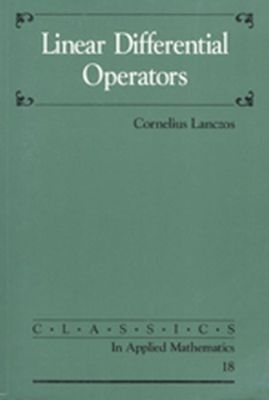
Linear Differential Operators
Society for Industrial & Applied Mathematics,U.S. (Verlag)
978-0-89871-370-1 (ISBN)
- Titel z.Zt. nicht lieferbar
- Versandkostenfrei
- Auch auf Rechnung
- Artikel merken
Don't let the title fool you! If you are interested in numerical analysis, applied mathematics, or the solution procedures for differential equations, you will find this book useful. Because of Lanczos's unique style of describing mathematical facts in nonmathematical language, Linear Differential Operators also will be helpful to nonmathematicians interested in applying the methods and techniques described.
Originally published in 1961, this Classics edition continues to be appealing because it describes a large number of techniques still useful today. Although the primary focus is on the analytical theory, concrete cases are cited to forge the link between theory and practice. Considerable manipulative skill in the practice of differential equations is to be developed by solving the 350 problems in the text. The problems are intended as stimulating corollaries linking theory with application and providing the reader with the foundation for tackling more difficult problems.
Lanczos begins with three introductory chapters that explore some of the technical tools needed later in the book, and then goes on to discuss interpolation, harmonic analysis, matrix calculus, the concept of the function space, boundary value problems, and the numerical solution of trajectory problems, among other things. The emphasis is constantly on one question: ""What are the basic and characteristic properties of linear differential operators?""
In the author's words, this book is written for those ""to whom a problem in ordinary or partial differential equations is not a problem of logical acrobatism, but a problem in the exploration of the physical universe. To get an explicit solution of a given boundary value problem is in this age of large electronic computers no longer a basic question. But of what value is the numerical answer if the scientist does not understand the peculiar analytical properties and idiosyncrasies of the given operator? The author hopes that this book will help in this task by telling something about the manifold aspects of a fascinating field.
Preface
Bibliography
Chapter 1: Interpolation. Introduction
The Taylor expansion
The finite Taylor series with the remainder term
Interpolation by polynomials
The remainder of Lagrangian interpolation formula
Equidistant interpolation
Local and global interpolation
Interpolation by central differences
Interpolation around the midpoint of the range
The Laguerre polynomials
Binomial expansions
The decisive integral transform
Binomial expansions of the hypergeometric type
Recurrence relations
The Laplace transform
The Stirling expansion
Operations with the Stirling functions
An integral transform of the Fourier type
Recurrence relations associated with the Stirling series
Interpolation of the Fourier transform
The general integral transform associated with the Stirling series Interpolation of the Bessel functions
Chapter 2: Harmonic Analysis. Introduction
The Fourier series for differentiable functions
The remainder of the finite Fourier expansion
Functions of higher differentiability
An alternative method of estimation
The Gibbs oscillations of the finite Fourier series
The method of the Green's function
Non-differentiable functions. Dirac's delta function
Smoothing of the Gibbs oscillations by Fejér's method
The remainder of the arithmetic mean method
Differentiation of the Fourier series
The method of the sigma factors
Local smoothing by integration
Smoothing of the Gibbs oscillations by the sigma method
Expansion of the delta function
The triangular pulse
Extension of the class of expandable functions
Asymptotic relations for the sigma factors
The method of trigonometric interpolation
Error bounds for the trigonometric interpolation method
Relation between equidistant trigonometric and polynomial interpolations
The Fourier series in the curve fitting
Chapter 3: Matrix Calculus. Introduction
Rectangular matrices
The basic rules of matrix calculus
Principal axis transformation of a symmetric matrix
Decomposition of a symmetric matrix
Self-adjoint systems
Arbitrary n x m systems
Solvability of the general n x m system
The fundamental decomposition theorem
The natural inverse of a matrix
General analysis of linear systems
Error analysis of linear systems
Classification of linear systems
Solution of incomplete systems
Over-determined systems
The method of orthogonalisation
The use of over-determined systems
The method of successive orthogonalisation
The bilinear identity
Minimum property of the smallest eigenvalue
Chapter 4: The Function Space. Introduction
The viewpoint of pure and applied mathematics
The language of geometry
Metrical spaces of infinitely many dimensions
The function as a vector
The differential operator as a matrix
The length of a vector
The scalar product of two vectors
The closeness of the algebraic approximation
The adjoint operator
The bilinear identity
The extended Green's identity
The adjoint boundary conditions
Incomplete systems
Over-determined systems
Compatibility under inhomogeneous boundary conditions
Green's identity in the realm of partial differential operators
The fundamental field operations of vector analysis
Solution of incomplete systems
Chapter 5: The Green's Function. Introduction
The role of the adjoint equation
The role of Green's identity
The delta function d(x, x)
The existence of the Green's function
Inhomogeneous boundary conditions
The Green's vector
Self-adjoint systems
The calculus of variations
The canonical equations of Hamilton
The Hamiltonisation of partial operators
The reciprocity theorem
Self-adjoint problems. Symmetry of the Green's function
Reciprocity of the Green's vector
The superposition principle of linear operators
The Green's function in the realm of ordinary differential operators
The change of boundary conditions
The remainder of the Taylor series
The remainder of the Lagrangian interpolation formula
Lagrangian interpolation with double points
| Erscheint lt. Verlag | 31.12.1996 |
|---|---|
| Reihe/Serie | Classics in Applied Mathematics |
| Verlagsort | New York |
| Sprache | englisch |
| Maße | 152 x 229 mm |
| Gewicht | 789 g |
| Themenwelt | Mathematik / Informatik ► Mathematik ► Analysis |
| Mathematik / Informatik ► Mathematik ► Angewandte Mathematik | |
| ISBN-10 | 0-89871-370-6 / 0898713706 |
| ISBN-13 | 978-0-89871-370-1 / 9780898713701 |
| Zustand | Neuware |
| Informationen gemäß Produktsicherheitsverordnung (GPSR) | |
| Haben Sie eine Frage zum Produkt? |
aus dem Bereich