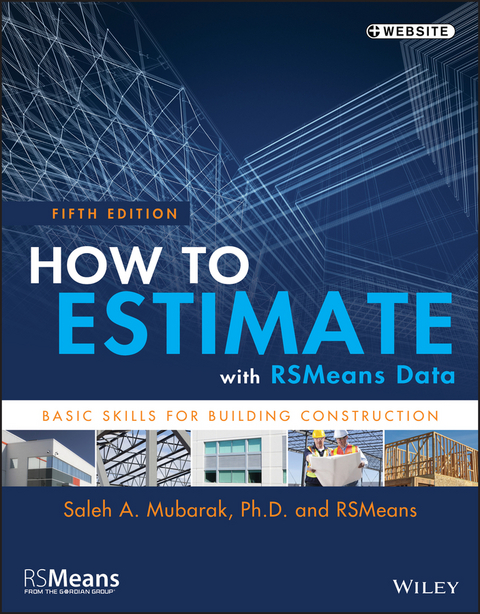
How to Estimate with RSMeans Data (eBook)
336 Seiten
Rsmeans (Verlag)
978-1-118-97797-2 (ISBN)
How to Estimate with RSMeans Data is the only instructional book on construction cost estimating that uses the most popular source of construction cost data, RS Means. This updated fifth edition includes new coverage on the role of Building Information Modeling (BIM) in the estimating process, and over 300 sample problems and exercises that show you how to apply cost data to your building project based on the RS Means 2015 Building Construction Cost Data. The companion website provides access to RS Means CostWorks data, allowing you to use real-world numbers in your practice estimates, and the included Instructor's Manual provides step-by-step solutions to problems in the book. Focused on the practical aspects of estimating, this book emphasizes the application of estimating techniques-which are transferable to any estimating software-through problem solving and the ground-up creation of complete construction project estimates.
Estimating skills are fundamental to the construction industry, and are applied by all parties at all levels throughout the industry. This book is a hands-on guide to the techniques and tools used to create a thorough estimate, with plenty of opportunities for practice.
- Apply cost data to all aspects of the building project
- Practice your skills on over 300 sample problems
- Construct a complete estimate using RSMeans
Besides being an essential construction skill, learning estimating helps you become familiar with reading and understanding construction blueprints and how construction assemblies are built. Mastery of these vital skills is important to your future career, and How to Estimate with RSMeans Data is your ideal guide to a solid foundation.
Dr. Saleh A. Mubarak, is an independent consultant in the field of construction project management. He is a former professor of civil engineering and has over 25 years of diversified and international experience in the construction industry. He is also??the author of Construction Project Scheduling and Control, Third Edition.
RSMeans has been the most trusted source of construction data for over 60 years. A division of Reed Construction Data, the company serves more than 250,000 construction professionals in the U.S. and Canada.
Dr. Saleh A. Mubarak, is an independent consultant in the field of construction project management. He is a former professor of civil engineering and has over 25 years of diversified and international experience in the construction industry. He is also??the author of Construction Project Scheduling and Control, Third Edition. RSMeans has been the most trusted source of construction data for over 60 years. A division of Reed Construction Data, the company serves more than 250,000 construction professionals in the U.S. and Canada.
Introduction
RSMeans data from Gordian provides accurate and up-to-date cost information to help owners, developers, architects, engineers, contractors and others carefully and precisely project and control the cost of both new building construction and renovation projects.
This book is based on the RSMeans Building Construction Costs Database, BCCD, which has been printed in books for over 80 years and is now available online. Along with the BCCD online database, RSMeans has provided a cost estimating software. We will refer to it in the book as the RSMeans Online Estimating. It offers a single line item, assemblies, and square foot estimating programs. Users of the book will be given free access to limited use as a supplement to this book.
Instructional Information
First, the user needs to register. Once registration is complete, user can long in to the site: www.rsmeansonline.com.
The user will be directed to the “Welcome to RSMeans Online!” page, where he/she needs to set own preferences (Figure 00.1).
Complete the choice of preferences and then click “Save & Continue”. This screen will appear every time the user logs in unless the “Display Cost Data Preferences at start-up” is unchecked.
On the main page, we have the main menu with these options:
- Search Data: Display of the database, cost line items or assemblies
- Manage Estimates: Manages the estimates you created
- Square Foot Estimator: A special program for conceptual estimating with more than 100 commercial and residential models available
- Life Cycle Cost: An option for improving the long-term performance of buildings and gauge installed costs versus long-term facility maintenance costs
- Cost Alerts and Trends: An option to receive notifications and track cost trends for the materials, labor, and equipment
- Reference Items: Supplemental information such as a list of abbreviations, city cost index, crews, labor rates, references (notes that relate to cost line items), estimating tips, dictionary (for cost-related terms), a video tutorial, and student edition materials
- My Favorites: A special database for items and assemblies you choose as favorite so it will be easy to reuse later
You can always click on the green button “Guide Me” on the upper right-hand side for valuable help lessons.
More explanation on creating and managing estimates through examples in the following chapters.
A Cautionary Note: Numerical Rounding and Mathematical Judgment
Construction cost estimating is not an exact science. It depends on many uncertain factors (labor productivity, price escalation, and so forth) that make absolute accuracy impossible. It is a prediction of future expenses. Assumptions will have to be made about waste factors, contingency costs, takeoff techniques, and many other unknown or uncertain factors. Given the same set of plans and specifications, several estimators will come up with different project totals, all of which will probably differ from the final project cost. The good estimator is the one who gets his estimates consistently close to the actual cost.
Mathematical Intuition
Scholars differ and argue on the definition of mathematical intuition and what factors play in measuring or increasing it. In the context of construction cost estimating, we can simply state that a cost estimator must possess a minimum level of mathematical intuition to enable him or her to make good common sense judgments on numbers and to judge whether a number is too high or too low. Such intuition is essential to avoid major mistakes that may lead to financial losses and other negative consequences. Cost estimators with good mathematical intuition also can provide, in most cases, a ballpark figure for the cost of a proposed project without sophisticated methods and tools.
Although scholars may argue, again, on how much of this mathematical intuition is inherited and how much is acquired, there is no question that any human being can enhance it by learning a few simple techniques and continuous practice. It is just like any other mental and physical power that humans possess; it increases—or at least is maintained—by practice, and decreases by neglect and lack of practice. This point is becoming increasingly important as we have entered the digital age and accumulated plenty of electronic gadgets. Technological advancements and inventions continue day after day with no end (or even a slowdown) in sight.
Our increasing dependence on such gadgets is leaving a negative effect on many talents such as the mathematical intuition. For example, there is no question that the quality of the average human's handwriting has declined because of the overwhelming use of computer and other electronic devices’ keyboards. People now depend more on their cell phones rather their own memory to store telephone numbers and other information. New technologies have also automated many processes such as structural analysis and design, medical diagnosis, and automotive mechanical and electrical diagnosis. As wonderful as it seems to many people, this should trigger an alarm: many people are losing their professional intuition and analytical capability. They are becoming too dependent on technologies to the point they cannot function or perform simple tasks without their electronic devices. Computers and other electronic gadgets are wonderful tools that can and do help tremendously, but they should never be a replacement for the human intelligence, thinking, and creativity.
To the cost estimator, there are simple exercises that can help build or at least maintain this intuition, such as calculating the value of the groceries or other commodities purchased from a store, including any percent discount and sales tax, and then comparing this approximate total to the cashier's total. One can calculate or estimate the monthly payment on a purchased car and compare it with the amount provided by the salesperson. Practice estimating the height of a high-rise building (in feet or meters, or number of floors), the number of bricks in a pallet or group of pallets of bricks, or the number of openings (doors and windows) in a building. It is always a good idea to do quick and approximate mental math and then compare the answer to the one produced by the computer, calculator, or other devices. When the two answers are significantly different, you might discover that the other answer (the supposedly accurate one) is wrong, either through human input error or a software flaw.
Some Helpful Suggestions
Rounding numbers must be done systematically and with care to avoid the introduction of significant errors. It is recommended when performing calculations that you enter dimensions without rounding, especially those to be multiplied by a large quantity. The amount of error in rounding depends on the number(s) the rounded number is multiplied by.
For example, assume an elevated concrete slab is 211′-11″ long, 120′-0″ wide, and 7.5″ thick. The volume is 588.66 CY. If we rounded the length to 212′, the volume would be 588.89 CY, an error of 0.23 CY. However, if we rounded the thickness to 8″ instead of 7.5″, the volume would be 627.90 CY, a whopping 39.24 CY error.
The explanation is easy: the first error represents a 1″ × 120′ × 7.5″ strip (two small and one large dimensions). The second error represents a 211′-11″ × 120′ × 0.5″ strip (one small and two large dimensions). It is important to be careful with such practices, and avoid rounding in early stages of the estimate.
The estimator should have a sense of the size of the error introduced by rounding to ensure that it will not significantly affect the total estimate. Mathematical intuition and good common sense judgment are a must for a good estimator. As one estimator said, “While the price of one item may be too high or too low, the overall estimate should be pretty accurate.”
Be careful when using manual or electronic tools for measuring dimensions. The results produced by rolling pens, digitizing boards, and other tools vary by device and user. Again, the estimator must use common sense judgment to make sure no unmanageable error is introduced into the estimate.
If using a handheld calculator, use one with ordinary fractions capability (b/c), so you can enter 8″ as 8/12 ft, rather than the decimal fraction 0.67. This eliminates the introduction of a rounding error. Follow the same concept when using Excel.
Avoid false accuracy. As cost estimating is a prediction of future expenses, final answers should be rounded to a reasonable degree. As a rule of thumb, a figure with four significant digits is an acceptable accuracy. It would be ridiculous to estimate the total cost of a construction project as $2,148,387.23. This is false accuracy because it gives the reader a feeling that this number is very accurate, while in fact it is not. If it refers to actual expenses, the previous number may be true and accurate. The following are some examples:
| Estimate | Estimate Rounded |
| $122,778.34 | $122,800 or... |
| Erscheint lt. Verlag | 23.3.2020 |
|---|---|
| Reihe/Serie | RSMeans |
| RSMeans | RSMeans |
| Sprache | englisch |
| Themenwelt | Informatik ► Grafik / Design ► Digitale Bildverarbeitung |
| Mathematik / Informatik ► Informatik ► Theorie / Studium | |
| Technik ► Bauwesen | |
| Wirtschaft | |
| Schlagworte | Baubetrieb • Bauingenieur- u. Bauwesen • Bauökonomie • building estimating • Civil Engineering & Construction • construction estimating • Construction estimating guide • construction estimating handbook • construction estimating how-to • construction estimating manual • construction estimating practice • construction estimating problems • construction estimating text • construction estimating training • construction estimating tutorials • Construction Management • learning estimating • Massenermittlung u. Bauökonomie • Means 2015 Building Construction Cost Data • Quantity Surveying & Construction Economics • RSMeans • RSMeans CostWorks • Saleh A. Mubarak |
| ISBN-10 | 1-118-97797-1 / 1118977971 |
| ISBN-13 | 978-1-118-97797-2 / 9781118977972 |
| Informationen gemäß Produktsicherheitsverordnung (GPSR) | |
| Haben Sie eine Frage zum Produkt? |
 EPUB (Adobe DRM)
Kopierschutz: Adobe-DRM
Adobe-DRM ist ein Kopierschutz, der das eBook vor Mißbrauch schützen soll. Dabei wird das eBook bereits beim Download auf Ihre persönliche Adobe-ID autorisiert. Lesen können Sie das eBook dann nur auf den Geräten, welche ebenfalls auf Ihre Adobe-ID registriert sind.
Details zum Adobe-DRM
Dateiformat: EPUB (Electronic Publication)
EPUB ist ein offener Standard für eBooks und eignet sich besonders zur Darstellung von Belletristik und Sachbüchern. Der Fließtext wird dynamisch an die Display- und Schriftgröße angepasst. Auch für mobile Lesegeräte ist EPUB daher gut geeignet.
Systemvoraussetzungen:
PC/Mac: Mit einem PC oder Mac können Sie dieses eBook lesen. Sie benötigen eine
eReader: Dieses eBook kann mit (fast) allen eBook-Readern gelesen werden. Mit dem amazon-Kindle ist es aber nicht kompatibel.
Smartphone/Tablet: Egal ob Apple oder Android, dieses eBook können Sie lesen. Sie benötigen eine
Geräteliste und zusätzliche Hinweise
Buying eBooks from abroad
For tax law reasons we can sell eBooks just within Germany and Switzerland. Regrettably we cannot fulfill eBook-orders from other countries.
aus dem Bereich