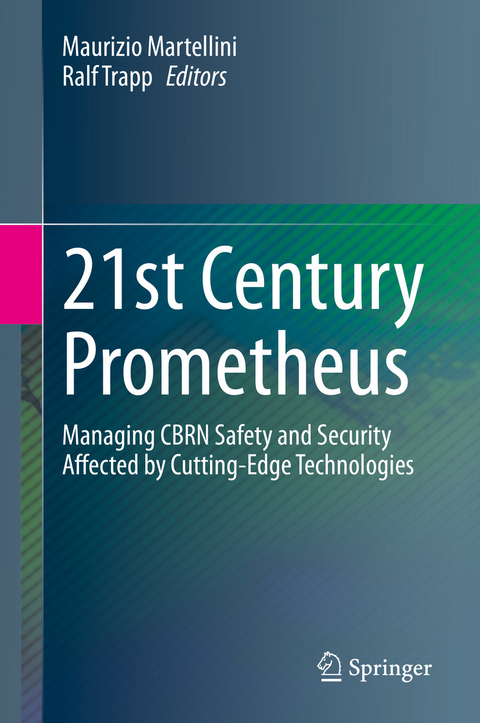
This book describes the evolving CBRN risk landscape and highlights advances in the 'core' CBRN technologies, including when combined with (improvised) explosive devices (CBRNe threats). It analyses how associated technologies create new safety and security risks, challenging certain assumptions that underlie current control regimes. The book also shows how technologies can be enablers for more effective strategies to mitigate these risks.
21st-century safety and security risks emanating from chemical, biological, radiological and nuclear materials - whether resulting from natural events, accidents or malevolent use - are increasingly shaped by technologies that enable their development, production or use in ways that differ from the past. Artificial intelligence, the use of cyberspace, the revolution in the life sciences, new manufacturing methods, new platforms and equipment for agent delivery, hypersonic weapons systems, information tools utilised in hybrid warfare - these and other technologies are reshaping the global security environment and CBRN landscape. They are leading to a growing potential for highly targeted violence, and they can lead to greater instability and vulnerability worldwide. At the same time, technology offers solutions to manage CBRN risks. Examples are faster detection, more accurate characterisation of the nature and origin of CBRN agents, new forensic investigation methods, or new medical treatments for victims of CBRN incidents. New educational concepts help to foster a culture of responsibility in science and technology and strengthen governance. New training methods help develop practical skills to manage CBRN risks more effectively.
The book concludes that there is a growing need for a holistic framework towards CBRN risk mitigation. Traditional arms control mechanisms such as global, regional or bilateral treaties and export controls are still needed, as they provide a necessary legal and institutional framework. But laws and technology denial alone will not suffice, and institutional mechanisms can at times be weak. Given the pace of technological progress and the diffusion of critical knowledge, tools and materials, policymakers must accept that CBRN risks cannot be eliminated altogether. Instead, society has to learn to manage these risks and develop resilience against them. This requires a 'softer', broadly based multi-stakeholder approach involving governments, industry, the research and development communities, educators, and civil society. Furthermore, educating policymakers that cutting-edge technologies may seriously affect global strategic stability could create incentives for developing a more creative and contemporary arms control strategy that fosters cooperation rather than incremental polarisation.
Maurizio Martellini (State University of Insubria, Como, Italy) is an expert in non-proliferation and disarmament issues, CBRNe safety and security. He has co-authored numerous publications as well as specific case studies. He is Associate Professor of Theoretical Physics, holds a PhD in Physics from the University of Pavia and has been Senior Scholar at the Belfer Centre for Science and International Affairs on International Security program, John F. Kennedy School of Government, Harvard University, Cambridge, US. His fields of Research and Analysis include also CBRN non-proliferation and regulation, cyber security, global scientists' engagement, edging technologies with dual use purpose, science and engineering diplomacy and CBRN education and awareness. He has also been Consultant of Italian MFA and Team Leader or Key Expert in several EU CBRN CoE projects.
Ralf Trapp (independent consultant) is a chemist and toxicologist by training. He has worked for more than 35 years on technical, legal and policy issues related to the disarmament of chemical and biological weapons. His field of work included verification and inspection methodologies, the assessment of the impact of advances in science and technology on arms control, and the relationship between arms control and international cooperation. He participated in the negotiations of the Chemical Weapons Convention, served 13 years in senior positions at the OPCW, and works today as a consultant on chemical and biological weapons arms control, safety and security. He has collaborated with, amongst others, the United Nations, the OPCW, the European Commission, the ICRC, and research groups such as the Stockholm International Peace Research Institute, the Harvard Sussex Programme, Bath University and Spiez Laboratory.


 PDF (Wasserzeichen)