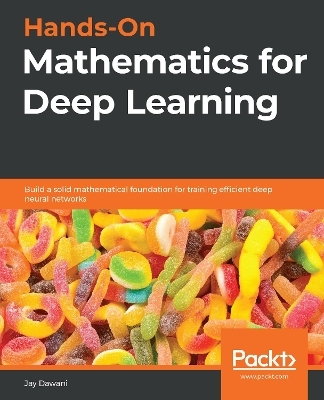
Hands-On Mathematics for Deep Learning
Packt Publishing Limited (Verlag)
978-1-83864-729-2 (ISBN)
A comprehensive guide to getting well-versed with the mathematical techniques for building modern deep learning architectures
Key Features
Understand linear algebra, calculus, gradient algorithms, and other concepts essential for training deep neural networks
Learn the mathematical concepts needed to understand how deep learning models function
Use deep learning for solving problems related to vision, image, text, and sequence applications
Book DescriptionMost programmers and data scientists struggle with mathematics, having either overlooked or forgotten core mathematical concepts. This book uses Python libraries to help you understand the math required to build deep learning (DL) models.
You'll begin by learning about core mathematical and modern computational techniques used to design and implement DL algorithms. This book will cover essential topics, such as linear algebra, eigenvalues and eigenvectors, the singular value decomposition concept, and gradient algorithms, to help you understand how to train deep neural networks. Later chapters focus on important neural networks, such as the linear neural network and multilayer perceptrons, with a primary focus on helping you learn how each model works. As you advance, you will delve into the math used for regularization, multi-layered DL, forward propagation, optimization, and backpropagation techniques to understand what it takes to build full-fledged DL models. Finally, you’ll explore CNN, recurrent neural network (RNN), and GAN models and their application.
By the end of this book, you'll have built a strong foundation in neural networks and DL mathematical concepts, which will help you to confidently research and build custom models in DL.
What you will learn
Understand the key mathematical concepts for building neural network models
Discover core multivariable calculus concepts
Improve the performance of deep learning models using optimization techniques
Cover optimization algorithms, from basic stochastic gradient descent (SGD) to the advanced Adam optimizer
Understand computational graphs and their importance in DL
Explore the backpropagation algorithm to reduce output error
Cover DL algorithms such as convolutional neural networks (CNNs), sequence models, and generative adversarial networks (GANs)
Who this book is forThis book is for data scientists, machine learning developers, aspiring deep learning developers, or anyone who wants to understand the foundation of deep learning by learning the math behind it. Working knowledge of the Python programming language and machine learning basics is required.
Jay Dawani is a former professional swimmer turned mathematician and computer scientist. He is also a Forbes 30 Under 30 Fellow. At present, he is the Director of Artificial Intelligence at Geometric Energy Corporation (NATO CAGE) and the CEO of Lemurian Labs—a startup he founded that is developing the next generation of autonomy, intelligent process automation, and driver intelligence. Previously he has also been the technology and R&D advisor to Spacebit Capital. He has spent the last three years researching at the frontiers of AI with a focus on reinforcement learning, open-ended learning, deep learning, quantum machine learning, human-machine interaction, multi-agent and complex systems, and artificial general intelligence.
Table of Contents
Linear Algebra
Vector Calculus
Probability and Statistics
Optimization
Graph Theory
Linear Neural Networks
Feedforward Neural Networks
Regularization
Convolutional Neural Networks
Recurrent Neural Networks
Attention Mechanisms
Generative Models
Transfer and Meta Learning
Geometric Deep Learning
| Erscheinungsdatum | 29.06.2020 |
|---|---|
| Verlagsort | Birmingham |
| Sprache | englisch |
| Maße | 75 x 93 mm |
| Themenwelt | Informatik ► Theorie / Studium ► Künstliche Intelligenz / Robotik |
| Mathematik / Informatik ► Mathematik ► Angewandte Mathematik | |
| ISBN-10 | 1-83864-729-5 / 1838647295 |
| ISBN-13 | 978-1-83864-729-2 / 9781838647292 |
| Zustand | Neuware |
| Informationen gemäß Produktsicherheitsverordnung (GPSR) | |
| Haben Sie eine Frage zum Produkt? |
aus dem Bereich