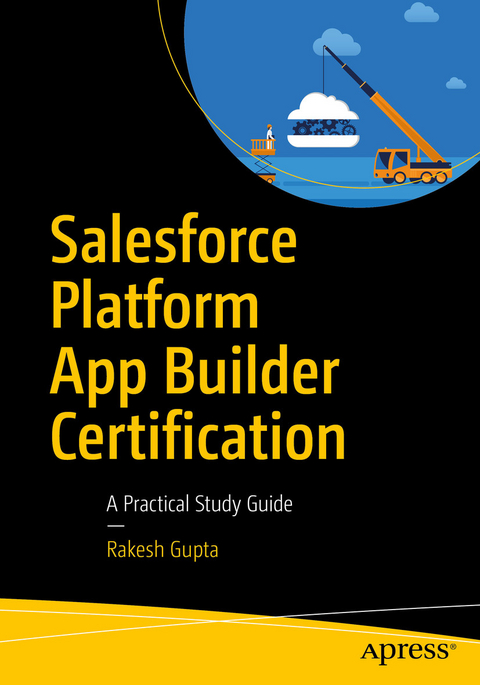
Salesforce Platform App Builder Certification (eBook)
241 Seiten
Apress (Verlag)
978-1-4842-5479-0 (ISBN)
This is the first book available covering this content, and Salesforce training is very costly. This book is filled with real-world examples and hands-on exercises, enabling you to prepare for the certification exam in a short span of time. Multiple-choice study questions and exercises are included to help you apply what you learn in each chapter.
Author Rakesh Gupta explains Salesforce Platform fundamentals, including knowledge about the limitations of the declarative platform and when to use programmatic development versus the AppExchange. Data management and data analytics are covered. And you will learn how to set up organization-wide features that affect the look and feel of your application.Sandbox design patterns and process automation tools available in Salesforce are discussed and you will know when to use them. You will become familiar with a wide array of topics, including designing a mobile app and reporting in Salesforce.
What You Will Learn
- Know when to use declarative development versus programmatic development versus the AppExchange
- Understand the Salesforce data model, field type (when to use which fields), and how and when to use an external object in Salesforce
- Be familiar with security and settings in Salesforce
- See how easily users can migrate to the Lightning experience from the classic platform
- Implement business process automation using declarative features
- Apply the automation process in Salesforce
- Utilize Process Builder and manage its power to automate business processes
- Use sandboxes and deployment tools
Who This Book Is For
New or intermediate Salesforce developers or anyone in the Salesforce development arena who wants to learn or explore the platform
New or intermediate developers will want to use this hands-on guide to prepare for the Salesforce Certified Platform App Builder credential, awarded for designing, building, and implementing applications using the declarative customization capabilities of the Salesforce Platform.This is the first book available covering this content, and Salesforce training is very costly. This book is filled with real-world examples and hands-on exercises, enabling you to prepare for the certification exam in a short span of time. Multiple-choice study questions and exercises are included to help you apply what you learn in each chapter.Author Rakesh Gupta explains Salesforce Platform fundamentals, including knowledge about the limitations of the declarative platform and when to use programmatic development versus the AppExchange. Data management and data analytics are covered. And you will learn how to set up organization-wide features that affect the look and feel of your application. Sandbox design patterns and process automation tools available in Salesforce are discussed and you will know when to use them. You will become familiar with a wide array of topics, including designing a mobile app and reporting in Salesforce. What You Will LearnKnow when to use declarative development versus programmatic development versus the AppExchangeUnderstand the Salesforce data model, field type (when to use which fields), and how and when to use an external object in SalesforceBe familiar with security and settings in SalesforceSee how easily users can migrate to the Lightning experience from the classic platformImplement business process automation using declarative featuresApply the automation process in SalesforceUtilize Process Builder and manage its power to automate business processesUse sandboxes and deployment toolsWho This Book Is ForNew or intermediate Salesforce developers or anyone in the Salesforce development arena who wants to learn or explore the platform
Table of Contents 5
About the Author 11
About the Technical Reviewers 12
Acknowledgments 13
Introduction 14
Chapter 1: Salesforce Platform Fundamentals 15
Salesforce: A Brief History 15
An Overview of the Salesforce Platform 17
Types of Objects in Salesforce 19
Standard Objects 19
Custom Objects 20
External Objects 20
Difference between Standard and Custom Objects 20
Getting Started with Lightning Experience 21
Sales Cloud Lightning Editions 21
Service Cloud Lightning Editions 24
Why Is Understanding Lightning Experience Important? 26
Sign up for Developer Playground 26
Navigation Menu 28
App Launcher 28
Global Search 30
AppExchange: Apps That Make Life Easier 30
Benefits of Using AppExchange Apps 32
The Force.com Multitenant Architecture 33
Additional Hands-on Exercises 35
Summary 35
Chapter 2: The Underpinnings of Data Modeling 36
Metadata: The Core of the Salesforce Platform 36
Look No Further Than Metadata: It’s the Key! 37
The Question Is: Why Do We Need Metadata? 38
Understanding the Power of Schema Builder 40
Understanding the Data Model 40
Creating a Custom Field 42
Managing Field-level Security 44
Advantages of Using Schema Builder 45
Understanding Relationship Types in Salesforce 46
Lookup Relationship 46
Self-relationship 48
Master Detail Relationship 49
Difference between a Master Detail Relationship and a Lookup Relationship 49
External Lookup Relationship 50
Indirect Lookup Relationship 50
Many-to-Many Relationship 51
Hierarchal Relationship 51
Selecting the Appropriate Field Type 52
Understanding Field Dependencies 54
Setting up Field Dependencies 56
Implications of Changing a Field’s Type 58
Exploring External Objects 60
Points to Remember 61
Hands-on Exercises 62
Summary 65
Chapter 3: Platform Security 66
OWD: A Baseline Setting for Objects 66
Understanding Different Settings Available for OWD 69
Predefined OWD for Objects 71
Importance of Role Hierarchy 72
Use Case 1 73
Use Case 2 75
Setting up Role Hierarchies 76
Use Case 1 79
Use Case 2 81
Use Case 3 82
Use Case 4 82
Use Case 5 84
Use Case 6 85
Use Case 7 86
Record-sharing Capabilities 87
Manual Sharing: Share Records on a One-off Basis 88
Owner-based Sharing: A Way to Share Records Automatically 90
Apex-managed Sharing: A Way to Manage Complex Sharing in Seconds 92
Deferring Sharing Calculations: Postpone Automatic Sharing Recalculation 92
Profiles: A Way to Control Actions Users Can Take on a Record 94
Different Types of Profiles 94
Permission Sets 95
Settings That Can Be Granted through Permission Sets 96
Granting Object Access 96
Managing Field-level security 98
Through a Profile 98
Points to Remember 100
Hands-on Exercises 101
Summary 104
Chapter 4: Customizing the User Interface 105
A Deep Dive into Lightning Experience 105
The Lightning Experience Navigation Menu 106
The App Launcher in Lightning Experience 107
The Home Page 108
Global Search 109
Creating Dynamic Lightning Pages 111
Controlling Component Visibility 111
Lightning Page Assignment 114
Use Case for Custom Buttons and Links 117
Use Case for Custom Actions 120
Points to Remember 121
Hands-on Exercises 122
Summary 123
Chapter 5: Improving and Enriching Data Quality 124
Record Types: A Better Way to Handle Varied Business Processes 124
What Are Record Types? 127
How Record Types Control Lightning Record Pages 132
Lookup Filter: Limit the Records That Can Be Shown in a Lookup Window 133
Formula Fields: Small Work, Big Impact 135
Rollup Summary Field 139
Validation Rules 143
Custom Permissions: A Way to Bypass Validation Rules 146
Points to Remember 149
Hands-on Exercises 151
Summary 154
Chapter 6: Automating Business Processes 155
Introduction to Lightning Flow 155
Advantages of Using Lightning Flow 157
Lightning Flow Life Cycle 158
An Overview of Lightning Flow Designer 158
Different Ways to Launch a Flow 160
Use Case 1: Mortgage Broker Commission Calculator 161
Connecting the Flow Elements 167
Activating a Version of a Flow 167
Displaying a Flow from the Lightning Home Page 168
Use Case 2: Delete Unqualified Leads 169
Introduction to Lightning Process Builder 173
Actions Process Builder Supports 173
When to Use Which Automation Tool 174
Use Case 3: Call an Autolaunched Flow 176
Use Case 4: Update Child Records 180
Introduction to Approval Processes 185
Wizards to Create an Approval Process 186
Creating a New Approval Process 186
Final Approval Actions 192
Initial Submission Actions 193
Approval Steps 194
Approval Step 1 194
Activating an Approval Process 196
Points to Remember 196
Hands-on Exercises 197
Summary 198
Chapter 7: Nuts and Bolts of Application Development 199
Limits of Declarative Development 199
Business Use Case 1 199
Solution: Use an Apex Trigger 200
Business Use Case 2 200
Solution 1: Use a Visualforce Page 200
Solution 2: Use an AppExchange App 201
Business Use Case 3 201
Solution: Use APIs 202
Use Case Summary 202
Managing the Application Life Cycle 202
Application Governance 202
Application Development 203
Application Operations 203
Sandboxes 203
Developer Sandbox 204
Developer Pro Sandbox 205
Partial Sandbox 205
Full Sandbox 205
Setting up a Sandbox 205
Accessing a Sandbox 207
Deployment 208
Deploy Using Change Sets 208
Outbound Change Sets 208
Inbound Change Sets 213
Benefits of Using Change Sets 215
Deploy Using Packages 216
Points to Remember 217
Hands-on Exercises 217
Summary 219
Chapter 8: The Power of Social Analytics 220
Social Features 220
Update Social Accounts, Contacts, and Leads Settings 220
Hide Social Network Profiles 221
Link Twitter Profiles to Accounts, Contacts, and Leads 222
Introduction to Reports 223
Report Types 224
Standard Report Type 224
Custom Report Type 224
Setting up a Custom Report Type 224
Report Format Types 227
Tabular Report Format 227
Summary Report Format 229
Matrix Report Format 230
Joined Report Format 231
Dashboard Components and Its Types 231
Creating a Dashboard 232
Making a Dashboard Dynamic 234
Points to Remember 236
Hands-on Exercises 236
Summary 238
Appendix: Answers to Hands-on Exercises 239
Chapter 1 239
Chapter 2 239
Chapter 3 240
Chapter 4 241
Chapter 5 242
Chapter 6 242
Chapter 7 243
Chapter 8 243
Index 244
| Erscheint lt. Verlag | 16.12.2019 |
|---|---|
| Zusatzinfo | XVII, 241 p. 150 illus. |
| Sprache | englisch |
| Themenwelt | Mathematik / Informatik ► Informatik |
| Schlagworte | App Exchange • Apps • CRM • Data Modeling • Lightning • Process Builder • Salesforce • Salesforce App Builder • Salesforce Certification • Salesforce Lightning • Salesforce Process Builder • Salesforce User Experience |
| ISBN-10 | 1-4842-5479-1 / 1484254791 |
| ISBN-13 | 978-1-4842-5479-0 / 9781484254790 |
| Informationen gemäß Produktsicherheitsverordnung (GPSR) | |
| Haben Sie eine Frage zum Produkt? |
 PDF (Wasserzeichen)
Größe: 9,0 MB
DRM: Digitales Wasserzeichen
Dieses eBook enthält ein digitales Wasserzeichen und ist damit für Sie personalisiert. Bei einer missbräuchlichen Weitergabe des eBooks an Dritte ist eine Rückverfolgung an die Quelle möglich.
Dateiformat: PDF (Portable Document Format)
Mit einem festen Seitenlayout eignet sich die PDF besonders für Fachbücher mit Spalten, Tabellen und Abbildungen. Eine PDF kann auf fast allen Geräten angezeigt werden, ist aber für kleine Displays (Smartphone, eReader) nur eingeschränkt geeignet.
Systemvoraussetzungen:
PC/Mac: Mit einem PC oder Mac können Sie dieses eBook lesen. Sie benötigen dafür einen PDF-Viewer - z.B. den Adobe Reader oder Adobe Digital Editions.
eReader: Dieses eBook kann mit (fast) allen eBook-Readern gelesen werden. Mit dem amazon-Kindle ist es aber nicht kompatibel.
Smartphone/Tablet: Egal ob Apple oder Android, dieses eBook können Sie lesen. Sie benötigen dafür einen PDF-Viewer - z.B. die kostenlose Adobe Digital Editions-App.
Zusätzliches Feature: Online Lesen
Dieses eBook können Sie zusätzlich zum Download auch online im Webbrowser lesen.
Buying eBooks from abroad
For tax law reasons we can sell eBooks just within Germany and Switzerland. Regrettably we cannot fulfill eBook-orders from other countries.
aus dem Bereich