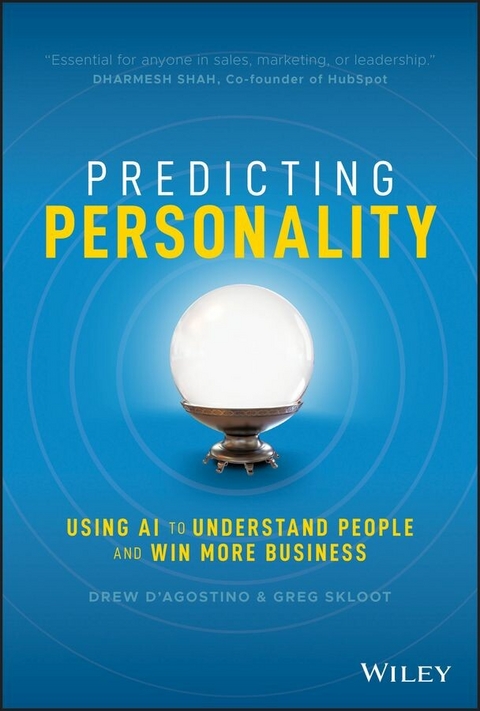
Predicting Personality (eBook)
John Wiley & Sons (Verlag)
978-1-119-63096-8 (ISBN)
The ultimate playbook for using artificial intelligence to communicate effectively, build teams, and win customers
Not long ago, we imagined a hyper-connected world full of trust and openness-a world where effortless communication would bring about a new understanding between people everywhere. Judging from our current environment, this vision of the future may have been overly optimistic. With infinite channels and countless voices flooding them with messages, most people have become highly skeptical and guarded by necessity. As a result, communication is much harder than ever before.
Despite the unprecedented connectivity enabled by modern technology, we are far less likely to trust and to invest the time needed to build strong relationships. How can we use technology to reverse this trend? A groundbreaking new branch of artificial intelligence-Personality AI-may be the answer. Combining traditional machine learning, data analytics, and behavioral psychology, Personality AI helps professional communicators tear down walls, establish trust with their audiences, and utilize data to build meaningful relationships, strengthen empathy, and win more customers.
Predicting Personality is a practical, real-world playbook for any individual or business whose success hinges on the ability to communicate effectively and build teams. Authors Drew D'Agostino and Greg Skloot-CEO and President, respectively, of Crystal, the app that tells you anyone's personality-show you how businesses can leverage Personality AI and machine learning to grow faster and communicate more effectively than was previously possible. This reader-friendly guide teaches you what Personality AI is, how it works, and demonstrates its practical applications in both life and business. This book:
? Explains how to understand personality types in various contexts, including sales, recruiting, coaching
? Provides guidelines for using personality data to learn and execute
? Explores ethics and compliance considerations surrounding the use of Personality AI
? Offers valuable insights from a leader in the business applications of Personality AI
Predicting Personality: Using AI to Understand People and Win More Business is a must-have guide for C-suite executives, sales and marketing professionals, coaches, recruiters, and business owners.
DREW D'AGOSTINO is CEO of Crystal, an app that uses AI to accurately reveal people's motivations, communication styles, and other behavioral traits. Crystal has been featured in Inc., Fortune, CNN, Fast Company, MIT Technology Review, Wired, and The Guardian. Previously, Drew was CTO of Attend.com, an event management software firm.
GREG SKLOOT is President and COO of Crystal and a passionate evangelist for leveraging AI to better understand personality and build stronger relationships. Previously, Greg was Vice President of Growth at fitness-technology startup Netpulse and CEO of Attend.com.
The ultimate playbook for using artificial intelligence to communicate effectively, build teams, and win customers Not long ago, we imagined a hyper-connected world full of trust and openness a world where effortless communication would bring about a new understanding between people everywhere. Judging from our current environment, this vision of the future may have been overly optimistic. With infinite channels and countless voices flooding them with messages, most people have become highly skeptical and guarded by necessity. As a result, communication is much harder than ever before. Despite the unprecedented connectivity enabled by modern technology, we are far less likely to trust and to invest the time needed to build strong relationships. How can we use technology to reverse this trend? A groundbreaking new branch of artificial intelligence Personality AI may be the answer. Combining traditional machine learning, data analytics, and behavioral psychology, Personality AI helps professional communicators tear down walls, establish trust with their audiences, and utilize data to build meaningful relationships, strengthen empathy, and win more customers. Predicting Personality is a practical, real-world playbook for any individual or business whose success hinges on the ability to communicate effectively and build teams. Authors Drew D Agostino and Greg Skloot CEO and President, respectively, of Crystal, the app that tells you anyone's personality show you how businesses can leverage Personality AI and machine learning to grow faster and communicate more effectively than was previously possible. This reader-friendly guide teaches you what Personality AI is, how it works, and demonstrates its practical applications in both life and business. This book: Explains how to understand personality types in various contexts, including sales, recruiting, coaching Provides guidelines for using personality data to learn and execute Explores ethics and compliance considerations surrounding the use of Personality AI Offers valuable insights from a leader in the business applications of Personality AI Predicting Personality: Using AI to Understand People and Win More Business is a must-have guide for C-suite executives, sales and marketing professionals, coaches, recruiters, and business owners.
DREW D'AGOSTINO is CEO of Crystal, an app that uses AI to accurately reveal people's motivations, communication styles, and other behavioral traits. Crystal has been featured in Inc., Fortune, CNN, Fast Company, MIT Technology Review, Wired, and The Guardian. Previously, Drew was CTO of Attend.com, an event management software firm. GREG SKLOOT is President and COO of Crystal and a passionate evangelist for leveraging AI to better understand personality and build stronger relationships. Previously, Greg was Vice President of Growth at fitness-technology startup Netpulse and CEO of Attend.com.
Introduction ix
Part One The Truth About Personality 1
Making sense of human behavior in an unpredictable world
1: The High Cost of Not Understanding People 3
2: The Ingredients of a Unique Personality 17
3: The Biggest Challenges to Successful Communication 22
4: How to Understand Anyone's Personality 30
5: The Personality Map 42
Part Two Read Your Own User Manual 51
Understanding your personality and how to harness it
6: Personality Differences Shape Every Relationship 53
7: How to Find Your Personality Type 56
8: Take a Personality Assessment 59
9: The 16 Personality Types 61
10: How I Fired (and then Rehired) Myself 139
Part Three How Personality AI Works 149
Understanding the technology driving the personality revolution
11: Why the Soft Skills are the Hardest 151
12: Before Personality AI: Flying Blind 156
13: How AI is Already Impacting You 158
14: A GPS for Communicating with People 161
15: Under the Hood of Personality AI 166
16: Using Personality AI to Understand Anyone 193
Part Four Communicate Better 197
Using personality insights for every conversation
17: Communicating with Ignorance versus Empathy 199
18: Adapting to Different Personality Types 201
19: Personality AI for Email Outreach 204
20: Personality AI for Sales Meetings 220
21: Personality AI for Difficult Conversations 235
22: Personality AI for More Situations 244
Part Five Lead Better 247
Using personality profiles to build teams with chemistry
23: Understanding the Dynamics of Your Team 249
24: Facilitating One-on-One Chemistry between Others 259
25: Creating Chemistry within an Entire Group 270
26: Becoming an Empathy-Driven Leader 277
Part Six Predict Responsibly 299
Understanding the proper, ethical use of Personality AI
27: How to Properly Use Personality Data 301
28: Restoring Empathy in a Hyper-Skeptical World 311
Acknowledgments 313
About the Authors 315
Index 317
Chapter One
THE HIGH COST OF NOT UNDERSTANDING PEOPLE
“The motion has passed.”
Click. Beep. Click. Beep.
“The organizer has left the conference.”
And just like that, we lost everything.
Greg and I sat in his basement apartment and exhaled. That friendly female robot was gently informing us that our final board meeting was over, and that we had just been fired from the company we started. It was a stinging message delivered with a peppy, upbeat voice.
“Well, what do we do now?” he said.
“Let's just drive.”
We needed to get out of Boston. It was early August 2014 and the humidity was thick. After so many months with all-day meetings punctuated by all-night coding sessions, I was feeling claustrophobic, burnt out, and emotionally exhausted.
We hopped into my 2000 Nissan Altima, crumpled up another parking ticket, and started our westbound journey on the Massachusetts Turnpike. It was an odd feeling … driving in the opposite direction of our office in the middle of a workday. The entire team was back there, going about their ordinary business. Greg's sales team was trying a new go-to-market strategy calling on university advancement offices. My engineering team was cranking away on the new version of our mobile event management app.
The day probably seemed completely normal to them, but they were unaware that they no longer had bosses.
“Where are we going?”
“I don't know. Maybe Cleveland? Chicago? We could just go to California and start something new.”
I didn't really care where we ended up. I was numb.
My phone was still buzzing with notifications for website errors and other alerts that I normally needed to attend to as the technical leader. It was now someone else's problem, but it certainly didn't feel that way. I was still CTO in my mind, and I was still debugging, thinking through ways to rearchitect our software in the future.
Greg didn't say much as we drove. This whole thing seemed to hit him more quickly than it hit me, and I understood why. As CEO, he had convinced 30 of the most talented people we could find to quit their jobs and join us in this crazy, risky venture, most of the time with a sharp pay cut. He always felt an intense level of responsibility for our team and their future, and he feared letting them down.
“I'm hungry. Let's just pull off here.”
Our getaway lasted about 20 minutes. Normally at this hour we would be perched in our tower—an art deco Fenway office with sweeping views of the Boston skyline. But on this afternoon, a McDonald's booth in the Framingham Service Plaza was good enough.
Over a carton of McNuggets, we recounted the events that brought us here. Back in the spring, everything seemed great. Sales were up, product was moving, demand was growing, and we had a clear path to success. The whole thing started to feel like a real business, and one that could legitimately take off.
But by mid-summer, we were out.
I always thought that our downfall would be some major product bug, or loss of data, or running out of money, or not hitting our sales numbers, or any number of reasons you typically hear about entrepreneurs failing. But it wasn't any of those.
What ultimately did us in was so much simpler and more human than that … we understood technology, but we did not understand people.
FLYING BLIND IN A COMPLICATED WORLD
At the start of 2013, we were a couple of young, ambitious entrepreneurs who followed the startup playbook and tasted some early success. Build a product, raise venture capital, hire a team, make sales. Code, raise, hire, sell. The scrappy startup grind rewards immediate, independent action. Collaboration and communication were less important than simply getting things done. It was surprisingly comfortable for us.
However, as soon as the company started to scale beyond the walls of our Mission Hill apartment and we hired the first few employees, we saw both of our jobs change significantly. I had less time to code and spent far more time interviewing, instructing, and coaching. Greg's schedule was dominated by meetings with prospects, partners, customers, and candidates. Without any intentional decision on our parts, our jobs changed from producers to leaders. With almost zero real-world management experience, outside of some university clubs, it was uncharted territory. But, like everything else, we planned to learn on the fly.
And for the most part, we did. Despite plenty of growing pains over that next year, our team expanded, we figured out our business model, and eventually had a real, growing company on our hands. At that point, we began to witness some of the same people-related challenges that most leaders of rapidly growing companies see. Communication needed to be formalized, otherwise details would fall through the cracks. The culture needed to be set up intentionally, otherwise bad habits could take hold. Our hiring process needed structure and standards, rather than pure gut feel.
The stakes were rising, and we did not want to mess this up. We wanted to be real leaders instead of imposters with C-level job titles. And we knew we had blind spots—some we were aware of and others that we were not. So, we sought help and hired an executive coach, Walt, who came highly recommended from a fellow founder.
SEEING OTHERS THROUGH THE LENS OF PERSONALITY
Our coach had an impact from Day 1. He had been sitting on corporate boards for longer than we had been alive, and he had several careers worth of experience in strategy, management, sales, and company-building. We brought him our “unsolvable” problems, and while he wouldn't necessarily give us an answer, he could deconstruct it, pick apart the pieces, and show us the reality of whatever we were dealing with so that the solutions became obvious. He was the Yoda to our Luke, and his pool of wisdom was deep.
He also had a superpower—reading people.
You could tell Walt about any interpersonal situation in business or life, and with minimal information he could explain exactly what was going on. Like an expert therapist, he could describe underlying dynamics that were at play as if he were sitting in the room. From someone's mere words, he could infer their motivations, their emotions, and even their future reactions.
When Walt talked about people, he peppered his language with a personality model called DISC, and he taught us all about it. DISC explains how personality traits often fall together into four different categories:
- Dominance (D)
- Influence (I)
- Steadiness (S)
- Conscientiousness (C)
Everyone has a natural DISC type (behavioral patterns that we are born with and develop as we grow into adulthood) and an adapted DISC type (behavioral patterns we learn and adopt from our social or professional environments). Most people display a unique combination of these types, represented by a primary type and secondary type (for example, a DISC type of Si would indicate that Steadiness is the primary and Influence is the secondary).
If you could identify someone's type, Walt claimed, you could make incredibly accurate assumptions about how they are likely to behave, communicate, and make decisions. Knowing that information, you could vastly improve the depth and effectiveness of every conversation you had.
As an engineer, I was skeptical. People must be more complex than that, I thought. Nobody can predict human behavior.
However, the more I watched Walt at work, the more I understood his point. Time and time again, he would make a stunningly accurate assessment about how someone was acting, or what they were saying. These weren't horoscopes. He wasn't making a generalized guess and relying on your confirmation bias to do the legwork. He was identifying patterns of behavior, spread across similar people, and using a standard language to describe those patterns.
We were desperate to improve our soft skills, so we dug in.
We did more research into this idea and discovered a whole world of personality psychology, backed by rigorous studies and research. Some of the world's leading psychologists and neuroscientists discovered that you could, indeed, use someone's observed behavioral tendencies to predict other traits of their personality. Many variables—like brain chemistry, upbringing, and life experiences—can shape someone's personality in a measurable, quantifiable way.
This new way of thinking helped us understand our own behavioral patterns, as they lined up almost perfectly with DISC. Giving us even more confidence, we could see these patterns emerge in the people around us, like our family, coworkers, and friends. We had known some of these people for years, and assumed that their different behavioral tendencies made them quirky, or stubborn, or just plain wrong.
But understanding the real causes and effects of personality differences showed Greg and I that others weren't wrong; we were the ones who were incorrect in our thinking. Many personality traits are as real and differentiating as someone's hair color, but we cannot see them in the same way. For example, someone who is highly agreeable may have higher-than-normal activity in their amygdala (the part of their brain that...
| Erscheint lt. Verlag | 12.11.2019 |
|---|---|
| Sprache | englisch |
| Themenwelt | Informatik ► Theorie / Studium ► Künstliche Intelligenz / Robotik |
| Wirtschaft ► Betriebswirtschaft / Management ► Marketing / Vertrieb | |
| Schlagworte | business AI • Business & Management • Business & Management Special Topics • Business Technology • <p>Personality AI • machine learning marketing</p> • machine learning sales • Management • Marketing AI • Personality AI business • Personality AI communication • Personality AI guide • Personality AI marketing • Personality AI sales • sales AI • Spezialthemen Wirtschaft u. Management • Unternehmenstechnologie • Wirtschaft u. Management |
| ISBN-10 | 1-119-63096-7 / 1119630967 |
| ISBN-13 | 978-1-119-63096-8 / 9781119630968 |
| Informationen gemäß Produktsicherheitsverordnung (GPSR) | |
| Haben Sie eine Frage zum Produkt? |
 EPUB (Adobe DRM)
Kopierschutz: Adobe-DRM
Adobe-DRM ist ein Kopierschutz, der das eBook vor Mißbrauch schützen soll. Dabei wird das eBook bereits beim Download auf Ihre persönliche Adobe-ID autorisiert. Lesen können Sie das eBook dann nur auf den Geräten, welche ebenfalls auf Ihre Adobe-ID registriert sind.
Details zum Adobe-DRM
Dateiformat: EPUB (Electronic Publication)
EPUB ist ein offener Standard für eBooks und eignet sich besonders zur Darstellung von Belletristik und Sachbüchern. Der Fließtext wird dynamisch an die Display- und Schriftgröße angepasst. Auch für mobile Lesegeräte ist EPUB daher gut geeignet.
Systemvoraussetzungen:
PC/Mac: Mit einem PC oder Mac können Sie dieses eBook lesen. Sie benötigen eine
eReader: Dieses eBook kann mit (fast) allen eBook-Readern gelesen werden. Mit dem amazon-Kindle ist es aber nicht kompatibel.
Smartphone/Tablet: Egal ob Apple oder Android, dieses eBook können Sie lesen. Sie benötigen eine
Geräteliste und zusätzliche Hinweise
Buying eBooks from abroad
For tax law reasons we can sell eBooks just within Germany and Switzerland. Regrettably we cannot fulfill eBook-orders from other countries.
aus dem Bereich