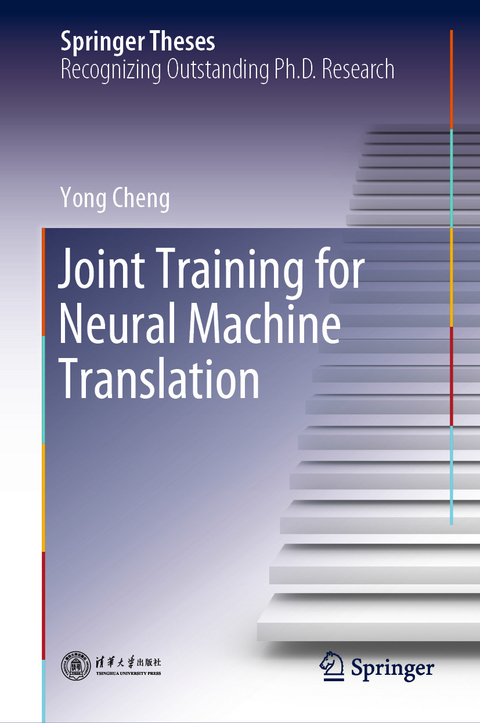
Joint Training for Neural Machine Translation (eBook)
XIII, 78 Seiten
Springer Singapore (Verlag)
978-981-329-748-7 (ISBN)
This book presents four approaches to jointly training bidirectional neural machine translation (NMT) models. First, in order to improve the accuracy of the attention mechanism, it proposes an agreement-based joint training approach to help the two complementary models agree on word alignment matrices for the same training data. Second, it presents a semi-supervised approach that uses an autoencoder to reconstruct monolingual corpora, so as to incorporate these corpora into neural machine translation. It then introduces a joint training algorithm for pivot-based neural machine translation, which can be used to mitigate the data scarcity problem. Lastly it describes an end-to-end bidirectional NMT model to connect the source-to-target and target-to-source translation models, allowing the interaction of parameters between these two directional models.
Yong Cheng is currently a software engineer engaged in research at Google. Before joining Google, he worked as a senior researcher at Tencent AI Lab. He obtained his Ph.D. from the Institute for Interdisciplinary Information Sciences (IIIS) at Tsinghua University in 2017. His research interests focus on neural machine translation and natural language processing.
This book presents four approaches to jointly training bidirectional neural machine translation (NMT) models. First, in order to improve the accuracy of the attention mechanism, it proposes an agreement-based joint training approach to help the two complementary models agree on word alignment matrices for the same training data. Second, it presents a semi-supervised approach that uses an autoencoder to reconstruct monolingual corpora, so as to incorporate these corpora into neural machine translation. It then introduces a joint training algorithm for pivot-based neural machine translation, which can be used to mitigate the data scarcity problem. Lastly it describes an end-to-end bidirectional NMT model to connect the source-to-target and target-to-source translation models, allowing the interaction of parameters between these two directional models.
| Erscheint lt. Verlag | 26.8.2019 |
|---|---|
| Reihe/Serie | Springer Theses | Springer Theses |
| Zusatzinfo | XIII, 78 p. 23 illus., 9 illus. in color. |
| Sprache | englisch |
| Themenwelt | Informatik ► Theorie / Studium ► Künstliche Intelligenz / Robotik |
| Schlagworte | Bidirectional Model • joint modeling • Joint Training • Machine Translation • Neural Machine Translation |
| ISBN-10 | 981-329-748-4 / 9813297484 |
| ISBN-13 | 978-981-329-748-7 / 9789813297487 |
| Informationen gemäß Produktsicherheitsverordnung (GPSR) | |
| Haben Sie eine Frage zum Produkt? |
 PDF (Wasserzeichen)
DRM: Digitales Wasserzeichen
Dieses eBook enthält ein digitales Wasserzeichen und ist damit für Sie personalisiert. Bei einer missbräuchlichen Weitergabe des eBooks an Dritte ist eine Rückverfolgung an die Quelle möglich.
Dateiformat: PDF (Portable Document Format)
Mit einem festen Seitenlayout eignet sich die PDF besonders für Fachbücher mit Spalten, Tabellen und Abbildungen. Eine PDF kann auf fast allen Geräten angezeigt werden, ist aber für kleine Displays (Smartphone, eReader) nur eingeschränkt geeignet.
Systemvoraussetzungen:
PC/Mac: Mit einem PC oder Mac können Sie dieses eBook lesen. Sie benötigen dafür einen PDF-Viewer - z.B. den Adobe Reader oder Adobe Digital Editions.
eReader: Dieses eBook kann mit (fast) allen eBook-Readern gelesen werden. Mit dem amazon-Kindle ist es aber nicht kompatibel.
Smartphone/Tablet: Egal ob Apple oder Android, dieses eBook können Sie lesen. Sie benötigen dafür einen PDF-Viewer - z.B. die kostenlose Adobe Digital Editions-App.
Buying eBooks from abroad
For tax law reasons we can sell eBooks just within Germany and Switzerland. Regrettably we cannot fulfill eBook-orders from other countries.
aus dem Bereich