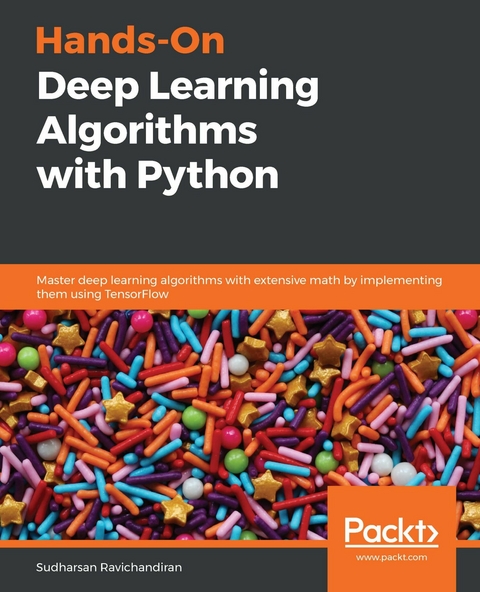
Hands-On Deep Learning Algorithms with Python (eBook)
512 Seiten
Packt Publishing (Verlag)
978-1-78934-451-6 (ISBN)
Understand basic to advanced deep learning algorithms, the mathematical principles behind them, and their practical applications.
Key Features
- Get up-to-speed with building your own neural networks from scratch
- Gain insights into the mathematical principles behind deep learning algorithms
- Implement popular deep learning algorithms such as CNNs, RNNs, and more using TensorFlow
Book Description
Deep learning is one of the most popular domains in the AI space, allowing you to develop multi-layered models of varying complexities.
This book introduces you to popular deep learning algorithms-from basic to advanced-and shows you how to implement them from scratch using TensorFlow. Throughout the book, you will gain insights into each algorithm, the mathematical principles behind it, and how to implement it in the best possible manner. The book starts by explaining how you can build your own neural networks, followed by introducing you to TensorFlow, the powerful Python-based library for machine learning and deep learning. Moving on, you will get up to speed with gradient descent variants, such as NAG, AMSGrad, AdaDelta, Adam, and Nadam. The book will then provide you with insights into RNNs and LSTM and how to generate song lyrics with RNN. Next, you will master the math for convolutional and capsule networks, widely used for image recognition tasks. Then you learn how machines understand the semantics of words and documents using CBOW, skip-gram, and PV-DM. Afterward, you will explore various GANs, including InfoGAN and LSGAN, and autoencoders, such as contractive autoencoders and VAE.
By the end of this book, you will be equipped with all the skills you need to implement deep learning in your own projects.
What you will learn
- Implement basic-to-advanced deep learning algorithms
- Master the mathematics behind deep learning algorithms
- Become familiar with gradient descent and its variants, such as AMSGrad, AdaDelta, Adam, and Nadam
- Implement recurrent networks, such as RNN, LSTM, GRU, and seq2seq models
- Understand how machines interpret images using CNN and capsule networks
- Implement different types of generative adversarial network, such as CGAN, CycleGAN, and StackGAN
- Explore various types of autoencoder, such as Sparse autoencoders, DAE, CAE, and VAE
Who this book is for
If you are a machine learning engineer, data scientist, AI developer, or simply want to focus on neural networks and deep learning, this book is for you. Those who are completely new to deep learning, but have some experience in machine learning and Python programming, will also find the book very helpful.
Understand basic to advanced deep learning algorithms, the mathematical principles behind them, and their practical applications.Key FeaturesGet up-to-speed with building your own neural networks from scratch Gain insights into the mathematical principles behind deep learning algorithmsImplement popular deep learning algorithms such as CNNs, RNNs, and more using TensorFlowBook DescriptionDeep learning is one of the most popular domains in the AI space, allowing you to develop multi-layered models of varying complexities. This book introduces you to popular deep learning algorithms-from basic to advanced-and shows you how to implement them from scratch using TensorFlow. Throughout the book, you will gain insights into each algorithm, the mathematical principles behind it, and how to implement it in the best possible manner. The book starts by explaining how you can build your own neural networks, followed by introducing you to TensorFlow, the powerful Python-based library for machine learning and deep learning. Moving on, you will get up to speed with gradient descent variants, such as NAG, AMSGrad, AdaDelta, Adam, and Nadam. The book will then provide you with insights into RNNs and LSTM and how to generate song lyrics with RNN. Next, you will master the math for convolutional and capsule networks, widely used for image recognition tasks. Then you learn how machines understand the semantics of words and documents using CBOW, skip-gram, and PV-DM. Afterward, you will explore various GANs, including InfoGAN and LSGAN, and autoencoders, such as contractive autoencoders and VAE. By the end of this book, you will be equipped with all the skills you need to implement deep learning in your own projects.What you will learnImplement basic-to-advanced deep learning algorithmsMaster the mathematics behind deep learning algorithmsBecome familiar with gradient descent and its variants, such as AMSGrad, AdaDelta, Adam, and NadamImplement recurrent networks, such as RNN, LSTM, GRU, and seq2seq modelsUnderstand how machines interpret images using CNN and capsule networksImplement different types of generative adversarial network, such as CGAN, CycleGAN, and StackGANExplore various types of autoencoder, such as Sparse autoencoders, DAE, CAE, and VAEWho this book is forIf you are a machine learning engineer, data scientist, AI developer, or simply want to focus on neural networks and deep learning, this book is for you. Those who are completely new to deep learning, but have some experience in machine learning and Python programming, will also find the book very helpful.
| Erscheint lt. Verlag | 25.7.2019 |
|---|---|
| Sprache | englisch |
| Themenwelt | Mathematik / Informatik ► Informatik |
| Schlagworte | Artificial Intelligence • Artificial Neural Network • CNN • convolutional neural network • Deep Belief Networks • Deep learning • GaN • Generative Adversarial Network • Generative model • Keras • machine learning • Python • Recurrent Neural Network • RNN • tensorflow |
| ISBN-10 | 1-78934-451-4 / 1789344514 |
| ISBN-13 | 978-1-78934-451-6 / 9781789344516 |
| Informationen gemäß Produktsicherheitsverordnung (GPSR) | |
| Haben Sie eine Frage zum Produkt? |
 EPUB (Adobe DRM)
Größe: 69,5 MB
Kopierschutz: Adobe-DRM
Adobe-DRM ist ein Kopierschutz, der das eBook vor Mißbrauch schützen soll. Dabei wird das eBook bereits beim Download auf Ihre persönliche Adobe-ID autorisiert. Lesen können Sie das eBook dann nur auf den Geräten, welche ebenfalls auf Ihre Adobe-ID registriert sind.
Details zum Adobe-DRM
Dateiformat: EPUB (Electronic Publication)
EPUB ist ein offener Standard für eBooks und eignet sich besonders zur Darstellung von Belletristik und Sachbüchern. Der Fließtext wird dynamisch an die Display- und Schriftgröße angepasst. Auch für mobile Lesegeräte ist EPUB daher gut geeignet.
Systemvoraussetzungen:
PC/Mac: Mit einem PC oder Mac können Sie dieses eBook lesen. Sie benötigen eine
eReader: Dieses eBook kann mit (fast) allen eBook-Readern gelesen werden. Mit dem amazon-Kindle ist es aber nicht kompatibel.
Smartphone/Tablet: Egal ob Apple oder Android, dieses eBook können Sie lesen. Sie benötigen eine
Geräteliste und zusätzliche Hinweise
Buying eBooks from abroad
For tax law reasons we can sell eBooks just within Germany and Switzerland. Regrettably we cannot fulfill eBook-orders from other countries.
EPUB (Ohne DRM)Digital Rights Management: ohne DRM
Dieses eBook enthält kein DRM oder Kopierschutz. Eine Weitergabe an Dritte ist jedoch rechtlich nicht zulässig, weil Sie beim Kauf nur die Rechte an der persönlichen Nutzung erwerben.
Dateiformat: EPUB (Electronic Publication)
EPUB ist ein offener Standard für eBooks und eignet sich besonders zur Darstellung von Belletristik und Sachbüchern. Der Fließtext wird dynamisch an die Display- und Schriftgröße angepasst. Auch für mobile Lesegeräte ist EPUB daher gut geeignet.
Systemvoraussetzungen:
PC/Mac: Mit einem PC oder Mac können Sie dieses eBook lesen. Sie benötigen dafür die kostenlose Software Adobe Digital Editions.
eReader: Dieses eBook kann mit (fast) allen eBook-Readern gelesen werden. Mit dem amazon-Kindle ist es aber nicht kompatibel.
Smartphone/Tablet: Egal ob Apple oder Android, dieses eBook können Sie lesen. Sie benötigen dafür eine kostenlose App.
Geräteliste und zusätzliche Hinweise
Buying eBooks from abroad
For tax law reasons we can sell eBooks just within Germany and Switzerland. Regrettably we cannot fulfill eBook-orders from other countries.
aus dem Bereich