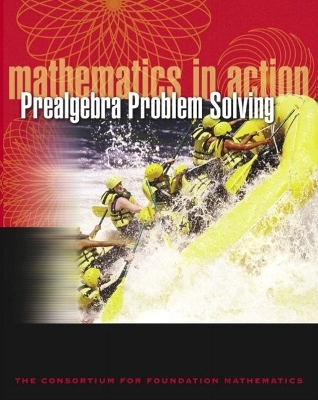
Mathematics in Action
Pearson (Verlag)
978-0-201-78585-2 (ISBN)
- Titel erscheint in neuer Auflage
- Artikel merken
This prealgebra text, based on the AMATYC Crossroads standards, motivates college math students to develop mathematical literacy and a solid foundation for future study in mathematics and other disciplines. This first book of a three-book series presents mathematical concepts and skills through relevant activities derived from real-life situations. These activities are meaningful to students because they illustrate how mathematics arises naturally from real-world situations and problems. Mathematics in Action is based on the assumption that students learn mathematics best by doing mathematics in a meaningful context. Students take an active role in their own learning by working in groups, thereby developing communication skills, a sense of independence, and a “can-do” attitude about mathematics. Appropriate technology is integrated throughout the book so that students learn to interpret real-life data numerically, symbolically, and graphically. Regardless of their level of preparation for the course, students can use this text to increase their knowledge of mathematics, their problem-solving skills, and their overall confidence in their ability to learn.
Students are encouraged to view the material as an interrelated collection of arithmetic, geometry, and fundamental algebra concepts and skills needed for future mathematics development. Each chapter is built upon real-world activities. Within each activity, mathematical objectives are noted, exposition of concepts and skills are highlighted, and several modeling examples are included. Following each activity, there is a summary box featuring the important concepts and skills arising out of the activity.
1 Whole Numbers and Problem Solving.
Activity 1.1. Education Pays!
Objectives:
1. Read and write whole numbers.
2. Compare whole numbers using inequality symbols.
3. Round whole numbers to specified place values.
4. Use rounding for estimation.
5. Classify whole numbers as even or odd, prime or composite.
6. Solve problems involving whole numbers.
Activity 1.2. Bald Eagle Population Increasing Again.
Objectives:
1. Read tables.
2. Read bar graphs.
3. Interpret bar graphs.
4. Construct graphs.
Activity 1.3. Bald Eagles Revisited.
Objectives:
1. Add whole numbers by hand and mentally.
2.Subtract whole numbers by hand and mentally.
3. Estimate sums and differences using rounding.
4. Recognize the associative property and the commutative property for addition.
5. Translate a written statement into an arithmetic expression.
Activity 1.4. Summer Camp.
Objectives:
1. Multiply whole numbers and check calculations using a calculator.
2. Multiply whole numbers using the distributive property.
3. Estimate the product of whole numbers by rounding.
4. Recognize the associative and commutative properties for multiplication.
Activity 1.5. College Supplies.
Objectives:
1. Divide whole numbers by “grouping”
2. Divide whole numbers “by hand” and by calculator.
3. Estimate the quotient of whole numbers by rounding.
4. Recognize noncommutative property for division.
Activity 1.6. Reach for the Stars.
Objectives:
1. Use exponential notation.
2. Apply the multiplication rule for numbers in exponential form.
3. Factor whole numbers.
4. Determine the prime factorization of a whole number.
5. Recognize square numbers, roots of square numbers.
6. Recognize cubed numbers.
Activity 1.7. You and Your Calculator.
Objectives:
1. Use order of operations to evaluate arithmetic expressions.
2.Use order of operations to evaluate formulas involving whole numbers.
What Have I Learned?
How Can I Practice?
Chapter 1 Concepts and Skills Summary.
Chapter 1 Gateway Review.
2. Variables and Problem Solving.
Activity 2.1. How Much Do I Need to Buy?
Objectives:
1. Understand the concept of a variable in context and symbolically.
2. Translate a written statement (verbal rule) into a statement involving variables (symbolic rule).
3. Evaluate variable expressions.
4. Apply formulas (area, perimeter, and others) to solve contextual problems.
Activity 2.2. How High Will it Go?
Objectives:
1. Understand the input-output relationship between variables in a formula or equation (two variables only).
2. Evaluate variable expressions in formulas and equations.
3. Generate a table of input and corresponding output values from a formula or equation or situation.
4. Read, interpret and plot points in rectangular coordinates (Quadrant I only) that are obtained from evaluating a formula or equation.
Activity 2.3. Are You Balanced?
Objectives:
1. Apply a fundamental principle in algebra to solve equations of the form x + a = b and x - a = b; using an algebraic approach.
2. Distinguish between expressions and equations.
3. Translate contextual situations and verbal statements into equations.
Activity 2.4. How Far Will You Go? How Long Will It Take?
Objectives:
1. Solve equations of the form ax = b using an algebraic approach.
2. Translate contextual situations and verbal statements into equations.
3. Use the formula rate time = amount in various contexts.
Activity 2.5. Web Devices for Sale.
Objectives:
1. Identify like terms.
2. Combine like terms using the distributive property.
3. Solve equations of the form ax + bx = c.
Activity 2.6. Make Me an Offer.
Objectives:
1. Introduce basic steps for problem solving.
2. Use basic principles of algebra to solve real-world problems.
3. Translate verbal statements into algebraic equations.
What Have I Learned?
How Can I Practice?
Chapter 2 Concepts and Skills Summary.
Chapter 2 Gateway Review.
3. Problem Solving with Rational Numbers: Addition and Subtraction of Integers, Fractions, and Decimals.
Cluster 1. Adding and Subtracting Integers.
Activity 3.1. Be Positive about Negatives.
Objectives:
1. Identify integers.
2. Represent quantities in real-world situations using integers.
3. Compare integers.
4. Calculate absolute value of integers.
Activity 3.2. Pointing the Way.
Objectives:
1. Construct a number line.
2. Add and subtract integers on a number line.
Activity 3.3. Maintaining Your Balance.
Objectives:
1. Add and subtract integers using absolute values.
2. Identify addition and subtraction properties of integers.
Activity 3.4. What's the Bottom Line?
Objectives:
1. Write formulas from verbal statements.
2. Evaluate expressions.
3. Solve formulas for a given variable.
4. Solve equations of the form x + b = c and x - b = c.
Activity 3.5. Modeling with Integers.
Objectives:
1. Translate a verbal rule into an equation.
2. Determine an equation from a table of values.
3. Solve equations of the form x + b = c and x - b = c.
4. Use a rectangular coordinate system to represent an equation graphically.
What Have I Learned?
How Can I Practice?
Cluster 2. Adding and Subtracting Fractions.
Activity 3.6. Are You Hungry?
Objectives:
1. Identify numerator and denominator of a fraction.
2. Determine the greatest common divisor (GCD).
3. Write equivalent fractions.
4. Reduce fractions.
5. Convert mixed numbers to improper fractions and improper fractions to mixed numbers.
6. Determine the least common denominator (LCD).
7. Compare fractions.
Activity 3.7. The Ups and Downs of Temperatures and Recipes.
Objective: Add and subtract fractions and mixed numbers with the same denominators.
Activity 3.8. Math is a Trip.
Objectives:
1. Determine the least common denominator (LCD).
2. Add and subtract fractions with different denominators.
3. Solve equations in the form x + b = c and x - b = c that involve fractions.
4. Evaluate formulas.
What Have I Learned?
How Can I Practice?
Cluster 3. Adding and Subtracting Decimals.
Activity 3.9. What Are You Made Of?
Objectives:
1. Identify place values of numbers written in decimal form.
2. Convert a decimal to a fraction or a mixed number.
3. Compare decimals.
4. Read and write decimals.
5. Round decimals.
Activity 3.10. Dive into Decimals.
Objectives:
1. Add and subtract decimals.
2. Compare and interpret decimal numbers.
Activity 3.11. Boiling, Freezing, and Financial Aid.
Objectives:
1. Add and subtract positive and negative decimal numbers.
2. Interpret and compare decimal numbers.
3. Solve equations of the type x + b = c and x - b = c involving decimal numbers.
What Have I Learned?
How Can I Practice?
Chapter 3. Concepts and Skills Summary.
Chapter 3. Gateway Review.
4. Problem Solving with Rational Numbers: Multiplication and Division of Integers, Fractions, and Decimals.
Cluster 1. Multiplying and Dividing Integers.
Activity 4.1. Are You Physically Fit?
Objectives:
1. Multiply and divide integers.
2. Perform calculations involving a series of operations.
3. Apply exponents to integers.
4. Perform calculations multiplication and division with zero.
Activity 4.2. Integers and Tiger Woods.
Objectives:
1. Use order of operations with expressions involving integers.
2. Apply the distributive property.
3. Evaluate algebraic expressions and formulas using integers.
4. Solve equations of the form ax = b involving integers.
What Have I Learned?
How Can I Practice?
Cluster 2. Multiplying and Dividing Fractions.
Activity 4.3. Get Your Homestead Land.
Objectives:
1. Multiply and divide fractions.
2. Recognize the sign of a fraction.
3. Determine the reciprocal of a fraction.
4. Solve equations of form ax=b involving fractions.
Activity 4.4. Tiling the Bathroom.
Objectives:
1. Multiply and divide mixed numbers.
2.Evaluate expressions with mixed numbers.
3. Calculate the square root of a mixed number.
What Have I Learned?
How Can I Practice?
Cluster 3. Multiplying and Dividing Decimals.
Activity 4.5. Quality Points and GPA: Tracking Academic Standing.
Objective:
1. Multiply and Divide Decimals.
2. Estimate Products and Quotients Involving Decimals.
Activity 4.6. Tracking Temperature.
Objectives:
1. Use the order of operations to evaluate expressions that include decimals.
2. Use the distributive property in calculations involving decimals.
3. Evaluate formulas that include decimals.
4. Solve equations of the form ax = b that include decimals.
What Have I Learned?
How Can I Practice?
Chapter 4. Concepts and Skills Summary.
Chapter 4. Gateway Review.
5. Problem Solving with Ratios, Proportions, and Percents.
Activity 5.1. Everything is Relative.
Objectives:
1. Understand the distinction between absolute and relative measure.
2. Write a ratio in its fraction, decimal and percent formats.
Activity 5.2. The Devastation of AIDS in Africa.
Objective:
1. Use proportional reasoning to apply a known ratio to a given piece of information.
2. Write an equation using the relationship “ratiototal = part” and then solve the resulting equation.
3. Write a proportion and then solve the resulting proportion.
Activity 5.3. Who Really Did Better?
Objective: Define and distinguish between actual and relative change—conceptually and computationally.
Activity 5.4. Don't Forget the Sales Tax.
Objective: Understand and apply growth factors to problems involving percent increases.
Activity 5.5. It's All On Sale!
Objective: Understand and apply decay factors to problems involving percent decreases.
Activity 5.6. Take an Additional 20 Percent Off.
Objective: Apply consecutive growth and/or decay factors to problems involving two or more percent changes.
Activity 5.7. Fuel Economy.
Objectives:
1. Apply rates directly to solve problems.
2. Use proportion equations to solve problems involving rates.
3.Use dimensional analysis to solve problems that involve consecutive rates.
What Have I Learned?
How Can I Practice?
Chapter 5 Concepts and Skills Summary.
Chapter 5 Gateway Review.
6. Problem Solving with Geometry.
Cluster 1. The Geometry of Two-dimensional Plane Figures.
Activity 6.1. Walking Around Bases, Gardens, Trusses, and Other Figures.
Objectives:
1. Recognize perimeter as a geometric property of plane figures.
2. Write formulas for, and calculate perimeters of squares, rectangles, triangles, parallelograms, trapezoids, and polygons.
3. Use unit analysis to solve problems involving perimeters.
Activity 6.2. Circles Are Everywhere.
Objectives:
1. Measure the lengths of the diameters and circumferences of circles.
2. Develop and use formulas for the circumference of a circle.
Activity 6.3. Lance Armstrong and You.
Objectives:
1. Calculate perimeters of many sided figures using formulas and combinations of formulas.
2. Use unit or dimensional analysis to solve problems involving perimeters.
Activity 6.4. Bases, Gardens, Trusses, and Other Figures, Revisited.
Objective:
1. Write formulas for areas of squares, rectangles, parallelograms, triangles, trapezoids, and polygons.
2. Calculate areas of polygons using appropriate formulas.
Activity 6.5. How Many Squares Are in a Circle?
Objective:
1. Develop formulas for the area of a circle.
2. Use formulas to determine areas of circles.
Activity 6.6. A New Pool and Other Home Improvements.
Objective: Use a variety of geometry formulas to solve problems.
Activity 6.7. Who Cares about Pythagorous?
Objectives:
1. Measure the sides and angles of right triangles, using rulers and protractors.
2. Classify triangles as equiangular, equilateral, isosceles, or scalene.
3. Develop and use the Pythagorean Theorem for right triangles.
4. Calculate the square root of numbers other than perfect squares.
Activity 6.8. Pythagorous, Septic Tanks, and Wells.
Objective:
1. Use the Pythagorean Theorem in context.
2. Solve equations of the form x² = number.
Activity 6.9. Getting High on Math.
Objectives:
1. Recognize the geometric properties of similar triangles.
2. Use similar triangles in indirect measurement.
Cluster 1. What Have I Learned?
Cluster 1. How Can I Practice?
Cluster 2. The Geometry of Three-Dimensional Space Figures.
Activity 6.10. Painting Your Way through the Summer.
Objectives:
1. Recognize geometric properties of three-dimensional figures.
2. Write formulas for and calculate surface areas of boxes (rectangular prisms), cans (right circular cylinders), and balls (spheres).
Activity 6.11. Truth in Labeling.
Objective: Write formulas for and calculate volumes of boxes and cans.
Activity 6.12. Analyzing an Ice Cream Cone.
Objective: Write formulas for and calculate volumes of balls (spheres) and cones.
Activity 6.13. Summertime.
Objectives:
1. Use geometry formulas to solve problems.
2. Use scale drawings in the problem solving process.
Cluster 2. What Have I learned?
Cluster 2. How Can I Practice.
Chapter 6. Concepts and Skills Summary.
Chapter 6. Gateway Review.
7. Mathematical Modeling and Problem Solving.
Cluster 1. Mathematical Modeling and Problem Solving Involving Solution of Equations.
Activity 7.1. Leasing a Copier.
Objectives:
1. Translate English statements into equations.
2. Solve equations of the form ax + b = c.
3. Solve problems by solving equations of the form ax + b = c.
Activity 7.2. How Long Can You Live?
Objectives:
1. Represent data by a regression equation of the form y = ax + b.
2. Solve problems by solving equations of the form ax + b = c.
Activity 7.3. The Algebra of Weather.
Objectives:
1. Evaluate formulas.
2. Solve a formula for a specified letter.
Activity 7.4. The Geometry of the Distributive Property.
Objectives:
1. Interpret the distributive property geometrically using areas of rectangles.
2. Identify equivalent expressions.
3. Use the distributive property to write the product of a single term and the sum of terms as a sum.
4. Translate an English phrase into an algebraic expression involving parenthesis.
Activity 7.5. Comparing Energy Costs.
Objectives:
1. Translate English statements into equations.
2. Solve equations of the form ax + b = cx + d.
3. Use the distributive property to solve equations involving grouping symbols.
4.Develop mathematical models to solve problems.
What Have I Learned?
How Can I Practice?
Cluster 2. Mathematical Modeling Involving Polynomials.
Activity 7.6. Volume of a Storage Tank.
Outcomes:
1. Use property of exponents to multiply powers having the same base.
2. Use property of exponents to raise a power to a power.
3. Use the distributive property and property of exponents to write an expression as an equivalent expression in expanded form.
Activity 7.7Reverse It!
Objectives:
1. Identify the greatest common factor.
2. Factor out the greatest common factor.
3. Simplify an expression by combining like terms.
Activity 7.8. Math Magic.
Objectives:
1. Identify polynomials.
2. Classify a polynomial as a monomial, binomial or trinomial.
3. Simplify a polynomial by identifying and combining like terms.
4. Add and subtract polynomials.
5. Model a situation using a polynomial expression.
6. Evaluate a polynomial.
Activity 7.9. Making Room.
Objectives:
1. Use a geometric model to multiply any two polynomials.
2. Multiply two binomials using the FOIL method.
Activity 7.10. Summer Jobs.
Objectives:
1. Translate a situation into an equation.
2. Solve a problem by solving a corresponding equation.
What Have I Learned?
How Can I Practice?
Chapter 7 Concepts and Skills Summary.
Chapter 7 Gateway Review.
Appendix: Mathematics Opens Doors: Keys to Success.
Selected Answers.
Glossary.
Index.
| Erscheint lt. Verlag | 26.6.2003 |
|---|---|
| Sprache | englisch |
| Maße | 217 x 276 mm |
| Gewicht | 1506 g |
| Themenwelt | Mathematik / Informatik ► Mathematik |
| ISBN-10 | 0-201-78585-4 / 0201785854 |
| ISBN-13 | 978-0-201-78585-2 / 9780201785852 |
| Zustand | Neuware |
| Informationen gemäß Produktsicherheitsverordnung (GPSR) | |
| Haben Sie eine Frage zum Produkt? |
aus dem Bereich