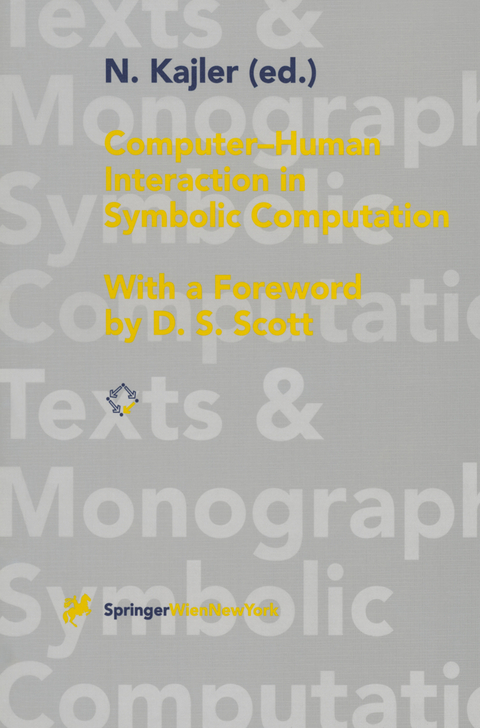
Computer - Human Interaction in Symbolic Computation
Springer Wien (Verlag)
9783211828434 (ISBN)
The ACELA project: aims and plans.- 1 Introduction.- 2 Interactive books.- 3 Interactive mathematical books.- 4 Architecture.- 5 The content of the book.- 6 Related work.- 7 Conclusion.- References.- Active structured documents as user interfaces.- 1 Introduction.- 2 Limitations of graphical user interface toolkits.- 3 Active and structured documents.- 4 The Grif editing toolkit.- 5 Applications based on active structured documents.- 6 Related work.- 7 Conclusion.- References.- Direct manipulation in a mathematics user interface.- 1 Introduction.- 2 Previous work.- 3 Design overview.- 4 Overview of static interface elements.- 5 Direct manipulation.- 6 Usability.- 7 Interval arithmetic.- 8 Implementation details.- 9 Directions for future work.- 10 Conclusion.- References.- Successful pedagogical applications of symbolic computation.- 1 Introduction.- 2 Symbolic computation and pedagogy.- 3 The EPGY course software.- 4 User interface and design issues.- 5 Logical structure of a derivation.- 6 Two examples.- 7 What is gained.- 8 Limitations and desiderata.- 9 Final remarks.- References.- Design principles of Mathpert: software to support education in algebra and calculus.- 1 Introduction.- 2 Purposes of software for mathematics education.- 3 Design principles.- 4 Cognitive fidelity and glass box in Mathpert: operations and pedagogy.- 5 Customizing the solution in Mathpert.- 6 The correctness principle in Mathpert.- 7 Using the computer's power when the user is stuck.- 8 Traditional interface issues: ease of use.- 9 Interfaces and pedagogy.- 10 Use and availability of Mathpert.- References.- Hypermedia learning environment for mathematical sciences.- 1 Introduction.- 2 Related work in the field.- 3 Components of mathematical hypermedia.- 4 Designing mathematicalhypermedia.- 5 Structure of the hypermedia database.- 6 Learning interface.- 7 Conclusion and research topics.- References.- Chains of recurrences for functions of two variables and their application to surface plotting.- 1 Introduction.- 2 Chains of recurrences for functions of one variable.- 3 Chains of recurrences for functions of two variables.- 4 A Maxima/IZIC implementation.- 5 Conclusions and future work.- 6 Availability.- References.- Algorithm animation with Agat.- 1 Introduction.- 2 Overview of Agat.- 3 Using Agat.- 4 The Agat language.- 5 The graphical features of Agat.- 6 Some applications of Agat.- 7 Implementation.- 8 Conclusion.- References.- Computation Computation and images in combinatorics.- 1 Introduction.- 2 Overview of CalICo.- 3 The use of CalICO as illustrated by examples.- 4 The tutor.- 5 Formal coding and symbolic computation.- 6 Graphical workshops and graphical interfaces.- 7 Communication manager.- 8 Availability and implementation.- 9 Conclusion.- References.
| Erscheint lt. Verlag | 10.6.1998 |
|---|---|
| Reihe/Serie | Texts & Monographs in Symbolic Computation |
| Vorwort | D.S. Scott |
| Zusatzinfo | XI, 212 p. |
| Verlagsort | Vienna |
| Sprache | englisch |
| Maße | 155 x 235 mm |
| Gewicht | 443 g |
| Themenwelt | Mathematik / Informatik ► Informatik ► Theorie / Studium |
| Mathematik / Informatik ► Mathematik | |
| Schlagworte | algorithms • Animation • Calculus • combinatorics • Computer • Design • Human-Computer interaction • Hypermedia • interaction • Interface • interfaces • Mathematica • Mathematische Logik • Mensch Computer Kommunikation • Mensch-Maschine-Kommunikation • Software • Symbolic Computation • Symbolisches Rechnen • user interface • User Interfaces • Visualization |
| ISBN-13 | 9783211828434 / 9783211828434 |
| Zustand | Neuware |
| Informationen gemäß Produktsicherheitsverordnung (GPSR) | |
| Haben Sie eine Frage zum Produkt? |
aus dem Bereich